Highbridge Music Ltd.
| 27th November 2006 | University of Nebraska, Kearney, NE USA |
| 31st October 2005 - 1st November 2005 |
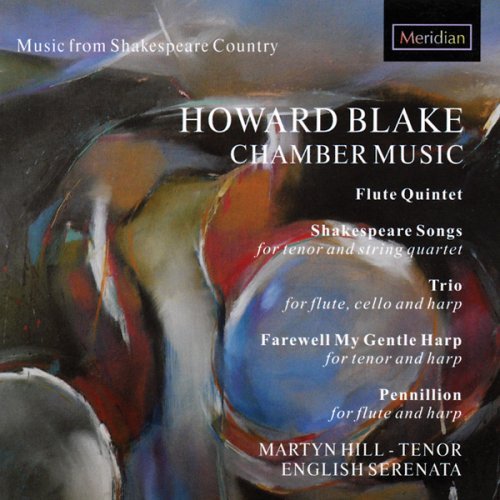
Martyn Hill, English Serenata, St Lawrence's Parish Church, Mickleton, Gloucestershire
First recording for Meridian by Richard Hughes,produced by Susanne Stanzeleit |
| 19th November 2003 | Patricia Rozario, Schubert Ensemble, Wigmore Hall |
| 6th April 1989 | Ian Partridge, Coull Quartet, Queen Elizabeth Hall, London |
| 3rd March 1988 | Martyn Hill, Coull Quartet, Recording for BBC Radio 3, Birmingham |
| 21st July 1987 | Martyn Hill / Medici Quartet, Chester Festival |
The Shakespeare Songs fearlessly confront the English song tradition. The nine songs are subtle and very carefully crafted and shaped. It is notable that although these are quite short, Blake establishes without a falter or a blink his own anterior pacing. Fear No More, Full Fathom Five, Wedding Hymn and Lament inhabit an unhurried world. There are inevitable echoes from Britten yet Blake has more humanity and you may also catch yourself thinking of Geoffrey Bush and to a slight extent Gerald Finzi. Blake addresses these much-set texts without a tremor and with a confidence that does not trample on the words. Classic texts expressed with lucidity, nuance and with a response to their need for emotional release.
Martyn Hill takes the colour of every word and reflects and refracts it into the 5 minute song Farewell My Gentle Harp to the anonymous Gaelic poem ‘The Lament of Rory Dall’. On a similar beautiful downbeat we come to the Penillion for flute and harp. For me the melody - which is limpid and enthralling - does not sound especially Cambrian. It is, however, gracious and utterly delightful. It delivers everything engaging that one would expect from the juxtaposing of flute and harp.
The ASV disc of the Violin Concerto has been written about with more insight than I can muster by Ian Lace. It was written for Nigel Kennedy but premiered by Christiane Edinger in Leeds whose city fathers commissioned the piece. It stands in the central pathway of the great English tradition of music for violin and orchestra. At various times its wondrously presented ideas sing out in exultant company with The Lark Ascending and with the concertos of Walton, Elgar and Delius. It is however no pastiche and is deeply affecting in its own right. I only mention these other works to give you some idea of the sound-world. There's a tender Adagio and an Allegro con brio that is chipper, exultantly pointed and light-on-the-feet. This work belongs among my favourite violin concertos alongside Prokofiev 1, the superb Ivanovs, the Sainsbury and the Sibelius.
The five movement A Month in the Country began life as the music for a Channel 4 drama. Its plot was about two soldiers returning to the English countryside from the trauma of the Great War. English pastoralism is certainly present in this score as in the Holstian trudge of the Alla marcia and the elegiac Howellsian atmosphere of the first movement which takes on a grimmer mien in the Adagio-Elegy. There’s a lighter Finzian quality in the Scherzando - slower than I might have expected. The Delian concentration of the sighing Andante is also memorable. The Sinfonietta is in four movements and was written for the Philip Jones Brass Ensemble. It is for ten brass instruments and was premiered at the Brighton Festival. It tracks through a world caught between the grandeur of the Venetian Gabriellis and Walton’s kinetic determination. You can hear this in the almost bitter Presto. The Maestoso has an evolutionary, slow-blooming, crowning motion and some superb writing for Jones's trumpet here taken by the trumpet principal of the English Northern Philharmonia.
This ASV disc has been around since 1994 and supplies may be difficult to source. It is however well worth the effort.
Recently reissued under a new number and with new finery the Sony disc is also deeply rewarding. The Piano Concerto was commissioned by the Philharmonia to celebrate the birthday of Diana, Princess of Wales. The brilliant melodic writing, full of inventive engagement, is redolent of Walton's much underrated Sinfonia Concertante. It has a limpid, straight-talking and beguiling enthralment about it. Echoes of the starry fluency and sincerity of the middle movement of Beethoven’s Emperor come across in the firefly glimmer of the Andante espressivo. The finale combines explosive New York jazziness with a Grainger-like zest. The piece ends with great delicacy and a satisfying blast of fireworks. It is not difficult to appreciate yet is not so easy as to be bland.
The eight movements of Diversions are full of wit and enchantment - Maurice Gendron assisted Blake with the editing of the cello part. Once again the composer adroitly times and paces his treatment of intrinsically pleasing and grateful ideas. In some ways this is a modern Rococo Variations but with less bone china and more of a contemporary emotional landscape though nothing is dissonant. There are some lovely conceits here such as the confidingly pattering Serenade but profundity is never far away. The Finale has the cello and orchestra blazing away. Once again the Sony team must be congratulated on a recording balance that is both clear and sensitive to excitement and poetry.
It is clear that Blake is drawn to revise his earlier works. His 1977 Toccata, dubbed a ‘Celebration for orchestra’ has been revisited and spruced up - to what extent we are not told. This extended work has lambent jazzy exultation, searing victorious heat, playful percussion and a humming and shining expectancy which glitters with Arnoldian stars. It's a moving, fragile yet robust fantasy - elegant in its strengths and foot-tapping in its rhythmic Waltonian exaltation. The orchestra give a dazzling account of themselves throughout. Toccata was premiered by the RPO under Hans Vonk in 1976 at the Fairfield Hall, Croydon. The Sony recording is stunning.
The late Christopher Palmer provides the notes (from the original issue) with a brief update from the composer.
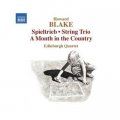
The most recent disc and the one you are likely to encounter easily is the Naxos collection of Blake's chamber music. All four works here began their existence in the period 1973-76. Again Blake is a participant as pianist and as note-writer.
The Violin Sonata is in the safe hands of Madeleine Mitchell who is an increasingly familiar presence in British violin music projects and beyond. The Sonata dates from 1973 when it was written for Jack Rothstein. Dissatisfied, Blake rewrote it in 2007 and it is this version we hear now. There are three movements. The first is typically impassioned like RVW's Lark but with a burning fervour. The Lento is at first in uncharacteristically expressionist language but soon evolves, slow-blooming yet passionately lyrical, with the piano becoming increasingly animated. The headlong final Presto soon finds a steady and sternly romantic mood which becomes more florid towards the close. The style is at times quite close to that of the Howells Piano Quartet.
The Penillion is the same work that appears on the Meridian anthology - there for flute and harp. It was originally written for violinist Jack Rothstein and Annabel Etkind. Here its eight episodes are helpfully separately tracked. It remains determinedly unWelsh but that hardly matters a whit - it's a most gracious invention with Hungarian and English accents. The four movement Piano Quartet is the biggest work here at approaching half an hour. The vivid and fine analogue recording dates from 1974 and features the original team of the composer, Peter Willison (cello), Jack Rothstein (violin) and Kenneth Essex (viola) - a top-flight ensemble. For all its analogue origins its attractions are irresistible. The language is that of high romance between Dvořák, Schubert and Beethoven. If there is a touch of trilling pastiche about it that is no obstacle to the delightful and ineluctable flow of ideas and treatment. The nine Jazz Dances are a skilled celebration with unblushing fidelity to a range of popular dance forms. Nothing extraordinary here but everything is fresh and warmly engages mind and heart. It recalls Barber's Souvenirs yet without the volcanic climax that marks out the sultry Tango. Sentiment, terpsichore, frictionless seduction and foot-tapping vitality are all there.
In addition to these various commercially accessible discs have been fortunate to hear a number of recordings not commonly accessible. I mention them here in the hope that they may encourage companies to record them or reissue existing recordings. The succinct Symphony in one movement op. 42 plays for between 12:14 and 14:30. It opens wistfully in the manner of Constant Lambert’s Music for Orchestra and Blake's own film score for The Riddle of the Sands. Superbly done and very English it is understated, quiet and vernal. There's a touch of RVW's In the Fen Country too. This pastoral flavour gives way to some decidedly American-style syncopation, the verve of which suggests Copland and Bernstein: super-fast pizzicato, finger-snapping kinetic vitality, bluesy swoons and mid-Western exultation.
There are quite a few Blake film scores. Two are reflected in a now deleted Airstrip One CD AOD HB02 from 2000. The Duellists is a Ridley Scott film (1977) in which the principals were Harvey Keitel and Keith Carradine with Edward Fox, Robert Stephens and Albert Finney. The session orchestra in this and in The Riddle of the Sands (1978) is Sidney Sax's luxury item ensemble - the National Philharmonic - well known from the RCA Classic Film Scores series. Blake's music for The Duellists includes a series of variations, many darkly inventive (tr. 10), on a plangently stated theme for flute or cor anglais. There are some psychologically oppressive cues drawing somewhat on Herrmann and Schoenberg. Things lighten up for The Chateau (tr. 13). The orchestral principals included Susan Milan (flute) and Alan Civil (horn) with Sax as leader. The score for The Riddle adds a sparingly used choir - in this case the John McCarthy Singers in music that is sweet, discreet and with a redolence of the Brahms Volkslieder. Though set along the Friesian coast the music wistfully evokes the world of Norfolk and the fen country. It is a very strong and certainly beautiful score. Just try the truly magical Sailing where every tickling and singing detail is tellingly invented and performed. A discreet chugging ostinato in the violins counterpoints delicious writing for oboe and for flute. This cue should be tracked down by Classic FM - a wonderfully memorable piece of writing. The music also carries the implication of threat and the smell of fog. Carruthers investigates the Barn suggests that Blake might well have been influenced by the Moeran G minor symphony - then recently issued on EMI (Dilkes) and Lyrita LPs (Boult). It's a wonderful score and stunningly recorded, even in analogue. I've read some pretty sniffy comments about the film. I disagree. It lacks glitz but is beautifully shot and oozes a kind of understated sincerity. The leads are Michael York, Simon MacCorkindale, Jenny Agutter and the greatly underrated Alan Badel.
The major choral work that is Benedictus was issued commercially at about the same time as the concertos disc. Sadly it remains banished to deletion limbo. It really should be reissued. One of a series of major choral pieces by Blake, it revels in and extends the English choral tradition. Blake uses the solo viola as interlocutor in the prelude and postlude to frame the three parts and eleven segments. The viola lays bare a pensive and melancholy soul. The original recording is most beautifully done and the music seems to reference the monastery life in which Blake had immersed himself before writing this substantial work. It is however far from ascetic. Blake also articulates the fire in the sky. Robert Tear, who for the most part keeps the vinegar in his voice well under control, is the tenor soloist. The music he is allocated has the sense and feel of Tippett's A Child of our Time. Passion is not far away at any time - try tr. 5 Lord who shall dwell. Seraphically sweet writing carries the How lovely is thy dwelling place although it sometimes finds Tear in effortful mode. The solo viola returns for the start of Part 2 and precedes a setting of Thompson's The Hound of Heaven; a masterful work to the same words by Maurice Jacobson is in clamant need of recording. Blake characterises and colours sensitively at every turn of the poem. Part III starts with more peaceful music to salve the excoriation of I fled him .… This continues in balm and healing in Suscipe me with just a hint of Delius's Song of the High Hills. Blake finds his kinetic impetus again in Bless the Lord O my soul (tr. 11). The ascetic music of the monastery and the church bells return for Processu (tr. 12) which melts into an enchantingly glimmering diaphanous mist. A golden halo of choral sound fades down to meet the pensive valedictorian that is the viola.
Benedictus dates from May 1980 and was first recorded in 1988 on Sony CDHB2. It was commissioned by The Ditchling Choral Society with assistance from The Ralph Vaughan Williams Trust. The premiere was given by Richard Lewis (tenor), Frederick Riddle (viola), The National Philharmonic Orchestra and The Ditchling Choral Society, conducted by Janet Canetty-Clarke at Worth Abbey on 17 May 1980. The premiere of the revised version followed under the baton of Sir David Willcocks at St Albans Cathedral on 25 January 1986.
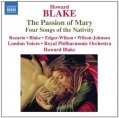
Let’s look forward now to the next Naxos Blake disc. This will include his second dramatic oratorio The Passion Of Mary (for soloists, chorus and orchestra) and Four Songs Of The Nativity (for chorus and brass ensemble). Blake conducted the premiere recordings at the Abbey Road Studios 12-13 August 2009 with The Royal Philharmonic Orchestra, the choir of London Voices and soloists: Patricia Rozario (soprano), Richard Edgar-Wilson (tenor), David Wilson-Johnson (bass-baritone) and treble Robert William Blake the composer's 10-year old son.
Amid the hubbub of dissonance and the clamour for constantly renewed novelty for its own sake Howard Blake stands out as an urgently communicative and accessible creative voice.
Jonathan Woolf, Musicweb-international, 9/9/2009

Catalogue Number: 02I074
Label: Meridian
Reference: CDE 84553
Format: CD
Price: $17.98
Description: Any of these pieces would be perfect background music for a film, TV show or play set in the lush green, pastoral English countryside which is so much a part of Anglophile minds that it will exist forever, even after everything is paved over. But it’s not film music or incidental music - except for the Shakespeare songs, which are adapted from songs written for performance during stage performances of plays - it’s finely crafted, tuneful and utterly enjoyable professionalism which will appeal to all lovers of English chamber music. Texts included. Martyn Hill (tenor), English Serenata.
RECORDS iNTERNATIONAL, 2/2/2007
'Of the various works especially commissioned by the Chester Summer Music Festival this year's Shakespeare song cycle would musically and artistically speaking seem to be the best....Blake has achieved true sensitivity, originality and innate musicianship with all the technical skills of modern song-writing to breathe fresh life into familiar stanzas. The songs are crafted with much perception. Devices such as suddenly-soaring intervals to give emphasis, sense of movement with changing time-signatures, and the manner in which lines are phrased to make literate as well as refined musical sense are some of the ways that help underline the significance of the texts...the composer acknowledged the prolonged ovation that was given the first performance.'
Chester Standard, 31/7/1987
'...a big success in the Festival..a work which received a stamping ovation...Blake's appreciation and comprehension of the poems was expressed precisely, passionately and descriptively...music utterly fitting to each mood, modern in sound, classical in impact.'
Chester Chronicle, 24/7/1987
'...the odd faint passing hint of Britten in some of the textures, and the more obvious debt of Stravinskian neo-classicism in the recurring motif of trills in the string accompaniments, the Shakespeare Songs hark back to Peter Warlock in their blend of rhythmic regularity spiced with the occasional irregularity and almost embarassingly direct tunefulness...the audience was duly enthusiastic.'
Paul Dewhirst, Daily Telegraph, 23/7/1987
Rarely does one witness so warm and prolonged a reception for the premiere of a new composition as greeted Howard Blake's Shakespeare Songs...the English folk song tradition permeates every nook and cranny. Britten (in his Serenade style) seems to have been a particularly strong influence but the writing is at once highly skilled and conceptually fresh
Chester Post, 22/7/1987