Symphony No.2 - Toccata
A 'concerto for orchestra' commissioned for the 30th anniversary of the Royal Philharmonic Orchestra in an extended one-movement form consisting of a toccata, fugue and finale. aka 'A celebration of the orchestra'.'
First Performance: Royal Philharmonic Orchestra, Nicholas Cleobury, St John’s Smith Square London, September 2003.
A ‘Toccata’ was originally commissioned from Howard Blake by the Royal Philharmonic Orchestra for their 30th Anniversary in 1976 and the first performance conducted by Hans Vonk at the Fairfield Hall in September of that year. A review by Hugo Cole in the Arts Guardian Sept. 17 1976 states: ‘Howard Blake’s newly commissioned Birthday Toccata was almost as tuneful and harmonious (as Sibelius’ The Swan of Tuonela, which it followed) – a sort of orchestral sampler showing off the instruments section by section and even working up to a final fugue. But the work is not reminiscent of any previous composer except possibly Malcolm Arnold and is highly succesful taken on its own terms. It falls back perhaps too often on cheerful syncopated rhythms to keep it going, but very skilfully allows instruments each to have their say in their conventional characters yet without reminiscences of famous conventional roles’.
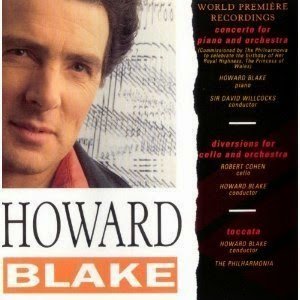
Note by the composer: At the concert it seemed that guest conductor Hans Vonk was somewhat less than comfortable with the work, throwing the score onto the floor at the conclusion and apparently stamping on it! But such a view was by no means held by either the orchestra or the audience, who applauded it enthusiastically. Disappointingly no further performances were given and in 1988 I decided on an extensive revision of the work in preparation for a recording with The Philharmonia, which I myself would conduct. The CD would also contain premiere recordings of Diversions for Cello with soloist Robert Cohen and the Piano Concerto with myself as soloist. How did this happen? In fact a soloist had been engaged – no less than the Russian virtuoso Evgeny Kissin, but nearing the concert date, when he saw the difficulty of the work and assessed the time it would take him to learn it, he backed out of the whole date. In some desperation Philharmonia orchestra manager David Welton rang me saying ‘the orchestral players believe you would play it magnificently yourself’ and begged me to clear the decks and learn the solo part. This was no easy task. I needed not only to learn the solo part but also to rehearse it with a second (orchestral) piano part. By some sort of divine piece of fortune I had just inherited my parents’ house in Preston Park Brighton which housed a grand piano, a Baldwin, and I now transported a second piano, a Kawai, down from London. By another divine act of fortune I had just married singer and pianist Helen Glover who was happy to accompany me and see me through to the recording for Sony and on to the concert premiere for Princess Diana at the Festival Hall. I asked my friend and colleague Sir David Willcocks to conduct, which he was most happy to do. The CD was issued in 1991 as Sony CDHB3
On the original score a dictionary definition of the word ‘Toccata’ had been written:
TOCCATA: A PIECE REQUIRING BRILLIANT EXECUTION
A PRELUDE OR OVERTURE
A COMPOSITION WRITTEN AS AN EXERCISE
A FANTASIA
A PIECE IN WHICH THE NOTES ARE JUST ‘TOUCHED AND LEFT (NOT DWELT ON) – from the Italian past participle of toccare ‘to touch’
This piece however is far longer and far different from any other Toccata previously written and at a length of 22 minutes falls more into the category of a symphony. The form of the work is determined by a sort of ‘gematria’ or talmudic mathematics, here applied to music. The numbers that have great magical significance are 12, 7, 4 and 3; 12 apostles, 12 months of the year, 12 hours of the day, 7 days of the week, the addition of the magic numbers 4 and 3 signifying the human being and the Trinity. The theme of the work is 84 bars long, 7×12, divided into 4 sections of 26,16,16 and 24 bars each. The 84 bar unit is repeated 7 times with some extension to the 7th which forms the recapitulation of the main theme plus the coda. A single-sheet key to the work A chart of the work (‘TOCCATA ’76) was created by the graphic artist and animator Tony White, available on request from Highbridge Music,
The music critic Christopher Palmer wrote about the work in his sleeve-note to the Sony recording entitled ‘Triple debut, an appreciation’:
‘What is particularly unusual in Howard Blake’s case is that, far from disowning his alter ego, the kind of
musician he was and the kind of music he produced
for the first 25 years of his professional life, he has
found in them the mainspring of a remarkable personal
renaissance. Much of the raw material of his most
significant recent works – particularly the Toccata
for Orchestra and the Piano Concerto – derives
from this source, but so refined, processed,
enhanced, even sublimated, as to be scarcely
recognisable. This is particularly true of the remarkable
Toccata for Orchestra which is a kind of all-embracing
creative synthesis of everything that
featured in Howard’s musical landscape in the
formative years of his life – the music he heard and
played, the techniques he learned and practised.
It is also much more. Its official title is Toccata – a
celebration of the orchestra and on the title-page of
the score there follow five definitions of the term:-
1. a piece requiring brilliant execution
2. a prelude or overture
3. a composition written as an exercise
4. a fantasia
5. a piece in which the notes are just ‘touched’ and
left (not dwelt on) – Italian past participle of
toccare ‘to touch’.
Each of these definitions applies in some degree to
the present work, whose form may be described as
an extended melodic sequence of 84 bars, the
whole of which is played seven times. This
sequence itself divides into four sections, in each of
which a new instrument or group of instruments
appears in the following order:
WOODWIND: flutes and bass flute, bassoons
and contra-bassoons, oboes and cor anglais, clarinet and bass clarinet.
HORNS: 1, 3, 2 and 4
BRASS: trumpets 1 and 2, trumpet 3,
trombones, tuba
STRINGS: violins, violas, celli, basses
PERCUSSION: celeste, harp and string quartet,
xylophone, glockenspiel and piano
– which is as far as the kitchen department gets
before the onset of a fugue. Side-drum, tenor-drum,
claves, finger-cymbal and above all timpani all
perform their turns in an intensely busy, even
hyperactive, contrapuntal context. The last full
statement of the 84-bar, ‘theme’ (or ‘thematic
sequence’) takes the form of a climactic finale-plus-coda
in which everyone in the orchestra participates.
It’s difficult to find a precedent in orchestral literature
for Toccata. Just calling it a ‘showpiece’ or even a
‘concerto’ for orchestra won’t do because (a) it’s too
long, (b) it’s too sophisticated in content (in most
showpieces it is manner rather then matter which
counts) and (c) its difficulty is such that it can really
be performed only by orchestras of the highest
professional calibre in which almost every player is a
soloist. Further to (b) Toccata is, in fact, a tour-de-force
not merely of modern orchestral virtuosity but
also melodic construction and of contrapuntal savoirfaire.
It is a piece HB himself seems slightly surprised
at having written – ‘not really planned, it just
happened’, not specifically designed as a platform for
his technical accomplishments although it has turned
out to be one, and in a spectacular way. It is an
unapologetically exhibitionistic piece and one which
was, I suspect, a kind of catharsis for the composer, a
milestone in his composing career; as if the
composer has said to himself subconsciously, ‘There!
Now everyone knows what I’m capable of technically,
so I don’t need to go on demonstrating it over and
over again!’ Toccata is indeed this kind of
demonstration par excellence, and it is significant that
Howard Blake has never attempted anything quite as
complex or elaborate since. In fact later works – the
Piano Concerto is a prime example – have reverted to
an almost neo-classical simplicity in which there is no
exploitation of technique for it’s own sake (although of
course the simplicity is masterminded by technical
knowledge: otherwise it would come across as
commonplace or simplistic). As I’ve already pointed
out, much of Howard’s technical knowledge was
acquired in recording studios rather than in the
context of live concert performance and the
orchestration of Toccata contains a number of
inspired eccentricities which can only be explained in
terms of the close-microphone recording system,
which enabled the balance to be adjusted artificially
where necessary. Multiple re-takes are of course
available to correct mistakes, for the making of which
Toccata, with its procession of cruelly-exposed solos,
offers many possibilities. But Howard knows exactly
how far he can go with impunity. ‘Impossible!’ a
know-all might say, looking at the lone piccolo which
soars way above the strings in the great melodic
apotheosis which launches the finale and coda (one
of the works’ greatest moments). The timpanist is
expected to play the actual notes of the fugue’s
subject when his turn comes to go on stage, not just
a rhythmic outline – ‘impossible’! And what about the
violas, who in their solo spot are sent climbing way
into the upper reaches of their compass without
support? A pedagogue would probably red-pencil the
entire passage, and a good many others besides. He
should listen to this recording to hear how utterly
unmerited his strictures would be.’
[Christopher Palmer 1946-1995]
Movements
- 1:
- Theme - Woodwind
- 2:
- Horns
- 3:
- Trumpets, Trombones, Tuba
- 4:
- Strings
- 5:
- Celeste and Percussion
- 6:
- Fugue
- 7:
- Theme - Finale
Recordings