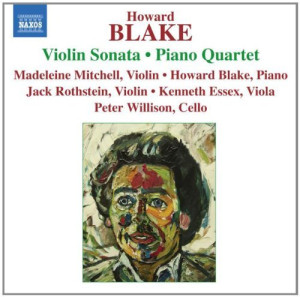
Violin Sonata No.2 - the Madeleine Mitchell Sonata
Naxos Sonata for violin and piano, concert work in 3 movements (dedicated to Madeleine Mitchell)
First Performance: James Shenton, Chapel Royal, Brighton, 9 February 2010.
Originally composed for Jack Rothstein 1973 (opus 169)
Revised for Christiane Edinger 1994 (opus 454)
All 3 movements rewritten August/September 2007 (opus 586). for a Naxos recording with Madeleine Mitchell Published by Highbridge Music 2007
Composer’s note: ‘Whilst a student from 1957 at the RAM I had been the piano part of a duo with Miles Baster, performing concerts of the standard repertoire, but Miles left london to live in Edinburgh in 1960 to lead The Edinburgh String Quartet and our partnership came to an end. Miles became violin professor at Glasgow Academy and Leith University and remained devoted solely to music there until his death. He had largely abandoned his earlier ambition to be a soloist in favour of professional activity in teaching, chamber and orchestral music. As a student he had once expressed the wish that I compose a sonata for him, but I produced nothing more than a sketch. In the early seventies I left London to live at Highbridge Mill in Sussex and started playing occasionally with the violinist Jack Rothstein. He also suggested a sonata which I did compose, quite rapidly during October-November 1973, but after a couple of performances I withdrew it.
More years went by and after the recording of the Violin Concerto in 1993 the German soloist Christiane Edinger asked to look at the sonata. We played it through and I made some revisions but was once again dissatisfied and discarded it.
In February 2007 I found myself conducting in Edinburgh and the cellist from Miles’ quartet, Mark Bailey, who was playing in the orchestra, approached me and we reminisced a little. I started to recall Miles’ playing from all those years ago. He had very high ideals in regard to music and strong opinions as to the quality and importance of the greatest composers. Perhaps for this very reason I had never summoned up the temerity to thrust my own work on him. During this conversation however the idea of some sort of musical tribute to Miles was briefly mooted, although it got no further, yet during the summer I dug out the material and looked at it again, some of it going back as far as 50 years! Suddenly I conceived a completely new beginning and this set me on the path of extensively and ferociously revising the entire piece. Whilst writing I constantly remembered Miles’ virtuosity and artistic punctiliousness, his views on music and his extreme conscientiousness as regards to markings, tempo and dynamics. Having completed it I marked it ‘Dedicated to the memory of Miles Baster.’ The slow movement might seem to have a requiem-like quality, although the work is of a virtuoso nature throughout. I can only hope that he might conceivably have approved. That would have been a rare honour.’ Brighton Year-Round 2019 Alan Parmenter and Howard Blake Violin and Piano Recital Alan Parmenter and Howard Blake Genre: Live Music, Music
Venue: Chapel Royal, North Road, Brighton
Festival: Brighton Year-Round Low Down Alan Parmenter and Howard Blake gave a violin and piano recital of Blake’s compositions: The Penillion Op 586 from 1975 revised 2005, the Solo Guitar Prelude Sarabande and Gigue Op 477 from January 1995 and the Violin Sonata Op 571 (1973/2007). Review Violinist Alan Parmenter joins composer and pianist Howard Blake for a very special recital.
Blake we know as the composer of The Snowman, as well as 204 commercial ads including reintroducing many classical music hits – the ‘Bell Song’ duet from Delibes’ Lakmé has worked for BA over 30 even 40 years.
Still his opus numbers total well over 600. Two compositions he returned to in the mid-noughties date originally from the 1970s but they’ve been overhauled. You can find them with his Piano Quintet on an acclaimed Naxos disc.
First was the Penillion Op 571 for Violin and Piano from 1975 revised 2005. Parmenter has a full but penetrating tone, and with the composer at the piano providing a sterling through-line this was always gong to be authoritative. It’s a work with the Theme at the opening and conclusion with six variations in between. It’s memorable, a mix of jaunty wistfulness and jazzy syncopations, elements of those commercial imprints Blake himself claims.
The melodic profile is keen, with an upward-moving theme worked though various tempi like moderato vivo, L’istesso tempo (same as before), Meno mosso, Allegro, Lento, Moderato Blake’s long-breathed melodies jaunt with sudden jagged upswings though generally smoothly shifting harmonies, with a popular melodic idiom almost on the breath of the work, but with its own personal integrity, somewhere where the highest kind of film music is distilled into utterly memorable chamber works like this one.
We then heard a masterwork, played by Paul Gregory on guitar. This is the Prelude Sarabande and Gigue Op 477, a typical guitar triptych. It’s a work from January 1995, again not only memorable but with its teeming invention in the quiet gentle Prelude, the Sarabande slipping quietly into an earworm and then a Gigue as memorable and fine as one of the Five Preludes of Villa-Lobos with its anticipated wrong-footing chords (like Beethoven’s Violin Sonata Op 12/3 with the violin and piano playing catch-up) this characterful works concluded. It really should be standard repertoire It’s the most distinct piece for guitar since Walton’s Five Pieces and Richard Rodney Bennett’s. Gregory is known as a sovereign interpreter, and here he gathered in the work’s expressive range, easy to bloom in this acoustic.
The Violin Sonata Op 586 from 1973 revised 2007 shares similar material with the slightly earlier Penillion opens with an Allegro reminding us of the work we heard at the opening. It’s fast-paced but not aggressive, sashaying in an out of a gently jazzy theme drawn on an Alberti bass.
The Lento in John Ireland’s mildly sinewy vein rippling to a kind of peace, perhaps gives no hint of the fiercer Presto to come, full of explosive lyric force. There’s a snap and ferocity at the end you’d not predict. Ireland yes but really Blake sounds only like himself. Parmenter summons piercing stratospheric sonance allied to a truly digging-out of those rhythmic figures, even more extreme than I’ve heard anywhere else. Blake throughout enthuses in the snappiness of his own part-writing,
A masterly composer whose works we all know more than we think, beyond The Snowman, this was treasurable.
Published December 4, 2019 by Simon Jenner
Movements
- 1:
- Allegro 7min 22sec
- 2:
- Lento 7min 4sec
- 3:
- Vivace 9min
Recordings