
The official website for the composer and
Highbridge Music, which publishes his works.
 Highbridge Music Ltd.
Studio 6, 18 Kensington Court Place, London W8 5BJ, UK
Email: howard@howardblake.com
Featured Recordings
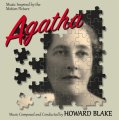
*THE PASSION OF MARY (for solo soprano,treble,tenor and bass soloists, SATB chorus and orchestra (with additional alto, tenor and bass solos from within the choir) op.577 (December 2006)
A dramatic oratorio
Published by: Highbridge Music LtdCommissioned by: The Lady Digby on behalf of The Summer Music Society of Dorset with assistance from South West Arts
Instrumentation: Soloists: Mary (soprano), Jesus the man (tenor),Jesus as a boy (treble), Prophet/Satan (bass), SATB chorus (plus optional boys choir), short solo parts which may be taken by singers from the chorus: Angel (alto), Simeon (tenor), Elder (bass). 2fl, 2ob (2=CA),2bsn; 2trpt, 2hn, 2trb (1 ten,1 bass), perc (cymbals,sus.cym,tri,sd,bd,t-t,bell-tree,wind chimes: Timpani; pno/celeste/portative organ (optional, section may be taken by ww), organ (optional),harp, strings
[Key to Abbreviations]
Note on Lyrics: Text by Howard Blake, adapted from biblical and other sources
Duration: 58 mins
First Performance: October 14th 2007, St Gorans, Stockholm, conducted by Olov Risberg
Sheet Music Available
Full score for saleStudy score for sale
Orchestral parts for sale
Piano / Vocal score for sale
Instrumental parts for sale
Organ / vocal score for sale
Full score for hire
Study score for hire
Orchestral parts for hire
Piano / Vocal score for hire
Instrumental parts for hire
Organ / vocal score for hire
Recordings Available
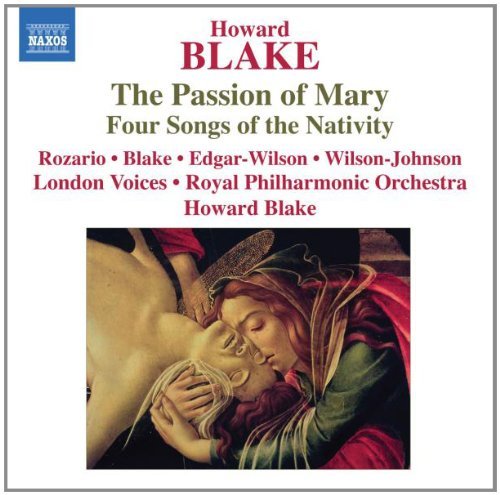
Released: March 2010
Recorded: 12th August 2009
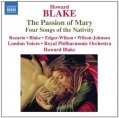
Artists: Patricia Rozario, Robert Blake, Richard Edgar-Wilson, David Wilson-Johnson, London Voices, Royal Philharmonic Orchestra conducted by Howard Blake.
Available from: Amazon UK Naxos Records
THE PASSION OF MARY (dramatic oratorio) PATRICIA ROZARIO, ROBERT WILLIAM BLAKE, RICHARD EDGAR-WILSON, DAVID WILSON-JOHNSON, LONDON VOICES (CHORUS MASTER TERRY EDWARDS), ROYAL PHILHARMONIC ORCHESTRA CONDUCTED BY HOWARD BLAKE
NAXOS DDD 8.572453 RELEASED APRIL 2010
COUPLED WITH 'FOUR SONGS OF THE NATIVITY', SONG-CYCLE FOR SATB CHOIR AND BRASS ENSEMBLE. RICHARD EDGAR-WILSON, LONDON VOICES (CHORUS MASTER TERRY EDWARDS), ROYAL PHILHARMONIC ORCHESTRA CONDUCTED BY HOWARD BLAKE
Movements
-
1:
Visitation, Nativity, Boyhood
20 minutes
26 seconds
-
2:
Temptation, Beatitudes, Crucifixion
11 minutes
23 seconds
-
3:
Stabat Mater
10 minutes
52 seconds
-
4:
Resurrection, Salve Regina
8 minutes
00 seconds
Notes
The work was originally commissioned under the title 'Stabat Mater' a performance being given on 18th May 2002 in Sherborne Abbey by Patricia Rozario, The Choir of Winchester Cathedral and the Bournemouth Symphony Orchestra conducted by David Hill. The only sung parts were for soprano and treble, other parts being spoken. This version has been withdrawn.
Betweeen 2002 and 2006 the composer extended, revised and renamed the work, giving it the title 'The Passion of Mary', as detailed above.
Performances
| 12th April 2020 | At 18.00 in Catalunya on Easter Sunday 12 April 2020 Ars Aurea Sonora Channel broadcast the film of the oratorio 'The Passion of Mary'. It was originally recorded in Manresa Cathedral on 8th December 2015 in a concert conducted by the composer with principal parts taken by Patricia Rozario (soprano), Richard Edgar Wilson (tenor) and David van Asch (Bass), with the choir and orchestra of Tarragona University. The Liverpool Quartet and Jaume Comas were also featured in a performance of 'The Snowman'. See coverage below., Manresa Basilica. |
| 7th December 2015 - 8th December 2015 |
The Liverpool String Quartet with Jaume Comas as narrator of The Snowman. Concerts produced by Ars Aurea Sonora (director Jordi Borras) with the support of 'Generalitat de Catalunya - Departament de Cultura, 7th December Reial Monestir de Santa Maria de Poblet. 8th December Manresa Cathedral |
| 21st November 2015 | David Halls, Salisbury Music Society: orchestra, choir, soloists tba, Salisbury Cathedral
The concert will consist of 'The Passion of Mary' and CPE Bach's 'Magnificat' |
| 16th March 2013 | Soloists Patricia Rozario soprano, Jamie Goodwyn treble, Richard Edgar Wilson tenor and Oliver Morris bass. The Woodbridge Choral Society, Ipswich School Chapel Choir and The Kingfisher Sinfonia. Conductor Andrew Leech., Snape Maltings Concert Hall, Aldeburgh 7.30
2013 is the year of Benjamin Britten's centenary and The Passion of Mary will be coupled with performances of his 'Spring Symphony' and 'Young Person's Guide to the orchestra.' |
| 20th November 2012 | Andras Schiff, Minterne, Dorchester, Dorset
The Lady Dione Digby has invited Howard as one of many guests attending the farewell concert of Dorset Summer Music, which she has directed with remarkable insight, vigour and dedication over an astonishing 50 years. In 1998 she decided to stage a performance of Howard's dramatic oratorio 'Benedictus' in Sherborne Abbey with the Bournemouth Sinfonietta and Winchester Cathedral Choir and it was the success of this concert which resulted in the commission of a 'Stabat Mater', later revised and expanded into 'The Passion of Mary'. Many distinguished artists have performed at The Lady Digby's festival over these amazing 50 years and among pianists are featured the names of Alfred Brendel, Tamas Vasary and Andras Schiff - invited to give the final celebratory concert. |
| 15th March 2012 |
Ronald Corp conducted the New London Orchestra and The London Chorus in the second London performance of 'The Passion of Mary' at St Alban's the Martyr, Holborn on 15th March at 7.00 with two of the soloists featured on the memorable Naxos recording issued in 2010: the soprano Patricia Rozario, and the tenor Richard Edgar Wilson. The role of Prophet and Satan was taken by bass Samuel Evans and the concert included a performance of Bach's Magnificat. |
| 21st October 2011 - 22nd October 2011 |
Westminster Abbey
Howard Blake contributed a special arrangement for voice and organ of the treble solo from his oratorio 'The Passion of Mary' (issued by Naxos in 2010) as a contribution to an all-night vigil held in Westminster Abbey on October 21/22 |
| 26th March 2011 | Lexden Choral Society, Beverley Lockyer (soprano),Richard Edgar-Wilson(tenor), Alistair Chapman(bass), Colchester Symphony Orchestra conducted by Sarah Blake, St.Botolph's Church, Colchester |
| 28th October 2008 | Patricia Rozario, Martyn Hill, Robert William Blake,Lars Arvidson,London Voices (choirmaster Terry Edwards), The Royal Philharmonic Orchestra, led by Clio Gould, conducted by Howard Blake, Cadogan Hall, London, 7.30 |
| 14th October 2007 | , St Gorans, Stockholm, Sweden, Sunday 14th October 4.00 pm |
Reviews
Just before Christmas I read an interesting article in The Sunday Telegraph by the journalist, Michael White. Under the headline “A seasonal hit can really lay a musician low” he lamented the fact that some composers, who write excellent music in all sorts of genres, find that the quality of the rest of their output is eclipsed if they write a Christmas ‘hit’. The Christmas piece gets done to death and almost everything else gets ignored, very unfairly. Inevitably, the name of John Rutter came up but a principal focus of Mr White’s attention - and sympathy - was Howard Blake. He is known pretty much the world over for the music he wrote for The Snowman and, financially, he’s probably done very nicely out of that - and rightly so. However, money isn’t everything, as they say; a bit of recognition helps too and so far as the broadcasters and critics are concerned, he might as well have not written anything else. Yet, if you look at the opus numbers in the heading to this review, there’s the proof of Howard Blake’s musical fertility.
All of which prompts consideration of this CD from Naxos. Its appearance was greeted ecstatically by my colleague, the late Bob Briggs (review) and I can understand why because here, in the shape of The Passion of Mary, we have a fine addition to the English choral repertoire. Furthermore, with one possible caveat which I’ll come to in a moment, this is a work which sounds eminently within the scope of a decent amateur choral society. The music is accessible - though there’s no hint of dumbing down - and, as such ought to have audience appeal.
Blake’s idea is an original one, which is something else that appeals to me. The first thought was that he should write a Stabat Mater but his ideas changed and instead what we have here is a work that tells the story of the life and death of Christ from the standpoint of his mother, Mary. I don’t know of any other piece of music that does this and I think it’s a highly imaginative concept - and I may as well say right away that Blake carries out his concept extremely successfully: the design of the work is strong, as is the music to which he carries out the design.
The Passion of Mary is cast in four sections. The first, which is by far the longest, takes the story from the Annunciation through to the childhood of Christ. The second section, from which the character of Mary is absent, considers elements from the life of Christ up to and including his Crucifixion. The third section is a setting, in Latin, of Stabat Mater for the soprano (Mary) and chorus and the concluding section is devoted to the Resurrection and a jubilant setting of Salve Regina.
Throughout the piece Blake’s music is highly effective and well suited to his chosen texts. I like some little touches such as his decision that Mary’s first, apprehensive words during the Annunciation are spoken rather than sung - and the way Patricia Rozario speaks those words is absolutely ideal, the inflection just right. Also highly effective is his charming setting of William Blake’s ‘A Cradle Song’ to anchor the Nativity element in Part I. In sacred music when a soloist takes the role of Christ it’s very often allocated to a baritone or bass. Here, instead, we have a tenor. Apart from anything else that’s perhaps a pragmatic decision given the dialogue between Jesus and Satan at the start of Part II, where Satan is sung by a low voice. I find the use of a tenor for Christ works well, not least in conveying the eagerness of a young man.
Mary is portrayed, unsurprisingly, by a soprano. I understand that Howard Blake had the voice of Patricia Rozario specifically in mind when writing this role. As we know, Miss Rozario is possessed of a phenomenal vocal range, which has been exploited by a number of composers, not least John Tavener. However, this brings me to the one reservation I have about the piece. On a good number of occasions, especially in the setting of the Magnificat that occurs in Part I and, to a lesser extent in the Stabat Mater, Blake writes a line for his soloist that includes leaps into the stratosphere. I’m sure this is intended to convey ecstasy, especially in the Magnificat, but purely as a matter of personal taste I feel this is overdone. In fact, these leaps stick out rather too much and, despite all Miss Rozario’s artistry come close to sounding ugly. I wonder if there’s a practical point here: it may not be easy for choirs to find a soprano soloist with a comparable range and I do hope this won’t inhibit performances.
The tenor’s big moment comes in Part II with a lengthy and demanding solo, which is lightly accompanied. The second half of the solo is an enunciation of The Beatitudes and it’s noticeable - and very fitting, I think - that Blake moves into a simpler style of music at this point. Richard Edgar-Wilson acquits himself very well here and in everything else that he does and David Wilson-Johnson is authoritative and characterful, as you’d expect. Despite my reservation over the high-lying parts of her line Patricia Rozario’s characterisation of Mary sounds well-nigh ideal throughout. With excellent contributions from London Voices and the RPO this performance under the composer must be counted as definitive in every respect.
The fairly substantial filler is a work written for the Bach Choir and Sir David Willcocks. I enjoyed these Four Songs of the Nativity very much indeed. They are settings of four medieval English poems for chorus and brass group. The brass ensemble is selectively employed and the writing for the brass strikes me as colourful and imaginative. Without getting in the way of the singers the contributions of the instruments are telling and add an extra dimension at just the right points. The chorus parts sound to be really well written for voices. These are accessible and consistently interesting settings which would make an excellent addition to the Christmas programmes of enterprising choirs.
I think Bob Briggs was right to welcome this disc; I can understand why it grabbed his imagination. The music is accessible, enjoyable and rewarding. Not only were these attractive pieces worth recording in their own right but the disc will have served a further important purpose if it encourages choirs to take up either of the works in question.
John Quinn
see also review by Bob Briggs
Read more: http://www.musicweb-international.com/classrev/2013/Jan13/Blake_Passion_8572453.htm#ixzz2JWZOTzMm
John Quinn, Music-Web International, 13/1/2013
British composer Howard Blake is best known for his film scores....and especially, The Snowman, which includes the memorable song "Walking in the Air." He has spent much of his career writing for the church and has created a substantial body of work for chorus. His hour-long oratorio, The Passion of Mary (his Op. 577), dates from 2006. Originally conceived of as a Stabat Mater, Blake expanded the piece to encompass a broader picture of Mary's life, from the Annunciation to the Resurrection, concluding with a Salve Regina, using a variety of Biblical, liturgical, and literary texts in English and Latin. Vocal ensemble London Voices and the Royal Philharmonic Orchestra, led by the composer, deliver assured performances. Blake seems more in his element in the Four Songs of the Nativity from 1990. The choral anthems, for small choir and brass ensemble, are entirely successful and are warmly and simply melodic.
Stephen Eddins, All Music, 2011
Philip Greenfield
American Record Guide, November 2010
Some of our British colleagues are extolling this Passion of Mary by Howard Blake (b 1938) as a seismic choral event and are using some pretty high flown language to do it. It is an interesting and rewarding attempt to visualize the life of Jesus through the eyes of his mother, set for soloists, choir, and an orchestra, heavy on strings and brass. The cantata fastforwards through scripture in four sections: nativity through childhood, temptation through the crucifixion, a ‘Stabat Mater’, and a ringing ‘Salve Regina’ to crown the Marian theme in triumph.
The emphasis on Mary makes for some interesting encounters, both musical and dramatic. Blake’s ‘Magnificat’ is all Mary—it’s her prayer, after all. (With the English text, it’s an affecting sequence, especially with some swirling orchestral colors accompanying the soliloquy.) The Virgin is also entrusted with much of the ‘Stabat Mater’. The drama comes across when Blake finally turns the soprano loose with a haunting melody at “Pro peccatis suae gentis”. The libretto even has Mary borrowing Jesus’ “O, Lord, let this cup pass from me” as she contemplates King Herod’s murderous decree. Rozario certainly sells the role. (Blake wrote it with her voice in mind.) Baritone David Wilson-Johnson’s Satan is suitably sleazy; and I like the sweet voice of young Master Blake, the composer’s son, who sings the role of Jesus as a child. Choral interludes like the ‘Cradle Song’ (William Blake), the ‘Stabat Mater’ shared with Mary, and the ‘Salve Regina’ are well written and well sung.
American Record Guide, 11/2010
SPECIALLY COMMENDED
Howard Blake, The Passion of Mary, Four Songs of the Nativity (8.572453)
Famed for his much-loved setting of Walking in the Air for The Snowman, Blake is a pianist and conductor as well as composer, and here he conducts the Royal Philharmonic Orchestra and London Voices in his works The Passion of Mary and Four Songs of the Nativity. Both are good, confidently-composed pieces, although The Passion of Mary particularly impresses. It is beautiful stuff, containing some exquisite music, and is superbly performed, although this is not surprising considering the star line-up of musicians including Patricia Rozario, Richard Edgar-Wilson and David Wilson-Johnson. There is an utterly magical moment in Part I of The Passion of Mary when the treble (Blake's son) enters as Baby Jesus. I was greatly impressed by this disc, and recommend it highly.
Albion Magazine Online, 1/9/2010
Having achieved a major success with his Benedictus in 1980 it took some 20 or more years for Howard Blake to produce a second dramatic oratorio The Passion of Mary. Conceived as a broad view of Jesus's life seen through the eyes of the Virgin Mary, it was originally entitled Stabat Mater. An expanded and revised version was first performed in Stockholm in 2007. The London premiere's soprano and treble soloists re-appear here together with London Voices and The RPO, the latter two ensembles on splendid form. David Wilson-Johnson provides suitable stentorian delivery of the Prophet's and Satan's pronouncements. Richard Edgar Wilson as Jesus the man copes well with the more lyrical writing. Patricia Rozario's demanding role suffers from some cruelly high writing. Blake's son Robert William lends a touching innocence as the young Jesus.
What of the piece? It's themes are striking, memorable and expertly cast and developed. I sensed traces of Poulenc, Britten (shades of the storm-tossed sailors in St. Nicholas) and Rutter. Much of the music is contemplative and meditative, making the more driven sections especially gripping. The orchestral scoring is masterly, at times pared to the bone, at others glowing opulently, full of magical detail. The Passion of Mary deserves widespread currency.
Malcolm Riley, Gramophone, 8/2010
Patricia Rozario is the tireless soprano soloist, with Richard Edgar-Wilsons giving us a Peter Pears-like representation of Jesus….[Blake’s writing] is technically skilled.
George Hall, BBC Music Magazine, 7/2010
Wednesday 16th June 2010 A world premiere recording conducted by 'The Snowman' composer.
Howard Blake (born 1938) is best known for one piece, the perennial favourite, 'The Snowman' but he has been a prolific writer in a variety of genres and here, on a generously priced CD, we have two excellent works both of which should be of interest. We start with 'The Passion of Mary', written in 2006. This tells the greatest story ever told from the perspective of the mother of our Lord sung by the inestimable Patricia Rozario (soprano) who makes some very tricky music sound effortless. Other soloists are the composer's son Robert William Blake (treble) as the young Jesus, Richard Edgar-Wilson (tenor) as Jesus the man, and David Wilson-Johnson (bass-baritone) as narrator and also a suitably demonic Satan. Part one covers the "Visitation, Nativity, and Childhood" and is suitably restrained and reflective but when we reach part two, which covers the ministry of Jesus, the pace picks up. Texts here are sung in English and taken from the Gospels. The Temptation scene is memorable and by the time we reach the Crucifixion we are on the edge of our seats, even though we know what is to happen. The orchestration is gripping and reminds us that Blake often writes soundtracks; we can see everything through our ears. Then we shift to Latin for a sublime "Stabat Mater Dolorosa" and the concluding "Salve Regina" leaves us on our feet demanding more or - more appropriately - on our knees thanking God. This is simply glorious. And there is more as those kind people at Naxos give us "Four Songs of the Nativity" written in 1990. The texts are from the Penguin Medieval English Verse and although the music is appropriate all four pieces sound fresh and would make lovely additions to any choir's seasonal repertoire. This is a splendid release and is thoroughly recommended.
Steven Whitehead, Cross Rhythms, 16/6/2010
'At the cross her station keeping'
Howard Blake’s oratorio the Passion of Mary made a strong impression at its UK premiere in the Cadogan Hall in London. This has now been surpassed by a fine recording on the Naxos label with London Voices and The Royal Philharmonic Orchestra.
The composer focuses the work on three Marian texts, the Magnificat, the Stabat Mater and the Salve Regina, embracing Christ’s mission with a substantial second movement that moves from the temptation via the Sermon on the Mount to the crucifixion. Blake makes imaginative use of passages from St. Matthew, St. Luke and Isaiah to produce a narrative that includes the boy Jesus, sung affectingly here by Robert William Blake, the composer’s son.
The baritone David Wilson-Johnson provides a stark prophecy from Deuteronomy before the wafting voice of Mary (Patricia Rozario) is heard in conversation with the Angel (sung by the chorus). He is also striking as Satan tempting the adult Jesus (Richard Edgar-Wilson) before light-stepped Finzi-like strings usher in the Beatitudes, yielding unexpectedly quickly to a rapid and effective crucifixion sequence.
A moving rendition of Jacopone da Todi’s Stabat Mater text follows, with the soprano alternating with chorus, and some subtle repetitions, culminating in a final moment of rapture. The passage from John 14 which opens the fourth part is sung with Peter Pears-like intensity by Richard Edgar-Wilson.
Blake’s Four Songs of the Nativity, carol settings of great charm and vitality which follow, make lovely, spare use of brass (just as the harp is effectively deployed in The Passion of Mary.
….highly recommended.
Roderick Dunnett, Church Times, 28/5/2010
BARGAIN OF MONTH
Howard BLAKE (b.1938)
The Passion of Mary, op.577 (2006) [57:21]
Four Songs of the Nativity, op.415 (1990) [19:04]
Patricia Rozario (soprano); Robert William Blake (treble); Richard Edgar–Wilson (tenor); David Wilson–Johnson (bass–baritone)
London Voices/Terry Edwards
Royal Philharmonic Orchestra/Howard Blake
rec. 12-13 August 2009, Studio 1, Abbey Road, London. DDD
NAXOS 8.572453 [76:25]
The British have long had a tradition of choral singing. By the turn of the 19th century into the 20th century there were choral festivals all over the country. The Leeds Triennial and the Three Choirs remain the best known and indigenous composers wrote prolifically for the amateur singers. And what a line of composition it is: Elgar, Stanford and Parry wrote innumerable works for chorus and orchestra. More recently we’ve had Peter Racine Fricker’s A Vision Of Judgement and David Blake’s Lumina (a superb work which has been unfairly neglected) (both for Leeds), and John McCabe’s Voyage, Geoffrey Burgon’s Requiem and Gerard Schurmann’s Piers Plowman (for the Worcester, Hereford and Gloucester meetings of the Three Choirs Festival). The list goes on and on. Now we have Howard Blake’s The Passion of Mary which, put simply, just had to be written.
Having set the Stabat Mater, Blake realised that more was needed as he hadn’t said all that he wanted to say, especially, as he realised, there was no setting of the Passion from Mary’s point of view. This work was the outcome. It is firmly of the British school of choral music. We must not forget that Blake, when younger, was a boy chorister and sang in the choir whilst studying at the Royal Academy of Music in London. He took part in a performance of VW’s Sancta Civitas in the presence of the great man himself.
The Passion of Mary was given its British premiere at his 70th birthday concert in the Cadogan Hall, in London, in October 2008. It stunned the audience with its fluency, directness and feeling of ecstasy. The effect was spectacular – overcome with emotion, the audience sat in awe at the end, feeling that applause was, perhaps, not quite right after such an experience. I was there and can attest to that feeling http://www.musicweb-international.com/SandH/2008/Jul-Dec08/blake2810.htm. That performance was of an exceptional quality and some of those performers have been reunited for this recording.
Although playing for less than an hour, Blake manages, with the most economic of means, to tell the whole story of Christ, from Mary’s pregnancy to the Crucifixion and after. Following a brief yet intensely effective orchestral prelude, and a bass recitative, the soprano (Mary) sings the Magnificat, to music of high elation. The vocal line flies aloft in a finely judged orchestral setting. The orchestra is used throughout in a most restrained manner and only raises its voice once – at the time of the Crucifixion - in music of great strength and fury. This is both mystical in feel and magical in conception. Blake’s son sings the small but telling part of Jesus as a child, a wonderful stroke of imagination this, and the tenor takes the part as a man. Throughout there are choruses, recitatives, arias, duets and scenas, all of which follow one another easily and grow out of the argument. One of the most striking moments is when Satan, a suitably oily performance from David Wilson–Johnson, tries to tempt Christ. This is written, save for four urgent chords from the orchestra, as an unaccompanied scene. The work ends with a chorus worthy of Gabrieli, with joyful shouts of Gloria!
The words “masterpiece” and “a work of genius” are bandied about far too easily these days, but here they can be used with confidence for this, surely, is Blake’s masterpiece, and, from a purely musical point of view, it is a work of genius. As my friend, and colleague, Robert Matthew-Walker wrote, “The Passion of Mary makes an immediate and lasting impact on the attentive listener, and there is no doubting the conviction of the composer and the directness of his musical utterance.” I cannot improve on that. This is superb stuff in a performance which is of the highest quality.
I was at the sessions and can confirm the immense amount of work which went into making this recording. Patricia Rozario, whose voice Blake had in his head whilst writing, glows as Mary, making the most of her long scenes, and taking the wide leaps in the vocal line as if they were the easiest things she had ever sung. Considering that the part covers more than two octaves this is, in itself, quite a feat. Richard Edgar–Wilson (Jesus, as a man) sings with an easy fluency and fine diction, displaying a beautiful high G, so soft as to make one gasp. David Wilson–Johnson (as both the Prophet and Satan) is full-voiced and creates both parts with such skill that you’d be hard pushed to realise that it was the same singer. He is especially impressive as Satan as he descends to a low E? in the temptation scene. Last, but by no means least, Robert William Blake (Jesus as a boy) imbues the part with a quiet authority, displaying a beautiful delicacy in his delivery, and a full understanding of the music. London Voices sing with real gravitas – whether in meditative mode or when screaming for blood. How could they not when they were trained by a man - Terry Edwards - who, I have said this before, is the best choral trainer in London. The Royal Philharmonic Orchestra is with Blake all the way, giving their all, especially when allowed music to themselves. The orchestration is magnificent, with some eloquent moments for the harp. Blake brings out all the voices with great clarity. Michael Ponder’s production is a real asset, for the sound is big, yet even in the loudest episodes everything is clear and precise. There are also passages of such breathtaking pianissimo that one is on the edge of one’s seat. The sound is the best I have ever heard from Naxos. All in all, this is one of the very best CDs it has been my pleasure to hear and report upon.
And we haven’t finished, for as a, very generous, coupling we have the Four Songs of the Nativity for chorus and brass. These are delightful settings of texts taken from Mediaeval English Verse (Penguin Books). Although not easy to perform, they make a lovely set of alternative carols if not of the community singing type. Ranging from devotional to racy this work makes a good conclusion to a very special disk. Choirs looking for new repertoire need look no further. Here are two works which can communicate easily and make a real impression on the audience. A very good booklet, with full texts, completes an issue which should be in every collection. This music is far too good to miss.
Bob Briggs
Far too good to miss … see Full Review
BOB BRIGGS, MUSIC WEB INTERNATONAL, 13/5/2010
Howard Blake: Modern Choral Music from England
I first came upon the music of Howard Blake via the soundtrack to the memorable animated film The Snowman. In particular the main theme as sung by boy treble with orchestra really captivated. It was a little like a cross between The Moody Blues's Days of Future Passed and middle-period Keith Jarrett. Hearing it still gives me goose bumps.
So when I saw this new Naxos release of Blake in a more "serious" concert choral zone, I jumped on the chance to hear and review it.
Blake seems like a natural when it comes to vocal-orchestral expression. Everything he writes in these two works (The Passions of Mary; Four Songs of the Nativity) seems to lay out in a kind of idiomatic near-perfection.
Howard Blake himself conducts the soloists, the London Voices, and the Royal Philharmonic Orchestra for this recording, which seems definitive.
The music falls in a 20th Century tradition of such works by Walton, Vaughan Williams and others similar. That is to say, it uses extended tonal-traditional means to express lyrically the dramatic import of the narrative texts. The Passion of Mary follows a modern oratorio vein; For Songs of the Nativity he uses the song form for some memorable Christmas fare.
Mr. Blake is a composer of talent. These are some beautiful and moving settings. If you are an Anglophile in matters classical, you will no doubt want this one. I will file it happily on my "modern English composers" shelf. That is, when I am not listening to and enjoying it.
Gregg Applegate Edwards, Gapplegate Music Review, 12/5/2010
Weaving together various pieces of Marian liturgy, Blake also fuses traditional religious music theatre with a distinctive modern idiom. His sense of dramatic conviction is shared by Patricia Rozario, brilliant in the testing title role, and the supporting cast. The more modest Nativity cycle gives a gentle let-down from the main drama.
Phillip Sommerich, Classical Music ****, 8/5/2010
The highly original oratorio and refreshing Nativity songs focus on the life of Christ through the eyes of Mary. The approachable sound-world delivers an immediacy and drama that will draw listeners in. Excellent soloists bring the texts alive
Matthew Power, Choir and Organ, 1/5/2010
David Denton
David's Review Corner, April 2010
The enormous popularity of The Snowman has rather masked Howard Blake’s output of choral and orchestral works, though he has been highly prolific in both genres. As a young man active in so many fields, he stood back from his success at the age of thirty-three to revisit his roots as a classical composer, and there followed a series of outstanding vocal scores, his most recent being The Passion of Mary completed in 2006. The fact that so many composers have set to music the mature life of Jesus as told by his disciples, gave him the idea of using a soprano voice to relate the Jesus story as seen by his mother. It was to have a long gestation period, the Stabat Mater section dating back to 2002, the whole work ending up in four sections running to almost an hour. It is a very pleasing but serious score written in a modern melodic mode, long solo passages and dramatic choral sections follow in the footsteps of mainstream English choral music of the 20th century. Opening with the ‘Visitation’ of the angel to Mary, and concluding with the ‘Resurrection’ it offers a deeply moving experience. The performance, conducted by the composer, has his eleven-year-old son, Robert William Blake, as the young Jesus, with Patricia Rozario, as Mary, and the much experienced tenor, Richard Edgar-Wilson, as the mature Jesus. Blake is a most imaginative orchestrator, the Royal Philharmonic playing with the perfect mix of delicacy and high impact drama. Outstanding singing from London Voices continues into the Four Songs of the Nativity a work commissioned in 1989 and ending with one of his most catchy tunes, Let Us Gather Hand in Hand. Both works are here receiving their world premiere on disc, the sound form London’s Abbey Road studios is excellent.
David Denton, David's Record Review, 4/2010
Very moving and well performed piece. Good to discover a living composer able to write such an excellent passion. Highly recommended.
Bjorn, 2010
There was no such problem for Robert William Blake, ten-year-old son of the composer Howard Blake. With Bernard Cribbins, nearly 80, and a polished Royal Philharmonic Orchestra, he was the the star of a 70th birthday tribute to Blake Sr. at the Cadogan Hall, near Sloane Square, in London (on 28th October 2008).
You could hear every word sung by Master Blake (a member of the Stockholm Boys Choir), both when he was amplified and when he wasn't. I have never heard 'The Snowman' live, and had not realised how, with its wit and sensitivity and subtle design, it is a masterpiece when viewed as a whole.
We were eager to hear the London premiere also conducted by the composer of Blake's 50-minute oratorio 'The Passion of Mary', which draws together his previous 'Stabat Mater ', the Magnificat, the Salve Regina and other Marian and nativity texts with the wisdom of a Berlioz.
The outcome is a splendid, highly accessible work of Three Choirs dimension. Patricia Rosario - here especially striking - and Martyn Hill were the soprano and tenor soloists. Howard Blake is a master-musician from whom our church and cathedral organists should commission anthems and canticle settings; for he has inspiration on his side.
RODERICK DUNNETT, CHURCH TIMES, 28/11/2008
SEEN AND HEARD CONCERT REVIEW
Howard Blake 70th Birthday Concert: Robert William Blake (treble), Bernard Cribbins (narrator), William Chen (piano), Patricia Rozario (soprano), Martyn Hill (tenor), Lars Arvidson (bass-baritone), London Voices (chorus master: Terry Edawrds), Royal Philharmonic Orchestra, Howard Blake, Cadogan Hall, London, 28.10.2008 (BBr)
Howard Blake: The Snowman, op.323 (1982)
Piano Concerto, op.412 (1991)
The Passion of Mary, op.577 (2006) (British première)
This was a fascinating evening, whether you knew Howard Blake's work or not. The first half contained two of his most approachable pieces - The Snowman (in its concert version for narrator and orchestra) and the Piano Concerto. The second half was made up of one of Blake's most recent, and most serious offerings - a dramatic oratorio The Passion of Mary.
The Snowman needs no introduction - it's the score for the famous animated film of Raymond Briggs's book, the most startling part of it being that there's no dialogue whatsoever, the music tells the story together with the visuals. In this version we have the music with a narration – brilliantly and humorously delivered by the ever dependable Bernard Cribbins – and all the well known bits are there - the Dance of the Snowmen, the little boy playing in the snow, the Snowman being shown round the house and the famous song Walking in the Air - beautifully delivered by Blake's 10 year old son. Both Cribbins and Robert William Blake were amplified, but much more discreetly than I have heard in recent times, and the balance was as near perfect as it could possibly be. This was a delightful start to the show and relaxed the audience, preparing it for what was to come.
Blake was commissioned to write his Piano Concerto for the 30th birthday of Princess Diana and he gave the première himself in the Royal Festival Hall in London in 1991. It's a real virtuoso piece and requires a pianist of world class. William Chen was just the man for the job - and he knows Blake's work, having recorded the suite Lifecycle (ABC Classics 476 118–4). His approach had many points of similarity with Blake's own recording but there were several passages which he treated in a new way. He enjoyed letting the music run away with itself (yet he was always in control) and was quite happy to throw caution to the wind and play devil's advocate with some of the showier passages, much to the consternation of Blake the conductor, but to the delight of Blake the composer. The slow movement was particularly well done, the simplicity of the opening, with solo lines for violins and viola over a quietly repeating piano chord, the full, and passionate, climax growing from the opening quartet and the nearly time–suspending coda were played almost nonchalantly, thus heightening the beauty of the music. The raucous set of variations, which is the finale, gave ample opportunity for both soloist and orchestra to let their hair down and have some real fun. The long first movement - Blake does like to write opening movements which take up half the playing time of the completed work - suffered slightly because the size of the string section (8.6.4.4.2), although being perfect for the other two pieces, left this work understrung at times and the sound was a bit thin. But one shouldn't complain when the overall performance was as fine as this one.
After the interval we entered a totally different world. The Passion of Mary is a large scale oratorio in all but playing time. Into a mere 50 minutes Blake crams the experience of a Bach Passion or Handel Oratorio, complete with recitatives arias and choruses and a particularly violent depiction of the Crucifixion scene for orchestra alone. As one might imagine from the title, the work relies heavily on the part of Mary, who is given the most radiant music, written in a wide range, much of it laying high in the voice. Patricia Rozario glowed in the part, mystical and full of wonder at the events unfolding in her life, keeping control of her voice and never loosing sight of the fact that this music truly is beautiful. The smaller parts – and any other parts would have to be fairly small – were well taken by Robert William Blake – as the young Jesus - Lars Arvidson (possibly the tallest singer around and with the lowest notes) was a solid narrator – and Martyn Hill had a particularly gorgeous scena as Jesus. The diction of all the soloists was admirable and this made it easy to follow the drama as the events unfolded. At the end the audience was dumbfounded at the strength of the work, and, perhaps through tiredness (this work is an emotionally tiring experience) didn’t give the work the credit it was due. In the foyer I heard many members of the audience expressing delight and satisfaction at what they had heard so we know that the music made the effect it was meant to.
It’s obvious that Blake isn’t a professional, career, conductor, but he coaxed fine playing from the Royal Philharmonic, who responded well to his direction. The 24 members of London Voices – trained by the ever dependable Terry Edwards – sounded like a much larger group and easily moved from bloodthirsty mob to Angelic chorus, for the final Salve Regina.
Howard Blake is a fine composer whose concert work has, for too long, gone unnoticed and unrecognised. It is to be hoped that this show has shown people just what fine music he is writing. Full marks to all concerned for a very special show.
Bob Briggs
Bob Briggs, SEEN AND HEARD INTERNATIONAL, 29/10/2008
THE PASSION OF MARY
London Première
www.rpo.co.uk
This work is the second of Howard Blake’s two large dramatic oratorios. The first was Benedictus, for solo tenor, solo viola, speaker (taking the part of St Benedict) SATB chorus, chamber choir, boys’ choir and orchestra. This was composed in 1986 and first performed in St Alban’s Cathedral conducted by Sir David Willcocks, who also conducted the first recording of the work for Sony.
The fifty-minute Passion of Mary was commissioned as a Stabat Mater in 2001 and was revised, extended and renamed in 2006. Blake compiled the text himself on the subject of Mary, the mother of Jesus, from biblical and poetic sources. In its new form, and bearing the impressive opus number 577, it calls for soprano, treble, tenor and bass-baritone soloists, chorus, boys’ voices, organ and orchestra. It was premièred in St Gorans Kyrka Stockholm last October, with Patricia Rozario and the Swedish bass Lars Arvidson - both of whom appear in tonight’s performance, which will be the London Première of the complete score.
As mentioned above, The Passion of Mary is a profound study of, and meditation on, Mary, the mother of Jesus. The text, adapted from biblical and other sources, falls into four main parts: Part 1 deals with the Annunciation, birth and early life of Jesus as seen through His mother’s eyes, incorporating texts from the Magnificat, William Blake and the Apocrypha as well as the Old and New Testaments. Part 2 is concerned with the Temptation of Christ, the Beatitudes and Christ’s Crucifixion. Part 3 is the Stabat Mater, a Latin hymn on the seven aspects of grief of the Virgin Mary (the prophesy of Simeon, the flight into Egypt, the three days’ loss of Jesus, the meeting of Him on the way to Calvary, the crucifixion, the descent from the cross, the entombment); Part 4 is the promise of Christ of the Holy Spirit (‘Let not your heart be troubled’) and the Salve Regina (‘Hail, Holy Queen’ - i.e. Mary).
One of the more impressive aspects of the work is the cumulative sense of forward momentum it possesses; this is not a disembodied sense of movement but, in purely musical terms, a certain ‘journey’ if you like, towards the brilliance of the dazzling A major triumphant ending, in which the certainty of belief is conveyed with great simplicity and immense inner strength. The Passion of Mary makes an immediate and lasting impact on the attentive listener, and there is no doubting the conviction of the composer and the directness of his musical utterance.
Robert Matthew-Walker, 2008
Robert Matthew-Walker, ROYAL PHILHARMONIC ORCHESTRA (from the programme-note for Howard Blake's 70th birthday concert), 28/10/2008
Related Works
'*SALVE REGINA'
op.543
(July 2004)
Setting for chorus and orchestra (added to 'Stabat Mater' as finale to 'The Passion of Mary', see op. 577
Setting for chorus and orchestra (added to 'Stabat Mater' as finale to 'The Passion of Mary', see op. 577
'ARIA DOLOROSA'
op.562
(January 2006)
The 'Stabat Mater' section from the oratorio 'The Passion of Mary' arranged for solo soprano and piano
The 'Stabat Mater' section from the oratorio 'The Passion of Mary' arranged for solo soprano and piano
'SLEEP, SLEEP, HAPPY CHILD'
op.564
(January 2006)
Arrangement for SATB and organ of the Nativity section from 'The Passion of Mary'
Arrangement for SATB and organ of the Nativity section from 'The Passion of Mary'