Reviews
by Richard Amey in Shoreham Herald 6/2/2020
Worthing Symphony Orchestra “Walking In The Air” concert at Assembly Hall, Friday 31 January 2020 (7.30pm), composer Howard Blake (narrator), John Alley (piano), Victoria Ridgway (singer) John Gibbons BEM (conductor), Julian Trevelyan (concerto piano).
Nik Rimsky-Korsakov, Dance of The Tumblers (from The Snow Maiden); Fred Delius, Sleigh Ride; Emil Waldteufel, Skaters Waltz; Howard Blake, The Snowman, concert version; Pete Tchaikovsky, Waltz (from Swan Lake); Leroy Anderson, Sleigh Ride; Johnny Sibelius, March (from Karelia Suite); Howard Blake, Piano Concerto Opus 412.
It was as though Sergei Prokofiev had been right there, narrating his own Peter And The Wolf with Worthing Symphony Orchestra. To audience surprise, Howard Blake was doing the same in The Snowman – a children’s composition of parallel universal success composed by he, an ex-Brighton & Hove Grammar School boy, and with some primary and secondary classmates in the audience.
Unbilled except last-minute on social media, Blake told me he was narrating a Snowman concert performance for the first time in five years. He was standing in for also-unpublicised actor Bernard Cribbins OBE, whose wife was unwell. Wombles voice-over Cribbins reached 91 in December. A month earlier, Blake OBE made it to 81, although he scarcely moves or looks older than 70. That’s the therapy of music for you.
Blake’s own ‘local lad makes good’ story happened 40 years ago when his idea of a TV cartoon outlawing dialogue struck gold. Instead, it’s musically with descriptive richness and synchronised with the precision of a Tchaikovsky-Petipa ballet, and delivering a hit song that seasonally sits alongside Irving Berlin’s White Christmas.
The familiar I’m Walking In The Air – the only words heard in the cartoon film – is sung by the Boy when the Snowman he has built suddenly lifts him up into flight, out over Brighton and up to the North Pole for a knees-up at a snowmen’s party visited by Father Christmas. A thaw-surviving scarf from that is living proof it happened for real, trumping at Christmas the Nutcracker Doll that can only underline a dream.
Now it was happening right here, without the images but with author Raymond Briggs’ dialogue pointed up by Blake’s music. A different and rewarding audience experience this way round. And a master class in light film music orchestration . . .
Sleep? Harp or strings. Fun building a snowman? Fairy harp and chirpy flute. Snowman greets his young creator? Cheery piccolo. Atmosphere around the boy’s house? Sober, nostalgic oboe. Terrified fleeing cat? Screeching strings. Snowman curious about human life? Cheeky bassoon or avuncular horn.
Perilous sources of heat? Cymbals! (Furtive footsteps? Xylophone) Music box? Glittery harp, piano, flute, piccolo. Motor-bike escapade? Tearing orchestra with xylophone saddled on top! The Celidh of the Father Christmases? Celtic pub dance tunes on flutes, piccolo, xylophone, muted trumpet.
And binding much together, the piano – setting new scenes, initiating rhythm and texture, creating mystery, punctuating or decorating percussively, bringing sentiment and affection, opening the mood and flow of I’m Walking In The Air for vocalist Victoria Ridgway – from Crawley, invited from the West Sussex Youth Choir.
The 17-year-old was singing it publicly for the first time and her nerves in the opening verse counted in her artistic favour. Initially frayed-edged in childlike wonder and fear (“What? My snowman’s really a bird?”), her voice gained in confidence (“He’s not going to drop me now – I’m flying too!”) arriving at a purity (“This is the best adventure I’ve EVER had”).
Incidentally, the washes of cymbals evoked for me the Cornish beach hut where Blake, years before, first thought of this tune. Blake’s is an unfamiliar face to most. His narration was thus like listening to a story a nice granddad at a small (under-control) children’s birthday party up the road. Throughout The Snowman, I sensed the audience’s adults captured by their own fascination and progressively moved. The final ovation’s vocal element was heartfelt.
Blake brought also his own Piano Concerto and soloist, the 21-year-old Paris-trained Briton, Julian Trevelyan. It’s rarely played, despite its distinctive, pleasing and constantly entertaining vigour and melodic content, easy form and good humour, since its commission for Princess Diana’s 30th birthday 29 years ago. Blake performed it for her at the Royal Festival Hall. Surely, her death is not the reason for its back seat in Blake’s output? “Yes, it is a portrait of her,” he replied. “There’s her warmth and sense of fun.”
After a shyly radiant opening musical vision, it garrulously flecks in syncopations and cross-rhythms of popular musical styles – though less prominently than in for example Ravel’s two-handed Concerto. Imagine a lively garden party, getting going. But in the jubilant, cosmopolitan finale of theme and variations they shine brightly and integral to the effervescence which, at the end, unexpectedly but poetically leaves us with a bookending repeat of that halting opening camera shot.
There are one or two royal sweeps of cinematic strings and French Horn grandeur, and the tenor trombone pair join in the contrapuntal fun.
The middle movement, far less loquacious, paints its own intimate photo or character album.
It began and ended with just piano plus the leaders of the three violin and viola section leaders, whom at rehearsal Blake persuaded Gibbons and the players themselves that they should stand to play. The effect in performance was of something original being done spontaneously as an apt focus on music speaking of loving homage and respect. A remarkable concert moment and result.
Trevelyan was bristlingly alive, alert and responsive to the Concerto’s solo demands and range, and evidently attuned with a composer whose birthday precedes his by a day. It was Trevelyan’s second performance of a piece composed for Russian prodigy Evgeny Kissin – who reportedly backed out of the premier, finding it too demanding to prepare in apparently ample time. It took Blake three months to prepare in Kissin’s place because Blake had abandoned concert piano performing.
But it took Trevelyan just a month before his December debut in it. “It’s challenging with its use of non-classical rhythms being put in a classical context,” he told me. “The trick is to let it sing, and to make an interpretation without destroying its simplicity.”
This climaxed and closed the concert, and won another enthusiastic reception. Trevelyan brought Blake on stage for a hug and then won over the audience without him in Chopin’s Mazurka No 2 in D major of Opus 33 as an encore.
What of the rest of the programme? Far from makeweights or fillers, they were Gibbons with reindeer bells setting a winter’s scene around a snowman. Rimsky’s bounding dance of the Russian street performers laid out cold any preference for a conventional overture. Delius’ Sleigh Ride and wander off on foot around snow-laden countryside may well have been a WSO first.
A Skater’s Waltz by a Strasbourg-born composer could not escape the notice of politically-aware Gibbons on Brexit Day. Out on Anderson’s stateside Sleigh Ride, the WSO were fully on the ball with its finger-snapping wit, and the Karelia Suite finale marched in out of the tundra chill with a genuine glow.
But seizing the biscuit was the one item which could have passed by unnoticed in a routine rendition – but instead launched the second half with hum-along anticipation. Gibbons and WSO gave us a Swan Lake Waltz with astute variation in dynamics and a sweeping conclusion of festive Russian theatricality lacking only Bolshoic vibrato in Tim Hawes’ important trumpet solo. Do take us the whole way to Moscow next time, Tim!
Richard Amey
by Simon Jenner in Brighton Year-Round 4/12/2019
Brighton Year-Round 2019
Alan Parmenter and Howard Blake Violin and Piano Recital
Alan Parmenter and Howard Blake
Genre: Live Music, Music
Venue: Chapel Royal, North Road, Brighton
Festival: Brighton Year-Round
Low Down
Alan Parmenter and Howard Blake gave a violin and piano recital of Blake’s compositions: The Penillion Op 586 from 1975 revised 2005, the Solo Guitar Prelude Sarabande and Gigue Op 477 from January 1995 and the Violin Sonata Op 571 (1973/2007).
Review
Violinist Alan Parmenter joins composer and pianist Howard Blake for a very special recital.
Blake we know as the composer of The Snowman, as well as 204 commercial ads including reintroducing many classical music hits – the ‘Bell Song’ duet from Delibes’ Lakmé has worked for BA over 30 even 40 years.
Still his opus numbers total well over 600. Two compositions he returned to in the mid-noughties date originally from the 1970s but they’ve been overhauled. You can find them with his Piano Quintet on an acclaimed Naxos disc.
First was the Penillion Op 571 for Violin and Piano from 1975 revised 2005. Parmenter has a full but penetrating tone, and with the composer at the piano providing a sterling through-line this was always gong to be authoritative. It’s a work with the Theme at the opening and conclusion with six variations in between. It’s memorable, a mix of jaunty wistfulness and jazzy syncopations, elements of those commercial imprints Blake himself claims.
The melodic profile is keen, with an upward-moving theme worked though various tempi like moderato vivo, L’istesso tempo (same as before), Meno mosso, Allegro, Lento, Moderato Blake’s long-breathed melodies jaunt with sudden jagged upswings though generally smoothly shifting harmonies, with a popular melodic idiom almost on the breath of the work, but with its own personal integrity, somewhere where the highest kind of film music is distilled into utterly memorable chamber works like this one.
We then heard a masterwork, played by Paul Gregory on guitar. This is the Prelude Sarabande and Gigue Op 477, a typical guitar triptych. It’s a work from January 1995, again not only memorable but with its teeming invention in the quiet gentle Prelude, the Sarabande slipping quietly into an earworm and then a Gigue as memorable and fine as one of the Five Preludes of Villa-Lobos with its anticipated wrong-footing chords (like Beethoven’s Violin Sonata Op 12/3 with the violin and piano playing catch-up) this characterful works concluded. It really should be standard repertoire It’s the most distinct piece for guitar since Walton’s Five Pieces and Richard Rodney Bennett’s. Gregory is known as a sovereign interpreter, and here he gathered in the work’s expressive range, easy to bloom in this acoustic.
The Violin Sonata Op 586 from 1973 revised 2007 shares similar material with the slightly earlier Penillion opens with an Allegro reminding us of the work we heard at the opening. It’s fast-paced but not aggressive, sashaying in an out of a gently jazzy theme drawn on an Alberti bass.
The Lento in John Ireland’s mildly sinewy vein rippling to a kind of peace, perhaps gives no hint of the fiercer Presto to come, full of explosive lyric force. There’s a snap and ferocity at the end you’d not predict. Ireland yes but really Blake sounds only like himself. Parmenter summons piercing stratospheric sonance allied to a truly digging-out of those rhythmic figures, even more extreme than I’ve heard anywhere else. Blake throughout enthuses in the snappiness of his own part-writing,
A masterly composer whose works we all know more than we think, beyond The Snowman, this was treasurable.
Published December 4, 2019 by Simon Jenner
by John Williams in tbc 1/4/2019
ARTICLE FOR MOVIE MUSIC INTERNATIONAL April 2 2019
"Now that's what I call FILM MUSIC!"
A brief appreciation of the continuing Genius that is Howard Blake
by John Williams
Film Music has changed drastically over the years, Chameleon - like, sometimes good, sometimes inspired, and sadly, more than not, a failure on all counts. If also you have been listening to MUSIC as long as I have, it takes a lot to rekindle that spark you first had many years ago which got you into this drug that we simply call FILM MUSIC which as much as we try, we can't kick!. Most people I have mentioned my hobby to over the years think of the current Blockbuster or hit that contains a song or two that gets into the charts. When you say: ’well actually no, I don't mean that, I mean the music that is played in the background’, they look at you as if you have flipped and said a four letter word.. So, you learn to grin and bear it, and after a while to tend not to even mention it at all, So it is like one of those guilty pleasures that you don't talk about.
We have had full-blown ‘Orchestral Scores that are Pop Music masquerading as Film Music. In the Eighties we had so much synthesized film music that it was wearing, and now, well, I know there must be Film Music out there, but it is, as was said in "Star Trek" - not as we know it!!!
If by some miracle Georges Delerue was to return to us, I doubt if he would get an assignment. " Well, sorry Georges. I know you write lovely gorgeous themes and scores, but, well, we don't want that,.. we want a sort of non- music, that no one notices"
Which brings me to Howard Blake: a composer of immense talent who can do practically anything, and often has. I tend to find parallels with the sorely-missed Andre Previn - Great Pianist, Arranger, Composer and now writer of Music for the Concert Hall. See what I mean ? Howard toiled in the media for many years, working on the Diana Rigg season of ‘THE AVENGERS’, playing keyboards on the sessions before the big break came on the final season, now well-known as THE TARA KING EPISODES OF THE AVENGERS (when Laurie Johnson was called away to that comedy gem ‘HOT MILLIONS’ with Maggie Smith and Peter Ustinov.) Good workmanlike scores - funny phrase that - workmanlike, let’s just say they are extremely good and evocative, and sound different enough to stand alongside Laurie Johnson's fine efforts. Howard also played on numerous film Scores, ‘THE ITALIAN JOB’ , arrangements for Francis Lai in that quintessentially Sixties Movie, ‘I'LL NEVER FORGET WHAT'S ‘IS NAME’ as well as conducting the LP (without credit) for Quincy Jones on that mammoth and somewhat under-rated western ‘MCKENNA'S GOLD.’
Scores for EMI Movies, ‘ALL THE WAY UP’, and ‘SOME WILL SOME WON'T’ followed, neither of which rate very highly in my book, but typical of their era. ‘S.O.S TITANIC’ is notably different. A powerful, almost heart-wrenching score, punctuated by the three notes that spell out S.O.S. Sadly the versions available on DVD ,Video, or Television are of the edited version, the full, longer film seeming not to be available anywhere. Howard also scored movies for the BBC when the Corporation had its own film-making arm, and they periodically show them under the SCREEN ON TWO banner, films such as ‘STRONGER THAN THE SUN’ with Tom Bell and Francesca Annis and ‘MRS REINHARDT’ with Helen Mirren.
He is of course best known now for the perennial Christmas favourite THE SNOWMAN, which has been shown on TV every Christmas since 1982 both in UK and across the world, from 1993 magically blossoming into a full-length stage show.now in its 25th year.
In the late 70's The Rank Organisation had the somewhat misguided idea to re-start production of feature films at Pinewood. There was ‘THE LADY VANISHES’, a very worthy attempt to up-date the old Hitchcock Movie with colour, slightly spicier dialogue and two principals from the USA. It actually worked well, even if Cybill Shepherd went way over the top and there was a good score by newcomer Richard Hartley utilising a main theme by Les Reed.
‘THE RIDDLE OF THE SANDS’,set in 1901, was adapted from Erskine Childer's novel warning Great Britain of a suspected threat from Germany by water-born invasion from the north German Coast . Exceptional cast with the two leads played by Michael York and Simon MacCorkindale and feminine interest supplied by Jenny Agutter, who had also teamed up with Michael York in LOGAN'S RUN Superbly lensed by Christopher Challis, If it had any down side, it was the ending which was somewhat rushed, and indeed anti climatic. A film like this needed a composer who would not just underline the visual aspects, but delve deeper into the story and add aspects that weren't visible. In fact a score that enhances the film and enriches the cinematic experience. Luckily, they called on the talents of Howard Blake. Working with the famed National Philharmonic Orchestra, Howard wrote a score that was just inspired. The lengthy Main Titles portray the sand dune islands off Northern Germany, and the music has a suitable nautical, yet mysterious ambience that is just superb;
Simon MacCorkindale portrays Arthur Davis, who at the start of the tale, had arrived in the Frisian Islands on the Baltic Coast of Germany, initially as he later infers, to do some duck shooting. There he meets the enigmatic Dollmann played by Alan Badel, who we later find out, has an incredible likeness to a British sailor in one of Davis' books. Double agent perhaps? Davis feels there has been an attempt on his life, so he asks Carruthers (Michael York - who was also involved on the production side -) , who works at the Foreign Office in London to come over and help him, and to bring some welcome supplies. Davis is drawn to Dollmann's daughter, Clara, which complicates matters. Early in the film Davis and Clara walk along the beach, aided by a superb treatment of the Principal theme, in a much more romantic setting.
At around 23/4 minutes in, Carruthers arrives at the railway station late at night , to be met by Davis, somewhat nonplussed by the amount of luggage Carruthers has brought with him, Though as Carruthers somewhat dryly points out. "Most of it is for you". They walk along the dock and the music here almost walks with them, slow and non- committal, till Davis shows Carruther's his prized boat, " The Dulcibella", "There she is " he says with pride. Now here they could have talked all the way to the boat, Davis showing how proud and happy he is with the craft. . But no, here the script is silent. Howard Blake provides the pride and fulfilment that Davis has with a short warm, proud cue no more than 20 seconds long. That is what GREAT film music can do, It can express unsaid feelings and emotions. It should not and never be just musical wallpaper, and that is what a master craftsman like Howard Blake can do.
So, in the rather unlikely event of someone asking me, "Why do you LIKE film music?" I would refer them to this film and this precise 20 seconds, and say. "That is why I LOVE Film Music!"
by PETER QUANTRILL in THE STRAD 2/2018
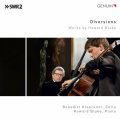
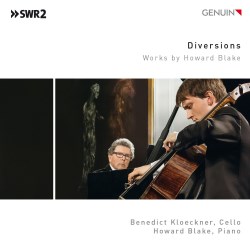
Review of 'Diversions' - an album of music by Howard Blake for cello and piano played by Benedict Kloeckner and the composer, released 2015 by Genuin.
'I'd also recommend an overlooked 2015 disc from the Austrian Genuin label where Benedict Kloeckner plays the cello music of Howard Blake, with the composer himself accompaying - unfialingly attractve and often tremendous fun for both performers and lsiteners.'
in Gramaphone Magazine 2018
The Benedictine Order has today spread far from its sixth-century origin on Monte Cassino; and among its present monasteries is that of Worth Abbey in Sussex. Living nearby in the 1970s Howard Blake wrote some music for the Abbey, and became fascinated by the contribution of the Abbey's acoustics to that music. Now comes further music of larger scope, using St Benedict, the Psalms, Francis Thompson and the composer's own words for collective text. And the resulting music turns out to be ideally suited to its purpose: those parents whose children's affection for The Snowman has persuaded them to swear that Blake's music must for sanity's sake never darken their doors again should consider recantation!
If they do they will find greatly different music; though equally skilled, equally suitable for its particular subject. That is, in the present case, moving, devotional, beautiful. The music is also expounded beautifully by the performers concerned: solo tenor, solo viola, chorus, and orchestra. Further, it is very well recorded.
Is the record in line, then, for the warmest possible of recommendations, for the final accolade? No, it is not, for one reason only: the type in the accompanying booklet is so absurdly small that it is well nigh impossible to read.'
by Robert Hugill in Planet Hugill 7/9/2017
Bold romanticism: Howard Blake's Piano Concerto and Diversions
Howard Blake Sleewalking, Piano Concerto, Diversions, Elegia Stravagante; Sophie Witte, Sasha Grynuk, Benedict Kloeckner, Nicolas Dautricourt, Royal Philharmonic Orchestra, Howard Blake; Cadogan Hall - Reviewed by Robert Hugill on Sep 7 2017
Howard Blake's piano concerto at the centre of an evening of his complex, and dramatic concertante works
The Royal Philharmonic Orchestra opened its 2017/18 season with a programme of music by Howard Blake, conducted by the composer. The centrepiece of the programme was Blake's Piano Concerto, originally commissioned by the Philharmonia Orchestra to celebrate the 30th birthday of Diana, Princess of Wales in 1991. Blake himself performed the taxing piano part at the premiere, this time he conducted with Sasha Grynyuk at the piano. Cellist Benedict Kloeckner was the soloist in Blake's Diversions for cello and orchestra (a work originally written for Maurice Gendron), and Kloeckner was joined by violinist Nicolas Dautricourt to give the premiere of Blake's Elegia Stravagante (Duo Concertante) for violin, cello and orchestra. The evening opened with a new version of Blake's Sleepwalking for soprano and string orchestra, with soprano Sophie Witte
Howard Blake remains best known for his music for the animated film The Snowman, with the song Walking in the air remaining inextricably linked with the composer's name. But his career has been far wider and varied than this, encompassing film music including Ridley Scott's The Duellists as well as a substantial body of concert music. But if you only know Blake from The Snowman and the film music, his concert music can be something of a surprise. Tonal and approachable in a tradition that links Blake to his original composition teacher at the Royal Academy of Music, Howard Ferguson, Blake writes large scale pieces of great depth and complexity. (Read my interview with Howard Blake).
Sleepwalking was originally written as a companion piece to Villa Lobos' Bachianas Brasileiras No. 5, for the same forces soprano and eight cellos. In his programme note Blake talked about finding the idea of eight cellos conjuring up the world of dreams, and his piece posits a scenario of a young woman asleep who then goes sleepwalking through various traumas before returning to sleep. Starting from atmospheric high sustained strings with the soprano vocalise over the top (the whole piece is wordless) the piece moved through seven highly contrasting movements, finally returning to the tranquillo of the opening. We had a series of highly varied moods evoked by instrumental writing very much in the English tradition of string music, from lyrical through to darker dramatic episodes. Witte sang with a lovely even tone, and a beautiful freedom at the top. A well put-together piece which did not quite take me on the journey the composer intended, and I would be interested to hear the original version.
Howard Blake's Piano Concerto is a large-scale dramatic work. It was in some ways the most conventional work in the programme, in three movements (the others were in seven or eight) and the only one to use classical sonata form. Christopher Palmer's 1991 programme note used the term Mozartian, but the composers who came to mind were Rachmaninov and Tippett; Rachmaninov for the big boned romanticism piece, particularly the piano writing, whilst Tippett for the way the piano texture sometimes eschewed showy bravura (but not complexity) and created a continuous texture which flowed over the orchestra..
The first movement started with an understated ear-worm on the piano alone, which Blake then developed into something more dramatic with tutti. Sasha Grynyuk was tireless, and indeed the piano solo got little rest in this movement. Even the cadenza eschewed virtuosity and was rather thoughtful and, unusually, ended the movement. The second movement started with solo piano chords accompanying solo violins and viola, until the tables were turned. The melodic piano line wandered expressively, but always with an elegant simplicity, and finally the whole ensemble moved the temperature up a notch and we got something richly romantic. The final movement started with a perky piano toccata, and developed into a series of variations with hints of jazz/blues. Often highly vigorous, the jaunty melody passed round the orchestra, but always with the piano to the fore over the top. Towards the end we had a simple return to the main theme in the piano before the big finish.
Blake's Piano Concerto is a terrific work, I enjoyed his recording of it (see my review) and I enjoyed this performance immensely. Sasha Grynyuk brought out the poetry in Blake's writing, and played the part with great flair. With longer rehearsal time, there would have been chance to iron out some of the issues of balance, Grynyuk's approach concentrated on poetry and nuance rather than sheer power, but overall he and the orchestra brought it off brilliantly and I hope it makes other orchestras interested.
After the interval the German cellist Benedict Kloeckner played Blake's Diversions. Originally written for Maurice Gendron (who encouraged Blake to add a cadenza and generally make the piece more virtuosic), the premiere was given by Steven Isserlis in 1989. But then it slept somewhat until Kloeckner played the version for cello and piano in the semi-finals of the European Broadcasting Union Awards in Bratislava (and went on to win the competition). Subsequently Kloeckner had played the work a number of times with Blake accompanying on the piano. But for this concert we heard the original orchestral version. It is based on an instrumental dance suite, with eight movements encompassing scherzo, march, waltz, aria serenade and sarabande, though in each Blake develops things in interesting ways. We started with Kloeckner's cello singing over an intense rather dark orchestral accompaniment. The scherzo was full of character, and toccata-lie, whilst the march developed into a really big romantic solo for the cello (and Kloeckner really made the piece sing here). The waltz was wistful and rather sly, with the cello line weaving in and out of the orchestra, and the serenade had the solo duetting with the oboe before moving into the perky sarabande which developed into a cadenza which had orchestral comments (including not quite raspberries from the bassoons). The finale was fast and furious, and completely joyous. Kloeckner clearly loves this work, and the virtuosity of the piece seems to suit him, he made everything magically engaging.
The final work in the programme was a new piece, Elegia Stravagante (Duo Concertante) for violin (Nicolas Dautricourt) and cello (Benedict Kloeckner). In seven movements, it started with violin and cello alone playing a melodic motif that sounded suspiciously like noodling, but in fact proved a fertile source for the musical inspiration of the piece. For much of the piece, the two soloists play together (in unison in some movements), and the effect was more like the structure of a baroque concerto rather than the large-scale battle of a full blown Romantic concerto.
During the work's seven movements, Blake brings back the original motif repeated in vastly different guises, creating some intense and full blown romantic moments, interspersed with episodes using different material such as a 'jazz fugue'. The two soloists often soared in unison (at one point at a 16th) over the orchestra, and the was a notably intense solo moment for Benedict Kloeckner, whilst a rather threatening orchestral passage rather evoked Walton. For the ending, there was a sense of the piece gradually unwinding, a moment for violin solo turned into a duet with the cello and the piece ended with just the two of them returning to the original motif.
This was a long and substantial concert, full of dramatic and complex music. It was a great pleasure to finally hear Blake's Piano Concerto live, as well as to experience the full orchestral colours in Diversions. Throughout Blake was supported by the sterling players of the Royal Philharmonic Orchestra, playing nearly two hours of complex and unfamiliar music, whilst the soloists encompassed the taxing demands of the solo parts in brilliant fashion.
Of course, no Howard Blake concert would be complete without The Snowman and as an encore Dautricourt and Kloeckner joined Blake and the orchestra for a version of Walking in the Air specially created for the occasion
by Jonathan Woolf in MusicWeb International 2017
Howard BLAKE (b.1938)
Diversions for cello and piano, Op.337a (1984/85) [23:15]
Pennillion for cello and piano Op. 525a (2001) [8:49]
Cello Sonata, Op.619 (2007/2010) [23:31]
The Enchantment of Venus, Op.566a (2006) [8:07]
Walking in the Air, from The Snowman, Op.620a (1982/2011) [3:54]
Archangel’s Lullaby, Op.436a (1991) [2:01]
Benedict Kloeckner (cello)
Howard Blake (piano)
rec. July 2013 and January 2014, Südwestrundfunk, SWR Studio Kaiserslautern
GENUIN GEN15346 [70:04]
The prolific
Howard Blake has made a virtue of recasting many of his works for different instruments or combinations of instruments. This accounts for the many times that opus numbers are followed by the letter ‘a’ – there are five such occasions on this delightfully conceived disc which traces a trajectory from Blake’s Opp.337 to 620. For Blakeans, extra pleasure comes from the fact that the composer is at the piano throughout.
Diversions was originally conceived as a suite for cello and piano but Maurice Gendron suggested it would work for cello and orchestra and edited the solo part (
review ~
review). With his Op.337a Blake returns to his original conception with Benedict Kloeckner, who has played it frequently, and has mastered its various moods – whether the bittersweet Prelude, the vital, rhythmically dashing and somewhat Francophile Scherzo, the slow expressive March or the work’s expressive heart, the rapt Aria. Not one to wallow, Blake ensures that the vivacious and slinky Serenade prefaces a rather eerie Sarabande and an exciting Finale.
Composed for the bardic team of violin and harp,
Pennillion is heard in its cello-and-piano incarnation here which well suits it, not least in that hypnotic
Lento, misterioso section in the work’s centre. The expressive flexibility of the melodic lines, and the affectingly quite close, never fail to move in whatever combination. The Cello Sonata, rather like the Franck arrangement, is a transcription of the Violin Sonata. This is a work I especially admire for its emotive candour. In fact, part of my MWI
review of the sonata in its Violin guise is reprinted in the booklet, and my comments apply equally to this version. I’d only say that knowing that it was conceived in memory of fiddle player Miles Baster makes performance on the violin a touch more poignant – though if you didn’t know, it wouldn’t much matter.
The Enchantment of Venus, Op.566a is an arrangement of a work originally for basset clarinet. It was Kloeckner who suggested this arrangement and he certainly ensures that the work’s occasional gruffness but also its essential lyricism are brought to the fore. It has strong March themes – Blake is very good at them - and is well proportioned. Two small pieces see the disc out.
Walking in the Air is recorded, for the first time, for cello and piano – a delight,
and the piano twinkles deliciously. Finally
Archangel’s Lullaby is a perfect envoi, offering a final glimpse at Blake’s seemingly endless gift for melody and beauty.
The recording is well judged and the booklet is sympathetic, quoting from a variety of source material.
Jonathan Woolf
in Hugh Mather - Facebook 18/11/2016
Astounding performance last night at St James Piccadilly of ‘Snowman Rhapsody’ by Howard Blake, by 18-year-old Julian Trevelyan. Haven’t heard him before – and was very impressed indeed. Certainly a major new British talent on the piano scene. Remember the name, and watch this space !
by Michaela Plattenteich in West Rheinischer Zeitung 16/5/2016
"Eine Frau ohne Namen" - ein Ballett von Robert North mit Musik von Howard Blake.
Das Leben einer Frau von ihrer Geburt bis zum Tod ist Thema eines neuen Ballettabends von Robert North. Im Theater Mönchengladbach wurde die Uraufführung dieses Werkes vom Publikum begeistert gefeiert. Dass der Abend zutiefst berührt ist neben der eindrucksvollen Choreografie vor allem der Musik zu verdanken. In enger Zusammenarbeit mit dem Ballettdirektor hat der britische Komponist Howard Blake verschiedene Teile aus seinen Werken zu einem faszinierenden Klangteppich zusammengefügt. Neben großem Orchester mit ausgedehnten Streichersoli kommt im letzten Teil auch ein Chor zum Einsatz.
Der Abend beginnt musikalisch mit einem Sopransolo (Sophie Witte), das sich von zarten Tönen zu ausdrucksvollem Gesang steigert. Die Sängerin steht am linken Bühnenrand und begleitet gemeinsam mit den Streichern der Niederrheinischen Sinfoniker den Prolog. Vor einem roten Hintergrund, auf dem als Sinnbild des Lebens eine Kreisform zu erkennen ist, erwachen die Tänzer zum Leben. Sieben Männer und Frauen, in schlichte graue Trikots gekleidet, tanzen gemeinsam, dann in Gruppen getrennt und schließlich wieder zusammen. In einer für North charakteristischen klaren Ausdrucksform, in der sich stets klassische und moderne Elemente des Tanzes mischen, wird vom Ursprung des Lebens erzählt. Männliche und weibliche Gene ziehen sich an, vereinigen sich, Leben entsteht.
Wo Leben ist, ist auch der Tod. Farbe und Licht wechseln in tiefes Blau und in einer kurzen Sequenz wird der Tod einer männlichen Figur betrauert. Am Ende des Prologs erscheint ein kleines Mädchen aus einem Tunnel heraus, den die Tänzer gebildet haben. Mit seinen Eltern läuft es im Kreis, ein größeres Mädchen wir eingewechselt, schließlich richtet sich eine in Rot gekleidete Frau (Karine Andrei-Sutter) im Zentrum der Bühne auf. Sie ist von einem schwebenden Metallkreis umgeben, der im Verlauf des Stücks noch eine wichtige Rolle spielen wird. Das Leben der Frau beginnt. Sie ist als allgemeines Sinnbild zu verstehen und bleibt daher namenlos. Auch bei den weiteren Figuren wird auf individuelle Namen verzichtet.
Da sind zwei Freunde (Takashi Kondo und Guiseppe Lazarra), die sie durchs Leben begleiten, eine Freundin (Elisa Rossignoli) taucht auf, die später zur erbitterten Rivalin wird. Vertrauensvoll und von einer zurückhaltenden Zuneigung ist die Beziehung zu dem Jugendfreund (Raphael Peter) gekennzeichnet, heftige Leidenschaft charakterisiert die Begegnung mit dem ersten Ehemann (Alessandro Borghesani). Kinder werden geboren und bald verlässt er sie wegen der Freundin. Eine banale alltägliche Geschichte, die allerdings sehr dicht und emotional erzählt wird. Das Bühnenbild bleibt bis auf wenige Farb-und Lichtwechsel abstrakt, die Kostüme sind der heutigen Zeit angepasst (Ausstattung Udo Hesse).
Zwei Sätze aus Howard Blakes Violinkonzert bieten den perfekten musikalischen Rahmen dazu. Unter der Leitung ihres Kapellmeisters Alexander Steinitz spielen die Niederrheinischen Sinfoniker hoch konzentriert und engagiert. Im hoch emotionalen Violinsolo (Philipp Wenger) spiegeln sich die Qualen der verlassenen Frau wider. Innerhalb des Metallkreises agiert sie wie eine Gefangene, die keinen Ausweg findet. Nicht nur in dieser Szene beeindruckt Karine Andrei-Sutter mit ihrer feinnervigen und zugleich so intensiven Körpersprache. Die langjährige Solistin des Ballettensembles feiert mit dieser Rolle, in der sie alle Facetten zeigen kann, einen glanzvollen Abschied von der Bühne. Aus der Krise führt der Weg zur Kunst. Gegen Ende des ersten Teils wird die Frau eine gefeierte Schriftstellerin, der Jugendfreund zum zweiten Ehemann. Der erste Mann und die Freundin tauchen als schmerzhafte Erinnerungen immer wieder auf. Der zweite Teil zeigt die Frau bereits am Ende ihres Lebens.
Der Dynamik des Lebens folgt eine eher elegische und versöhnliche Stimmung. Jetzt mit grauem Haar bekräftigt das Ehepaar im Tanz noch einmal seine Zuneigung, gibt es auch die Aussöhnung mit der Freundin. Der Tod erfolgt plötzlich am Schreibtisch, was den Abend aber noch nicht beendet. Denn in einem an den Prolog anknüpfenden Schlussteil wird der Übergang vom physischen Tod in ein anderes Leben thematisiert. Robert North’ Überlegungen sind hier eindeutig vom christlichen Abendland geprägt. Nach einem Zwischenzustand in Leere und Dunkelheit begleitet ein Engel (Viktoria Hays) die Frau in eine andere Sphäre. Die reduzierte Architektur eines Gewölbes mit Empore sowie die in Pastelltönen gehaltenen, schlichten Kostüme lassen an Renaissancebilder denken. Darauf abgestimmt ist auch die Musik, die mit einem wunderbaren Viola-Solo (Albert Hametoff) beginnt und dann Teile aus Blakes Oratorium „Benedictus“ verwendet. Der lateinische Gesang des gemischten Chores (Einstudierung Maria Benyumova) verbreitet eine feierlich-sakrale Atmosphäre, zu der die wieder sehr dynamische Choreografie einen spannenden Kontrast bietet. Mit Drehungen und Sprüngen und in unterschiedlichen Konstellationen scharen sich achtzehn Tänzerinnen und Tänzer als Himmelswesen um die jetzt weiß gekleidete Frau, die schließlich Teil von ihnen wird.
Die einfache Geschichte bekommt so einen überzeitlichen Charakter, Musik und Tanz verschmelzen zu einen eindrucksvollen Gesamtkunstwerk. Dass das alles nicht in Kitsch abdriftet sondern sehr berührt, ist der Kunst von Robert North zu verdanken. Er versteht es, mit Tanz Geschichten zu erzählen, prägnant und voller Poesie
Stück Das Ballett „Die Frau ohne Namen“ mit Musik von Howard Blake wird das nächste Mal am Donnerstag, 19.Mai, um 19.30Uhr am Theater Mönchengladbach an der Odenkirchener Straße 78 gezeigt.
Musikalische Leitung Alexander Steinitz
Choreografie Robert North
Choreografieassistenz Sheri Cook
Bühne und Kostüme Udo Hesse
Dramaturgie Regina Härtling
by Michaela Platepond in Westdeutsche Zeitung - A woman without a name 16/5/2016
"A woman without a name" is a ballet by Robert North with music by Howard Blake [Mönchengladbach Opera House]
A woman's life from birth to death is the subject of a new ballet-evening by Robert North, whose premiere entranced the audience. Next to the impressive choreography it is largely thanks to the music that the evening is so deeply moving. In close cooperation with the ballet director, British composer Howard Blake has joined together various excerpts of his works into a fascinating tapestry of sound. Besides work for large orchestra there are extended string solos and in the last act a full choir.
The evening begins with music for strings and soprano solo (Sophie Witte) which increases from soft tones to expressive vocalise. For this prologue the singer is on stage left together with the strings of the Lower Rhine Symphony Orchestra against a red background on which a symbol of life, a circular shape, can be seen, awakening the dancer to life. Seven men and women dressed in plain gray jerseys dance together, separate into groups and join back together in the clear expressivity characteristic of North which is always a mix of classic and modern dance, telling of the origin of life. Male and female genes attract, unite and life arises.
Where there is life, is death. Color and light switch in deep blue and in a short sequence the death of a male figure is mourned. At the end of the prologue a little girl appears out of a tunnel made of dancers. With his parents, she runs in a circle, a bigger girl takes her place, and finally a woman dressed in red (Karine Andrei-Sutter) appears on centre stage. She is surrounded by a floating metal circle which will play an important role in the course of the ballet and which starts the woman's life. She is to be understood as a general symbol and therefore remains nameless and even the other figures' individual names are omitted. .
There are two friends (Takashi Kondo and Guiseppe Lazarra) that accompany her through life, a girlfriend (Elisa Rossignoli) emerges who later becomes a bitter rival. She has a trusting and restrained affection with a childhood friend (Raphael Peter), in contrast to the violent passion which characterizes the encounter with her first husband (Alessandro Borghesani). Children are born but he abandons her for the girlfriend. It is a banal everyday story but it is told very densely and emotionally. The stage design by Udo Hesse is always abstract, depending on changes of colour, light and costume.
Two movements of Howard Blake's Violin Concerto provide a perfect musical backdrop. Under the direction of Alexander Steinitz the Lower Rhine Symphony Orchestra's playing is highly focussed and committed and the highly emotional violin solo work played by Philipp Wenger reflects the torments of the abandoned woman. Within the metal circle she acts like a prisoner who finds no way out. Karine Andrei-Sutter impressed in this scene with her angry and intense body language. The long-time soloist of the ballet company is displayed in this role where she can show all of her facets, making a dazzling farewell to the stage. Out of the crisis, the path leads to art. Towards the end of the first act, the woman is seen as a celebrated novelist and the childhood friend has a second husband. The first man and the girlfriend express painful memories.
The second part shows the woman coming to the end of her life. The dynamics of life follow a more elegiac and conciliatory mood. Now with gray hair the couple dance reaffirming their affection and there is a reconciliation with the girlfriend. Death occurs quite suddenly at the desk where her work is not yet completed. There is transition from physical death to another life.. Robert North's affiliations are clearly marked here as those of the Christian West. After an intermediate state in emptiness and darkness, an angel (Victoria Hays) accompanies the woman to another sphere, where the minimal architecture of a vault with gallery and pastel-coloured, simple costumes are reminiscent of Renaissance paintings. Matched to this is also the music that begins with a wonderful viola solo (Albert Hametoff) and then uses parts from Blake's oratorio "Benedictus". The Latin singing of the mixed choir (chorus director, Maria Benyumova) spreads a solemn religious atmosphere, but supports dynamic choreography with exciting contrasts. With twists and jumps in different constellations flock eighteen dancers as heavenly beings around the now white-clad woman who eventually becomes part of them. This simple story conveys a timeless character as music and dance merge into an impressive work of art. That all this does not drift into kitsch is thanks to the very touching artistry of Robert North. He knows how to tell stories in dance that is concise yet filled with poetry.
by Anna Catharina Nimczik in Das Orchester 11/2015
DIVERSIONS
Diversions Interpreters: Benedict Kloeckner (Violoncello), Howard Blake (Piano) Label: Genuin GEN 15346 Type: CD Published in: Das Orchester November 2015, page 85 On this CD ‘Diversions’ the composer Howard Blake (1938) joins up with Benedict Kloeckner (1989) the rising star of the cello world to present a programme of his own compositions. When Kloeckner won the New Talent Competition of the European Broadcasting Union in 2010 with Blake’s suite ‘Diversions’, the composer presented him with the Cello Sonata and the opportunity of being first to perform it. This led to the two musicians joining up in a close working relationship which has produced a wonderful-sounding album in which the rhythmic finesse of film music and elements of jazz combine to delight the ear. The British pianist, conductor and composer Howard Blake has written soundtracks for famous films as well as numerous concert works and is thus able to exhibit an extensive and multi-faceted oeuvre. One of his most famous pieces is the song ‘Walking in the Air’ from the film ‘The Snowman’, which is to be heard on this CD. Another famous credit is his soundtrack for the science-fiction film ‘Flash Gordon’ on which he worked together with the British rock band ‘Queen’. Throughout the album one can hear that Howard Blake is at home in the film metier in his compositions. They are colourfully laid out and tell stories. Striking melodies, rhythmic complexity, virtuosically-constructed passages and strongly-expressive harmonies determine their character. Some of the pieces heard on the CD were originally written for other combinations and therefore it is as transcriptions that they should be credited as world first performances. The work providing the album-title, ‘Diversions’, is an eight-movement suite which plays with contrasts. It takes historical forms such as the Prelude or the Sarabande, but dresses them up them in contemporary clothes, using jazzy and rhythmically-pointed musical elements. During the variation-work ‘Pennillion’ its longing, cantabile melody is allowed to shine in ever-changing new lights, the Cello Sonata is most unusual in its voicings. At last we come to the programme-piec ‘The Enchantment of Venus’, for whose story Blake is served by Greek myth. The farewell exhibits two short melodic pieces, ‘Walking in the Air’ and ‘Archangel’s Lullaby’ that was originally written for three cellos. Howard Blake and Benedict Kloeckner convince on this high-quality album by their clearly-heard joy in the music. The outstanding quality and the beauty of sound is maintained throughout the works and their very different characters. Blake’s compositions with their catchy melodies must surely appeal not only to film-music buffs but to anyone who opens their ears! Anna Catharina Nimczik
Arranged by DAS ORCHESTER NOVEMBER 2015
by Thomas S. Hischak in The Encyclopaedia of Film Composers 2015 1/8/2015
'...Like William Walton, Howard Blake, William Alwyn and other masterful British composers from the concert world who work or worked occasionally in films, Benjamin left his mark on the British cinema by providing superb scores for some fine movies, but all of Blake's many musical works, both for the screen and elsewhere, are somewhat eclipsed by his score for 'The Snowman'. The contagious six-note phrase in the 'Walking in the Air' theme (and song) is one of those rare pieces of music that needs to be heard only once and it is never forgotten. The hymn-like theme is both reverent and spirited, gleeful and bittersweet......Blake is not embarassed that of his hundreds of works his most beloved music is that for an animated short. How can one not be proud of this twenty-six minutes of pure musical joy?'
(see extended article on Howard Blake in 'The Encyclopaedia of Film Composers', Rowman & Littlefield, New York & London)
by Various in Rhein Main magazine, Pizzicato magazine and others 1/7/2015
'DIVERSIONS' - CD of works for cello and piano by Howard Blake on GenuinRecords
Benedict Kloeckner, Violoncello
Howard Blake, Piano and Composition
[DIVERSIONS (cello and piano)]
Rhein Main magazine 7/2015
'DIVERSIONS' - CD of works for cello and piano by Howard Blake on GenuinRecords
Benedict Kloeckner, Violoncello
Howard Blake, Klavier und Komposition
The English composer Howard Blake is a living legend, with his history of composed soundtracks from ‘The Avengers’ to the Oscar-nominated ‘Snowman’. That such a musician should also be invited as concert performer is a rare phenomenon, whilst the fact that he can still pull from his desk an unperformed work ready for first performance seems to beggar belief. But Benedict Kloeckner considers his participation an honour. In a new GENUIN-CD the shooting-star of our cello-scene fuses, with the master himself at the piano, into unity: Blake’s works, with their rhythmic finesse, their wit and their lights of a thousand colours. An absolute must for both chamber music and film fans! (trans.)
Der englische Komponist Howard Blake ist eine lebende Legende: Soundtracks wie „Mit Schirm, Charme und Melone“ oder der mit dem Academy Award nominierten „Schneemann“. Dass einen solch ein Musiker zum Musizieren einlädt, ist wahrscheinlichsehr selten. Dass er dann aber auch noch ein neues Werk zur Ersteinspielung aufs Pult legt, mag an ein Wunder grenzen. Benedict Klöckner aber erweist sich dieser Ehre als absolut würdig: Der Shootingstar der Cello-Szene verschmilzt in der neuen GENUIN-CD mit dem Grandseigneur selbst am Klavier zu einer Einheit: Die ganze Vielfalt des Blake‘schen Oeuvres, seine rhythmischen Finessen und sein Witz leuchten in tausend Farben. Für Kammermusik- und Filmmusik-Fans ein Muss!
(orig. German)
Gapplegate Classical-Modern Music Review
Fünf von fünf Sternen
"Howard Blake himself handles the piano part with dramatic credibility. (...) Kloeckner responds with an extraordinarily vibrant tone and rhapsodic lucidity. (...) It is not high modernist but it is thoroughly contemporary. It has a special quality to it that belongs very much to the musical personality of Howard Blake. Very much recommended."
Zur ausführlichen Rezension von Greg Applegate vom 24. April 2015
13.5.15 / WDR3 TonArt
Auf WDR3 TonArt wird am 13.05. ein Porträt über Benedict Klöckner gesendet.
Zur Homepage von WDR3 TonArt
klassik.com
"Der Cellist Benedict Kloeckner spielt Werke von Howard Blake, der Komponist selbst übernimmt den Klavierpart: Das Ergebnis ist rundum schön."
Zur Rezension von klassik.com!
Rhein Main Magazin
"leuchten in tausend Farben"
Besprechung im Rhein Main Magazin 4/2015
"Es ist raffiniert gemachte, leichte Musik mit vielen melodischen Einfällen, brillant gespielt und am Ende sehr unterhaltsam
[This is refined, light, well-constructed music, full of melodic inspiration, brilliantly performed and finally very engrossing.]
in Lark 21/6/2015
BRIGHTON PHILHARMONIC SUMMER MUSIC
Solstice, and the first of the Summer Season of chamber concerts which have now become a familiar feature of Brighton Philharmonic’s programme. Howard Blake is a very familiar figure as a result of his many film scores – to say nothing of The Snowman – but his other compositions are equally appealing. Though a recent injury to his wrist meant he was not able to play the piano parts himself he was present to introduce the music with a gentle humour which suited the occasion and the intimacy of the setting.
The short programme reflected a long-standing interest in the complexity of writing for chamber instruments, opening with a recent arrangement of Pennillion for cello and piano. Originally conceived for harp and piano, it has gone through a number of arrangements before arriving at the present one. The opening melody is intensely lyrical. Blake’s melodic gift is similar to that of Elgar or Tippett in that the melodies seem so inevitable that we can’t believe we have not known them all our lives and he is just recalling a tune we all know already. The work moves rapidly through a set of variations which allow the cellist, Peter Adams, to show his technical skill as well as his sensitivity towards the subtleties of the melody.
The following Fantasy Trio was being given its first performance though the original idea for the score goes back to his early school days. It is obviously difficult on a first hearing to judge how much is the work of the 17 year old and how much the mature composer, but the melodic ideas and the confidence of the work must have been part of the original spark and as such are a tribute to his genius from an early age. The part writing is exemplary, maintaining a balance between them which never allows one voice to dominate. The final Scherzando is more complex both in rhythm and harmonic density.
Howard Blake admitted that the String Trio is probably the most challenging form for him as it constantly misses the fourth note of the chord. The Trio dating from 1975 is a fierce work with a dark edge to it, strengthened by the deeper tones of viola and cello. The violin, Daniel Bhattacharya, takes the lead throughout though he is often challenged by the viola line from Bruce White.
The final piece was a recent extended single movement entitled Elegia Stravagante – a title suggested by a waiter as it is a reflective elegy which ends with unexpected enthusiasm. Though Howard Blake admitted there are strong auto-biographical elements within it, the piece moves rapidly as a whole with universal rather than personal impact. The seven sections are difficult to follow but the sense of achievement by the climax is persuasive.
As Howard Blake was not able to play the piano parts Sasha Grynyuk proved to be a more than ample substitute, bringing a fine mix of subtlety and bravura to his playing.
The next concert is on Sunday 5 July with music by Frank Bridge and Haydn.
by Andrew Connal in Classical Reviews 21/6/2015
Brighton Philharmonic Summer Season – Howard Blake
The new season began brilliantly! Peter Adams, the Philharmonic’s popular principal cello, was the virtuoso backbone of four chamber works covering the entire span of Brighton-bred Blake’s distinguished career. From the re-worked teenage Fantasy-trio of 1956 to last year’s ‘Elegia Stravagante’, each work was full of glorious melody and rhythmic complexity. The composer’s amiable introductions and helpful programme notes illuminated these delightful works even more. Blake is still recovering from a broken wrist so the piano part was played, at just a few days’ notice, by the excellent Sacha Grynyuk. Daniel Bhattacharya (violin) and Bruce White (viola) completed the ensemble.
Unitarian Church Brighton 21 June 2015
by Greg Applegate in Gapplegate 24/4/2015
Howard Blake, Diversions, Benedict Kloeckner
An English composer with a pronounced lyrical gift, Howard Blake (b. 1938) is perhaps best known for his soundtrack to the feature cartoon, "The Snowman," which has a hauntingly beautiful refrain "Walking in the Air" for boy soprano and orchestra. He has a body of more "serious" works though, and we can hear some of how that sounds on a new recording featuring works for cello and piano, Diversions (SWR2/Genuin 15346). Benedict Kloeckner takes on the cello role for these works and sounds terrific. Howard Blake himself handles the piano part with dramatic credibility.
These are modern lyric pieces that show us Blake the gritty but mellifluous contemporary composer in a series of six compositions, all but one enjoying world premier recordings in the versions presented. This is music of a pronounced tonality but without anything in the way of a neo-classical glance at the past. He may certainly have something of the romantic in him, but like Samuel Barber it is so individual that you don't find yourself saying, "yes, that is Brahmsian...that is Mendelssohnian, etc." The works hold their own as contemporary music with a pronounced Blakean signature affixed. There is nothing banally "new age" sounding to them either. The music is filled with inventive flourishes that evince a fertile creative mind at work.
The piano parts occasionally step into the spotlight but mostly this is music that gives the cellist a chance to take a singing melodic lead. Kloeckner responds with an extraordinarily vibrant tone and rhapsodic lucidity.
There is nothing in the way of filler. Each work has something to say. We get a touching rendition of "Walking in the Air" that reminds us how well-constructed the deceptively straightforward song is. But then we get more complexly lyrical works in the title work "Diversions for Cello & Piano," in "Pennillion for Cello & Piano," the "Cello Sonata," and "The Enchantment of Venus." The program concludes with a short and very lovely "Archangel's Lullaby" and we are done.
This is music any classical Anglophile will appreciate. It has an accessibility that will appeal to a large audience, potentially. And it is rousingly good music. It is not high modernist but it is thoroughly contemporary. It has a special quality to it that belongs very much to the musical personality of Howard Blake.
Very much recommended.
by Jonathan Butcher in website conductor and choral director Jonathan Butcher 2015
Conductor and choir director Jonathan Butcher took the initiative in giving the second performance of Howard Blake’s 'Benedictus' which re-kindled new interest in the work, resulting in it establishing itself as one of the twentieth century’s major oratorios.
by Royal S. Brown in Overtones and Undertones, Reading film music, University of California 2015
'An exceptionally beautiful theme (initially heard on the solo flute) huge swells in the orchestra, shimmering string tremolos and deep layers of harmonic effectivity in Howard Blake's music for Rridley Scott's 1977 film 'The Duellists' lend their colours more perhaps to the film's lush cinemtography than to the somewhat overbearing narrative of Joseph Conrad...'
by Straits Times 10/2014
CD Reviews (The Straits Times, October 2014)
WALKING IN THE AIR
The Music of Howard Blake
VLADIMIR ASHKENAZY, Piano
Decca 478 6300 / ****1/2
For all the prolific output of British composer Howard Blake (born 1938), over 650 works to date, he will forever be remembered for Walking In The Air, that mega-hit song in the children’s animated Christmas film The Snowman. Its simplicity and beauty permeates most of this album of Blake’s piano music which spans from 1955 to 2013, performed no less by his close friend Vladimir Ashkenazy. The piano version of Walking, which falls easily within the hands of young pianists, is now part of Lifecycle. This suite of 24 short pieces or preludes also includes Eight Character Pieces (1975), Music Box from the movie The Changeling (1979) and the early Russian-flavoured Romanza (1963), written for the Ashkenazys after their defection to the West.
Blake’s Sonata (1971) and Dances (1976) for two pianos (with Ashkenazy’s eldest son Vovka on second piano) deserve to be better known, the latter being a set of variations on a simple theme in a panoply of dance styles, including waltz, ragtime, boogie-woogie and cha-cha. The major single-movement work in this set is Speech After Long Silence (2011), written as a set-piece for the Hong Kong International Piano Competition. This is an alternatingly brooding and ecstatic essay in the manner of Rachmaninov, which perfectly suits the temperament of Russian virtuoso. An enjoyable listen, from start to end.
by Robert Hugill in Planet Hugill 16/8/2014
Howard Blake's Concerto for Piano and Orchestra was commissioned by the Philharmonia Orchestra in 1991 to celebrate the 30th birthday of Diana, Princess of Wales. It was given its premiere by the orchestra, conducted by David Willcocks, with the composer playing the piano part. The work had been recorded by Sony prior to this performance and this recording was reissued by Sony in 2008.
It is a substantial work lasting over 26 minutes and cast, as you might expect from Blake, in traditional form. Blake's career as a composer has been spent mediating between the traditional and more contemporary elements in the 20th century classical style.
The opening movement starts with an evocative and wistful Lento, a movement to which you might give the adjective filmic. Blake's concert music is fascinating for the way he does not turn his back on his film music but absorbs it and develops it. The music then gathers momentum, and the solo piano part become more strenuous as the Allegro bursts onto the scene. The writing is tonal, but complex and requires something from the listener. The piano writing is quite strenuous, but the soloist is rather part of the texture in the baroque or classical manner, rather then in combat with the orchestra in the Romantic tradition.
A hushed orchestra introduces a slow, evocative piano in the Andante espressivo. The movement develops with piano running passages through the orchestra texture, which culminates into a rather wonderful, big romantic moment The final Vivace wonderfully perky with the busy piano part loudly interrupted by the orchestra, and some lovely jazzy moments.
When I interviewed Howard Blake, he talked about how he had to re-learn his piano technique to play the piano part. The results are impressive and confidently fluent. It is piano writing which is probably difficult, but not always showy and Blake shows himself a sympathetic soloist, finely supported by Willcocks and the Philharmonia Orchestra.
The companion works to the concerto are two more of Blake's large scale orchestral works. His Diversions for Cello and Orchestra were written in their final form in 1985, with the cello part edited by the cellist Maurice Gendron. It started out life as a set of pieces for cello and piano, but the involvement of Gendron led to a considerable expansion of the piece with a commensurate increase in the virtuoso bravura of the solo cello part. Blake has recently started playing this bravura version with cello and piano and plans to record it with cellist ????
This recording of the orchestral version was made with Blake conducting the Philharmonia Orchestra, with cellist Robert Cohen as the soloist. The work is a sequence of relatively short movements which hark back to the suites of the past. The opening Prelude is melancholy, with the cello singing in the alto register at first unaccompanied and then with just high strings. A perkily busy not quite Scherzo leads to a melancholic, rather dramatic March. The rather busy Waltz has some rather skittish, skittery playing. The Aria is the longest movement, it is slow and dark, with a sense of sustained intensity. Serenade is a rhythmic and melodic dance, and here the solo cello part starts to get rather busy indeed. The Sarabande and Cadenza provides the solo cellist with some wonderful virtuoso display moments, with quite a spare and dark accompaniement from the orchestra. The Finale is fast and furious with a wonderfully bravura end.
Blake's Diversions is a terrific work which combines an element of bravura with just the right element of fun and Robert Cohen is suitably dazzling in the solo part.
The final work on the disc,Toccata (A celebration of the Orchestra) was commissioned by the Royal Philharmonic Orchestra for the 30th birthday season (1976/77). The version performed on the disc was revised by Blake in 1988/1990. The work is a large and complex piece designed to show of the orchestra, but allied to a quite sophisticated structural imagination. All based on an 84 bar theme, Blake plays imaginative games in the way he shows off the orchestra and demonstrates his ingenuity. The joy of the piece is that none of this really matters, as when you listen you are carried away. The first section of the work displays the various sections of the orchestra, with the music having a quiet sense of steady overall progression. Blake uses a lively imagination in the way he gives each section of its orchestra its moment. And then the piece concludes with a wonderful jazzy fugue.
None of the works on this disc is well known, and the disc itself is slightly tricky to obtain. But I rather like Blake's imaginative re-working of contemporary style. The music here doesn't seek to re-define or push boundaries, instead it builds intelligently what has gone before. The results are neither simple nor simplistic and fascinating in their combination of wit and complexity.
Elsewhere on this blog:
by Sylvia Morris in the shakespeare blog 4/6/2014
Howard Blake’s music for Shakespeare in performance Posted on June 4, 2014 by Sylvia Morris
Howard Blake
This Friday, 6 June, Stratford-upon-Avon’s Orchestra of the Swan’s celebration of the 450th anniversary of Shakespeare’s birth reaches its climax with a concert of music inspired by A Midsummer Night’s Dream. Three of the four concerts in the series have featured pieces by the composer Howard Blake, best known for the song Walking in the Air that was used in the animated film of The Snowman, memorably covered by the young Aled Jones in 1985. In a long career Blake has written much else, including film music and choral and orchestral work. He has also written a number of pieces for theatre: the first was for the 1984 RSC production of Henry V thatlaunchedthe young Kenneth Branagh’s Shakespearean career. This was played at the second concert in which the theme was “Rosemary for Remembrance”. In the programme note he explains that in between the scenes of war, he decided to “have a harpist playing variations quietly live on stage whenever there was peace in the land. The harpist would be placed on-stage in period costume…The “theme-tune” of the production was an unaccompanied song on Shakespeare’s words”:
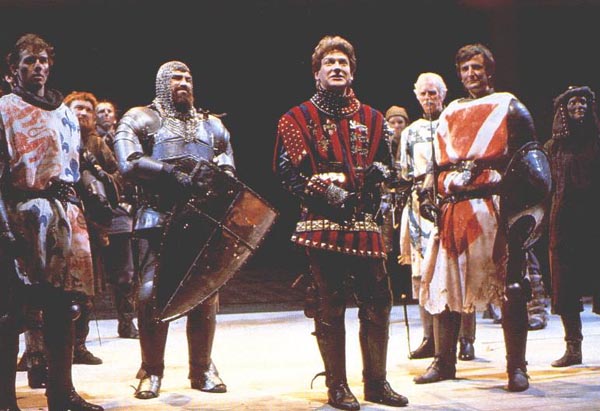
A scene from the 1984 Henry V with Kenneth Branagh
And sword and shield in bloody field Doth win immortal fame.
Would I were in an ale-house in London; If wishes would prevail with me,
My purpose should not fail with me;
But thither would I hie,
But thither would I hie.
Tanya Houghton was the performer at the Orchestra of the Swan concert, but the original soloist was Vanessa Sundstrup, then just beginning her career. She has recently put her own recording of this piece on YouTube. She recalls “The harp was featured as a solo instrument as a symbol of peace and was actually on stage”. I well remember her gentle playing of Blake’s musicwhile the audience was assembling, becoming, sadly,less and less audible as the auditorium filled up. Blake’s music is beautifully melodic and I particularly like the way that you can hear the wistful words of the song “But thither would I hie” in the music.
Blake became associated with Adrian Noble’s productions,writing the songs for his As You Like It in 1985 which have also been sung in this concert series. The first concert featured another Shakespeare commission by the distinguished ex-RSC director Bill Alexander, (who also directed the stage version of The Snowman), for a student production of Twelfth Night. Blake’s version of O Mistress Mine was not actually used in the production so the concert on 16 May was its first performance.
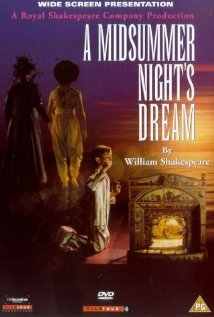
Poster for Adrian Noble’s film of A Midsummer Night’s Dream
In Friday’s concert the Orchestra will play a suite of Howard Blake’s music based on that which he wrote for the film version of Adrian Noble’s production of A Midsummer Night’s Dream. This will be the first performance of this suite which Blake has created specially for the 2014 anniversary. In the programme note Blake comments “Since Adrian’s production included a motor-bike for the Mechanicals and a forest consisting of light bulbs, the score did not have to be set in a conventional “mock-Tudor” style and the character of Bottom, for instance, is conveyed by a jazzy solo trombone”. And “A solo violin begins the work announcing the main theme, redolent of fairies flying through midnight skies and enchanted happenings”. Theatre and film music can be overwhelmed by the visuals, so on this occasion it’s going to be great for the music to get the attention it deserves. This series of concerts has been a delight and I’d like to thank conductor David Curtis for the opportunity to hear so much Shakespeare-related music in concert, and not just the obvious pieces.
As a bit of fun to celebrate Shakespeare’s birthday, the Guardian posted its suggestions of the best Shakespeare-inspired pieces of music. Several of the pieces that have featured in the Orchestra of the Swan concerts are included: Walton’s music for Olivier’s Henry V film, and Mendelssohn’s Midsummer Night’s Dream music which we will hear on the 6th. And nobody would argue with Bernstein’s West Side Story or Verdi’s Falstaff, but The Boys from Syracuse and The Lion King – really???? Even more oddly the selection consisted of pictures, with no links to any of the music. Sadly it’s too late to vote for any of the striking but lower-profile music like Howard Blake’s that’s been specifically written for Shakespeare on stage.
by Sylvia Morris in Shakespear Blog 6/2014
Howard Blake’s music for Shakespeare in performance
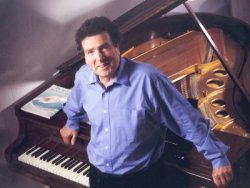
Howard Blake
This Friday, 6 June, Stratford-upon-Avon’s Orchestra of the Swan’s celebration of the 450th anniversary of Shakespeare’s birth reaches its climax with a concert of music inspired by A Midsummer Night’s Dream. Three of the four concerts in the series have featured pieces by the composer Howard Blake, best known for the song Walking in the Air that was used in the animated film of The Snowman, memorably covered by the young Aled Jones in 1985. In a long career Blake has written much else, including film music and choral and orchestral work. He has also written a number of pieces for theatre: the first was for the 1984 RSC production of Henry V that launched the young Kenneth Branagh’s Shakespearean career. This was played at the second concert in which the theme was “Rosemary for Remembrance”. In the programme note he explains that in between the scenes of war, he decided to “have a harpist playing variations quietly live on stage whenever there was peace in the land. The harpist would be placed on-stage in period costume…The “theme-tune” of the production was an unaccompanied song on Shakespeare’s words”:
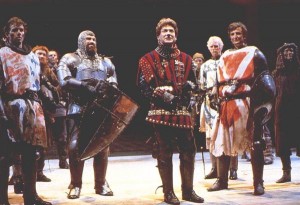
A scene from the 1984 Henry V with Kenneth Branagh
And sword and shield in bloody field Doth win immortal fame.
Would I were in an ale-house in London; If wishes would prevail with me,
My purpose should not fail with me;
But thither would I hie,
But thither would I hie.
Tanya Houghton was the performer at the Orchestra of the Swan concert, but the original soloist was Vanessa Sundstrup, then just beginning her career. She has recently put her own recording of this piece on YouTube. She recalls “The harp was featured as a solo instrument as a symbol of peace and was actually on stage”. I well remember her gentle playing of Blake’s music while the audience was assembling, becoming, sadly, less and less audible as the auditorium filled up. Blake’s music is beautifully melodic and I particularly like the way that you can hear the wistful words of the song “But thither would I hie” in the music.
Blake became associated with Adrian Noble’s productions, writing the songs for his As You Like It in 1985 which have also been sung in this concert series. The first concert featured another Shakespeare commission by the distinguished ex-RSC director Bill Alexander, (who also directed the stage version of The Snowman), for a student production of Twelfth Night. Blake’s version of O Mistress Mine was not actually used in the production so the concert on 16 May was its first performance.
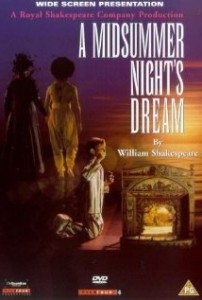
Poster for Adrian Noble’s film of A Midsummer Night’s Dream
In Friday’s concert the Orchestra will play a suite of Howard Blake’s music based on that which he wrote for the film version of Adrian Noble’s production of A Midsummer Night’s Dream. This will be the first performance of this suite which Blake has created specially for the 2014 anniversary. In the programme note Blake comments “Since Adrian’s production included a motor-bike for the Mechanicals and a forest consisting of light bulbs, the score did not have to be set in a conventional “mock-Tudor” style and the character of Bottom, for instance, is conveyed by a jazzy solo trombone”. And “A solo violin begins the work announcing the main theme, redolent of fairies flying through midnight skies and enchanted happenings”. Theatre and film music can be overwhelmed by the visuals, so on this occasion it’s going to be great for the music to get the attention it deserves. This series of concerts has been a delight and I’d like to thank conductor David Curtis for the opportunity to hear so much Shakespeare-related music in concert, and not just the obvious pieces.
by ROBERT MATTHEW-WALKER 6/2014
Walking in the Air: VLADIMIR ASHKENAZY PLAYS THE PIANO MUSIC OF HOWARD BLAKE
Reviewed by: Robert Matthew-Walker Howard Blake The Snowman – Walking in the Air, Op.489u The Changeling – Music Box, Op.489 The Duellists – Laura, Op.604 Prelude for Vova, Op.540 Speech After Long Silence, Op.610 Eight Character Pieces, Op.338 Dances for Two Pianos, Op.217a* Sonata for Two Pianos, Op.130* Piano Fantasy, Op.1 Three Easy Pieces, Op.1b Romanza, Op.489o Haiku for Yu-Che, Op.567 Parting, Op.650a Vladimir Ashkenazy & *Vovka Ashkenazy (pianos) Recorded March & June 2013 in Potton Hall, Dunwich, Suffolk, England CD Number DECCA CLASSICS 478 6300 Duration 81 minutes Review Date June 2014 Whence inspiration? The extraordinary, vital spark of artistic creativity – that which sets the artist off on a new journey of creation – from where does it come? Clearly, from within the mind (or so the interested observer will believe), but some aspect or combination of circumstances must surely exist at the moment an idea pops into the head as the composer might say. On walking down the road, we all might hum a tune to ourselves, and with little else to engage us perhaps our brain’s musical area might bring to mind a melody matching our mood and the tempo of our walking-pace: eighty years ago, Constant Lambert wrote of “the appalling popularity of music”, citing the sounds coming from the open windows of adjoining houses with their radios on, accompanying the town-dweller out for a stroll, each step on the paving stone coinciding with a bar of music. It’s probably as true today as it was then, although it’s more the mobile phone that carries the music to us (and others!), but without that outside stimulus Lambert’s notion of music accompanying our daily walk still holds good, even if we might wonder what tunes came unbidden into Karlheinz Stockhausen’s mind as he negotiated the winding Bergstrasse in Kürten, such a concept perhaps needing a greater leap of the imagination than most people possess. It’s probably truer to say that musical people from any cultural background (and we don’t have to define ‘musical’ people, do we? – for Hans Keller, such people are those who need to experience music frequently, as an important part of their lives, not those who take it or leave it) are those who probably are more prone to hum tunes to themselves, but if the comfort zones of today’s commuters, as exemplified through their personal earpieces, replace such spontaneous creative experiences with the reassurance of music they know already, then that creative area of the brain might wither and die through atrophy. Howard Blake. Photograph: Tim Motion After all, you cannot think of one tune if another is being fed into your brain. It may be possible, but it’s surely more difficult. So if you’re walking your dog in the park and, suddenly, unbidden, a tune comes into your conscious mind – one that you’ve never heard before and which catches your imagination – such an experience, surely, is a moment of inspiration. Tchaikovsky would enter his study each morning at 9 o’clock to begin writing music – composing, copying or revising an existing work, or orchestrating another, or whatever: keeping the brain’s channels of communication open for when his inspiration called. As he said: “My muse knows to contact me at that hour” (or something similar), but not every composer is as regular in those habits as was Tchaikovsky – although Britten, it seems, possessed a similar work ethic. Inspiration can strike at any time: Elgar asked his driver Dick for the Ordnance Survey map in the car to scribble down the opening of the Fifth Pomp and Circumstance March which had suddenly come to him when they were out for a drive, and Stravinsky is known to have used a restaurant menu for a similar purpose. The important thing, surely, is to capture that inspiration on paper, or at least in some permanent form, before it disappears; Turner carried a sketchpad for the same reason, and there must be very many instances of artists, in whichever medium, being desperately keen to capture that moment. Not all composers have permanent memories for such ideas, but Howard Blake has – and we may imagine he thanked his lucky stars one sunny day when, out walking his dog, a tune arrived in his mind. This was in the early 1970s, soon after Blake (born 1938) had resolved to abandon the constant pressures of composing commercial music to order, often at a few days’ notice, which had consumed his working life for a good many years. At first, he was not quite sure what to do with the tune, although he knew it was a good one. Years later, in 1982 in fact, he realised it ideally fitted a Channel 4 animated film of Raymond Briggs’s picture-book story, The Snowman. It soon became a hit, not only in countries where the film was shown; it has been televised every Christmas since; the CBS Masterworks album went platinum; the EMI single, sung by the young Aled Jones, reached the top of the singles chart, and the two-act ballet version has been staged by Sadler’s Wells in London for fifteen years running, becoming as much a part of Christmas as Tchaikovsky’s The Nutcracker. Seeing The Snowman at London’s Peacock Theatre over a dozen years ago, I described the ballet in Musical Opinion as a “masterpiece” – as a stage show, it certainly is, and remains so: the following year, I took my three-year-old granddaughter to see it, and she sat entranced. Vladimir Ashkenazy. Photograph: Keith Saunders ‘Walking in the air’ may have brought Howard Blake fame, and financial stability, but such is the nature of today’s compartmentalisation of what an artist can or cannot do, or what they ought or ought not to be doing, that society nowadays appears to have taken the view that, once tagged with a particular label (rightly or wrongly), a composer cannot be perceived to be just as good in another area, and if they venture to do so, a part of the critical fraternity has to put them in their place. Quite why this should be so may tell us more about the critics than about the artists involved. In recent decades we have seen a type of ‘cross-over’ from pop and rock to what might be broadly termed ‘classical’, yet perhaps it was always thus: ‘popularity’ does not – indeed, cannot – always equate with artistic inferiority, and ‘ivory-tower’ modern composers are not ‘better’ than popular ones simply because their music does not conform to the familiar or customary. It may take a while to remove such blinkered attitudes, for as Schoenberg said: “A Chinese philosopher speaks Chinese: the question is, ‘what is he saying?’”, and whilst we don’t necessarily have to agree with Leonard Bernstein’s statement that “I prefer great rock ‘n’ roll to bad Beethoven” (pity no-one asked him for chapter and verse), the fact that Sir William Glock gave Soft Machine the first-ever late-night BBC Prom in 1970, indicated a breadth of – at least – musical curiosity, if not acceptance, that we would do well to emulate. For Howard Blake, composition has been pretty much a compulsion for most of his life: “I had a local piano teacher, and I’d make up tunes for my family at Christmas and birthdays. Nobody told me to do it, I just wrote tunes, and when I was about eleven, I wrote a march and took it to my teacher who asked, ‘Where did this come from?’. “I wrote it”. At first he didn’t believe me. But he realised I was serious, and took me through all of Kitson’s harmony and counterpoint books. I loved it.” From then on, Blake knew he liked writing music more than anything, although his father “would not have entertained the idea that I could become a musician”. His mother was musical and played the piano and violin very well. “She encouraged me, and through her I started the piano. I worked hard ... getting Grade VIII with distinction. The Hastings Festival – the only Southern England festival offering a Royal Academy of Music scholarship – was the first time I entered any competition. I went in for the Bach Prize, the Beethoven Prize, the Chopin Prize and the Academy Scholarship Prize – and I won all four. Although I thought I might make a concert pianist, I still wrote music, but nobody encouraged me much. At the Academy I chose organ as a second subject, but during the interview the subject got round to harmony, and I was told to bring in some original work. I brought a four-movement orchestral suite, and they said, ‘Shouldn’t you be studying composition?’. It had never occurred to me!” And so Blake became a composition student of Howard Ferguson. There are few living composers who possess the combination of fluency, technical ability and melodic inspiration as Howard Blake does, so when such a greatly distinguished artist as Vladimir Ashkenazy makes a recording of his piano music, on which he has his son Vovka partner him in works for two pianos, we would do well to abandon any prejudices we might harbour and listen. The recital opens with ‘Walking in the air’; that simple tune, as a piano piece, continues to exert its haunting influence, and Ashkenazy’s phrasing raises it to the level of a minor masterpiece. This is followed by two other pieces, originally used as part of film scores: ‘Music Box’ from The Changeling (the 1980 horror movie, starring George C. Scott as a bereaved concert pianist), and ‘Laura’ from The Duellists (Harvey Keitel and Keith Carradine), a score which won the Special Jury Prize at the 1981 Cannes Film Festival. These two short concert studies (for, divorced from the screen, that is what they are) are given with much refinement by Ashkenazy, as does the succeeding item, Prelude for Vova (Vladimir Ashkenazy himself). The unusually entitled Speech After a Long Silence was also requested by Ashkenazy, an eight-minute test piece written for the 2011 Hong Kong International Piano Competition, played by each competitor in round four of the competition. Blake has said that Ashkenazy’s performance is “finer than I could have dreamed of”. In structural terms, the one composer it brings to mind is Sibelius. The Eight Character Pieces were also suggested by Ashkenazy, in 1975, following what Blake describes as “an extraordinarily brilliant Scriabin recital at the Queen Elizabeth Hall”. The work overall (22 minutes) is a late-20th-century Carnaval (the third – and longest – piece, ‘Impromptu’, is a truly fine example of Blake’s idiomatic writing, as well as being superbly expressive). The Character Pieces were eventually incorporated into Blake’s Lifecycle of 1995 (24 pieces, each in a different key), but the work in its original form makes a perfectly satisfying and coherent composition. Two very different pieces for two pianos follow: nine comparatively brief Dances, almost forming a collection of ‘encores’ in lighter style, succeeded by a major work by any standards, Sonata for Two Pianos (1971) in four movements, which in the finale demands (and gets here) considerable virtuosity from both players. Then comes a group of very early solo pieces: Fantasy, composed in 1955 at the age of sixteen (“rediscovered for this album”), a simple broad ABA structure, declares his natural compositional gifts in no uncertain manner, and Four Easy Pieces from the following year (written as a birthday present for a girlfriend, who apparently turned both composer and his music down), but delightful miniatures. Vladimir Ashkenazy reveals all there is to be found in these early pieces, and this excellently recorded recital continues with Romanza, inscribed to the pianist (and his wife), another extremely beautiful piece, based upon early material – a succinct morceau de fantasie, perhaps. The programme ends with two items, just 70 and 80 seconds in duration respectively, and perhaps the most personal of Blake’s piano pieces to appear in recent years. They form a fitting addendum to a recital of eminently worthwhile music by a composer whose more-serious works – in particular his concertos – manifestly deserve to be heard more frequently. It is a pity, though, that Decca’s presentation is poorly packaged, for nowhere on the front cover is the word “piano” given – Ashkenazy might be conducting Blake’s orchestral music; the layout is childishly feeble, and omitting Vovka’s name from the cover is a deplorable oversight. The opus number of the Eight Character Pieces is also omitted. It is worth mentioning that Sir Neville Marriner and the Academy of St Martin-in-the-Fields are to give a concert devoted to Howard Blake’s music on November 25 at the eponymous London church, including the world premiere of a work for double string orchestra, the melodic inspiration of which will not be hard to seek. Decca Classics
in Classic FM 12/4/2014
Walking in the Air - The Music of Howard Blake: Vladimir Ashkenazy
image: http://assets4.classicfm.com/2014/14/walking-in-the-air-blake-ashkenazy-1396850885-old-article-0.jpg
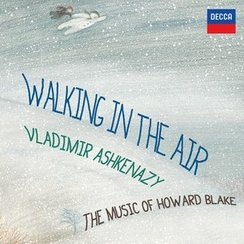
A tuneful and enjoyable collection from two masters. Album of the Weekend, 12-13 April 2014.
The great pianist and conductor Vladimir Ashkenazy has been friends with the composer Howard Blake - best known for The Snowman soundtrack - for many years.
On this unique and maybe unexpected album, there are no fewer than nine world premiere recordings including Blake's music from Ridley Scott’s film The Duellists and a prelude written especially for Ashkenazy, made out of his initials.
Not surprisingly, 'Walking in the Air' is a stand-out track on this generous 80-minute collection.
Blake's compositions are attractive and accessible and Ashkenazy's joy at playing his friend's music is evident on this album
Read more at http://www.classicfm.com/artists/vladimir-ashkenazy/album/walking-air-howard-blake/#TdszXW1pKogwxgWL.99
by The Classical Reviewer in blogspot review of Vladimir Ashkenazy album Walking in the Air 4/2014
http://theclassicalreviewer.blogspot.co.uk/2014/04/a-fine-collection-of-piano-works-by.html
in Klassik Akzente 4/3/2014
04.03.2014
Vladimir Ashkenazy
Von Freund zu Freund - Vladimir Ashkenazy spielt Klaviermusik von Howard Blake
Vladimir Ashkenazy widmet sein neues Album "Walking in the Air" der Musik des britischen Komponisten Howard Blake. Die Musiker verbindet eine langjährige Freundschaft. Für beide ging mit dem Album ein lang gehegter Wunsch in Erfüllung.
© Ben Ealovega / Decca Vladimir Ashkenazy
Der Pianist Vladimir Ashkenazy macht seit einem halben Jahrhundert als Exklusivkünstler Aufnahmen für das Label Decca und hat fast jede Facette der klassischen Klavierliteratur beleuchet. Mit seinem neuen Album beweist er, dass er nach wie vor für Überraschungen gut ist: "Walking in the Air" ist seine Hommage an den britischen Komponisten Howard Blake. Nicht weniger als neun Weltersteinspielungen beinhaltet diese Werkschau, in deren Verlauf der große Pianist das Schaffen von Howard Blake erkundet, von frühen Kompositionen aus den 1950er Jahren über Klavierstücke für Ashkenazy aus den 1970ern bis in die Gegenwart.
Längst überfällig
Vladimir Ashkenazy betrachtet sein neues Album als längst überfälliges Geschenk für den Komponisten, der im Oktober 2013 seinen 75. Geburtstag gefeiert hat. „Ich kenne Howard Blake seit über 40 Jahren und denke gern an seine vielen Besuche in meinen Konzerten und Recitals zurück“, sagt er. „Zu erfahren, dass mir Howard einige seiner Klavierstücke gewidmet hat, schmeichelte mir außerordentlich. Seither hegte ich den Wunsch, sie aufzunehmen. Es hat zwar etwas länger gedauert als geplant, doch ich bin sehr glücklich, nun endlich ein ganzes Album mit seiner Musik vorzustellen.“
Riesiges Œuvre
Howard Blake hat im Verlauf seiner über 50-jährigen Laufbahn mehr als 650 klassische und populäre Werke komponiert. Mit Unterstützung des legendären Bernard Herrmann gelang es ihm, sich in den 1970er Jahren als gefragter Filmkomponist zu etablieren. Aus seiner Feder stammen unter anderem die Soundtracks für Ridley Scotts "The Duellists" und Mikes Hodges' "Flash Gordon". Mit der Filmmusik für den Zeichentrickfilm "The Snowman" und dem darin enthaltenen Stück "Walking in the Air" feierte Howard Blake 1982 den größten Erfolg seiner Karriere. Sein Klavierkonzert zum 30. Geburtstag von Prinzessin Diana, an dessen Uraufführung im Jahr 1991 er als Solist mitwirkte, verhalf ihm zu noch größerer Popularität. 1994 wurde Blake mit dem Order of the British Empire für besondere musikalische Verdienste geehrt.
Tiefe Verbundenheit
Neben einer Auswahl von Howard Blakes bekanntesten Filmmelodien, wie "Laura" aus "The Duellists" und "Music Box" aus dem Horror-Klassiker "The Changeling", beinhaltet das Album auch eine Reihe jüngerer Werke, die Vladimir Ashkenazy in Auftrag gegeben hat. Eines davon ist das "Prelude for Vova" (op.640). In diesem 2012 komponierten Konzertstück, das von Liszts „Präludium und Fuge über den Namen BACH“ inspiriert ist, verwendet Blake anstelle von B-A-C-H die Notenfolge A-(E)S-H als Zeichen seiner Verbundenheit mit dem Pianisten. Ebenfalls im Auftrag Ashkenazys entstand das letzte Stück des Albums "Parting" (op.650a), in dem Blake die langjährige Freundschaft in ergreifender Weise verarbeitet. Die beiden Werke für zwei Klaviere (opp.217a und 130) hat Vladimir Ashkenazy zusammen mit seinem Sohn Vovka eingespielt.
„Seine Klaviermusik ist extrem gut geschrieben und pianistisch, was natürlich daran liegt, dass er selbst ein sehr guter Pianist ist. Darum macht es mir große Freude, sie zu spielen“, erklärt Vladimir Ashkenazy. „Mit diesem Album geht für mich ein Lebenstraum in Erfüllung“, sagt Howard Blake, „und Vovas Interpretationen der Werke sind noch schöner, als ich mir je hätte erträumen können.“
in AMAZON 2014
Sometimes I'm bowled over by new pieces I hear when half asleep. One a while ago was Poulenc's Concert Champetre. Something about having your defenses down...
Yesterday it was a quite Brahmsian Piano Quartet -- woke up a bit in the very chipper scherzo and listened on. The slow movement seemed deeply felt and affecting, but built very rigorously. The finale was a good-natured romp. I'm thinking, this is pretty good, but if it were Brahms wouldn't it sound familiar?
Turns out that it was Howard Blake's Piano Quartet from 1974! Definitely old-fashioned, but also far more enjoyable and memorable than most of those Brahmsian things written before and after the turn of the 20th century, which tend to be serious, pretentious, and boring.
Not on YouTube, but you can hear it on NML. The theme of the first movement will be VERY familiar to anybody who listens to KUSC in SoCal. If you know it or listen to it, what do you think?
Ken, Howard Blake is very well known in Britain for his music to 'The Snowman', an award winning TV animated film.
https://www.youtube.com/watch?v=xb-pX7sIjFY
He's written a lot of film music too.
I bought his violin concerto - 'The Leeds' a few years ago after hearing an extract from it on an ASV sampler CD. I like it a lot but have never got round to looking for anything else by him. I've just listened to and enjoyed the Piano Quartet but didn't recognise any Brahmsy bits, I'm afraid.
Thanks for reminding me about him, I'll definitely check him out.
Thanks Lez. On re-hearing it doesn't sound so Brahmsy, but believe me, half-asleep it did!
Found this blurb on Blake, which seems perceptive. "Howard Blake might be classified as neo-Romantic (with the derogatory implications that the term sometimes carries) because of his gift for melody and the conservatism of his tonal harmonic language, which for the most part sounds comfortably situated in the English pastoralism of the first decades of the 20th century. But because of his absolute mastery of his craft and the fact that his musical ideas are so often really attractive, he seems to transcend that category. Most importantly, he sounds like a composer who is entirely at ease in his own skin; he is not trying to be anything other than what he is, and that gives his music an unselfconscious naturalness and spontaneity."
Lez, I got another disk by Blake, mostly string quartet stuff, that includes Walking on Air, his String Trio, and other works. I really like this guy -- skilled, interesting, and replete with a big fund of good musical ideas. Just don't expect profundity, high drama, or angst, not in his kit bag at all. VERY conservative in his idiom. I think he really doesn't give a hoot about that sort of thing!
2014
A fine collection of piano works by Howard Blake receives terrific performances from Vladimir and Vovka Ashkenazy on a new release from Decca
Howard Blake www.howardblake.com (b. 1938) is best known for his music for the 1982 film The Snowman that includes the song Walking In The Air. Yet his compositions include concertos, oratorios, ballets, operas and many instrumental works.
Blake was born in London but grew up in Brighton, Sussex. Whilst attending Brighton, Hove and Sussex Grammar School for boys he sang lead parts in Gilbert and Sullivan operettas and was recognised as a talented pianist. At the age of 18 years Blake won a scholarship to the Royal Academy of Music to study piano with Harold Craxton and composition with Howard Ferguson. Finding himself at odds with his contemporaries concerning musical style he virtually stopped composing, turning his attention to film.
On leaving the RAM he briefly worked as a film projectionist at the National Film Theatre before playing piano in pubs and clubs for a period of time. Working as a session musician on many recordings led his to work as an arranger and a composer, a role which gradually became his full-time occupation
Blake has written numerous film scores, including The Duellists with Sir Ridley Scott and David Puttnam, which gained the Special Jury Award at the Cannes Festival in 1977, A Month in the Country with Kenneth Branagh and Colin Firth which gained him the British Film Institute Anthony Asquith Award for musical excellence in 1989, and, of course, The Snowman, which was nominated for an Oscar.
Blake’s concert works include a piano concerto commissioned by the Philharmonia Orchestra for the 30th birthday of Princess Diana in 1991, a violin concerto to celebrate the centenary of the City of Leeds in 1993, a cantata to celebrate the 50th Anniversary of the United Nations in 1995 and the large-scale choral/orchestral work, Benedictus (1980).
More recent works include Lifecycle – Twenty four pieces for solo piano (2003), Songs of Truth and Glory (2005), commissioned for the Three Choirs Festival, The Land of Counterpane (2007) a song-cycle to words by Robert Louis Stevenson.
Howard Blake is a Fellow of the Royal Academy of Music and, in 1994, received the OBE for services to music.
A new release from Decca www.deccaclassics.com , entitled Walking in the Air, features piano works by Blake performed by Vladimir Ashkenazy www.vladimirashkenazy.com and Vovka Ashkenazy http://musicalworld.com/artists/vovka-ashkenazy . The works on this disc give an excellent view of Blake’s work ranging in date from 1955 to 2013.
The title of this new release could, at first sight, be taken to indicate a collection of lightweight pieces. However, the composer of the music for The Snowman reveals himself to be a composer of substance in some terrific pieces played superbly by Ashkenazy.
What can one say about Blake’s music for The Snowman? Walking in the Air, Op.489u (1982) is a tune in a million and, as played by Vladimir Ashkenazy, has a beautiful richness of texture.There are two further film related pieces on this disc, first Music Box (from The Changeling), Op. 489n (1979) that has so many distinctive Blake features, yet with an early 20th century quality and some lovely touches from Ashkenazy. Laura (from The Duellists), Op. 604 (1977) has some surprisingly dissonant intervals that make this a very attractive piece.
Written for Vladimir Ashkenazy, Prelude for Vova, Op.640 (2012) has similar features and, though relatively short, is a work of some substance that rises to a rousing climax with terrific playing from Ashkenazy.
Speech After Long Silence, Op.610 (2011) is a haunting piece that rises to a number of climaxes with some rather difficult, quite unusual passages. When the main theme re-appears it is a terrific moment.
Eight Character Pieces (1975) opens with a Prelude: Andantino that has Blake’s distinctive rising intervals that are instantly identifiable. This is a lovely little piece. Nocturne: Andantino sounds like a tribute to Chopin with its trills and certain intervals. For all that, it is a gorgeous piece, with Ashkenazy providing all that one could want. Impromptu: Cantabile has Ashkenazy showing his incomparable technique in playing of formidable delicacy and lightness of touch. Toccatina: Vivo, an even faster piece than the Impromptu, again shows Ashkenazy’s terrific technique in this little gem that, again, has hints of Chopin.
Mazurka: Tempo di mazurka is fascinating in that, through the mazurka rhythm, one can again hear Blake’s distinctive fingerprints, those rising intervals. Walking Song: Semplice is simple, direct, yet full of character and feeling whilst the slow Chaconne in D minor: Lento has strange intervals and harmonies that slowly build in strength to a climax with superb playing from Ashkenazy particularly in the later cascading, descending passage. The final piece, Scherzo in D major: Prestissimo, hurtles forward before a slow affecting melody that is soon replaced when the prestissimo again pulls us forward at breakneck speed to a coda that returns to the slow tune.
Vladimir Ashkenazy is joined by, Vovka Ashkenazy for the Dances for Two Pianos, Op.217a (1976). Parade: Allegro is a rollicking piece, full of fun, Slow Ragtime has a lovely gentle pulse, Jump: Allegro an attractive syncopated rhythm,
Medium Rock has a nostalgic theme, still with a rhythmic pulse and in Folk Ballad: Lento Blake develops a simple folksy theme into something more substantial.
Boogie, tempo giusto is, again, great fun, full of manic humour with these pianists on fine form and enjoying themselves, Jazz Waltz is a terrific little waltz with, as the title suggests, jazz inflections, the infectious Cha-cha is given a lovely rhythmic pulse whilst the Dances conclude with a madcap Galop.
Vladimir and Vovka Ashkenazy are absolutely brilliant in this work.
The Allegro of Sonata for two pianos, Op.130 (1971) has a rather strident opening before the lines of the two pianos quieten and open out. There are many dramatic moments with some fabulous playing of great accuracy from Vladimir and Vovka Ashkenazy as well as moments of intense, nervous energy. The Lento brings some beautiful dissonances as the two pianists make their way through this haunting landscape, rising to a number of peaks before ending quietly.
There are terrific rhythms in the Scherzando that rattles ahead with each player chasing the other. In the final Presto these pianists burst out in the opening with powerful playing before a gentler section appears that doesn’t last long. This is virtuosic music that requires players of the utmost virtuosity which is exactly what it gets here. A stunning conclusion to a work that will give a surprise to anyone expecting the Howard Blake of The Snowman.
The early Piano Fantasy, Op.1 (1955) has a quiet, tranquil English atmosphere that gives way to a lively, buoyant central section before descending into the tranquillity of the opening theme. This piece is beautifully realised by Vladimir Ashkenazy. Comparing this with Blake’s later work shows that his music has lost none of his early freshness and life.
Four Easy Pieces, Op.1b (1956) has a spiky little Moderato, a gentle Valse triste that has a beautiful nostalgic feel, and a lively Con moto before the melancholy Andantino. Ashkenazy takes such care, always drawing all he can from these simple little pieces
Romanza, Op.489o (originally Op.5f) (1963) Andante con moto is a flowing piece that rises to a lovely climax. It is a beautiful piece full of atmosphere.
Haiku for Yu-Chee, Op.567 (2006) brings a halting little theme showing how Blake can draw so much from so little.
This fine collection of piano works concludes with Parting, Op.650a (2013), a brief, sad, haunting piece.
I do hope that the popularity of The Snowman will not have the opposite effect of discouraging serious collectors from trying this worthwhile and attractive disc. There are some extremely fine works here that receive terrific performances.
The recording made at Potton Hall, Suffolk, England is first class and there are excellent booklet notes by the composer
by Robert Hugill in HUGILL 19/11/2013
Diversions beyond the Snowman - an encounter with Howard Blake
The name of Howard Blake is immediately synonymous with the music written for the film The Snowman, beyond this his name might recall the scores for films such as Ridley Scott's The Duellists. But Blake has also had a parallel career writing concert music with works ranging from his piano concerto commissioned for the Princess of Wales's 30th birthday, through his oratorio Benedictus to his Diversions for cello and piano which he is recording next year with the young German cellist Benedict Kloeckner. I recently heard Benedict Kloeckner and Howard Blake playing a programme of Howard's music for cello and piano as a celebration of the composer's 75th birthday. At the concert Howard talked of his working on the cello part of the
Diversions with the great French cellist Maurice Gendron. Subsequent to this I found I could find no record of Gendron having played the work (Howard's
website is admirably comprehensive). So when I met up with Howard Blake to talk about his music and his career it seemed natural to start off our conversation by asking about
Diversions.
We met in his studio, a former artist's studio on a top floor in Kensington, double-height, top lit, with both a computer and a piano, walls lined with books, pictures and CDs, a record of a long working life; a lovely room in which to work. In person Howard Blake is charming and seemingly possessed of almost total recall, able to talk with ease about events in the past. He uses his website to store all the details of his various performances and during our conversations occasionally pauses to check a detail on his pc.
Diversions history is an example of how Howard's concert works seem to go through multiple version, responding to need. Howard is a very practical composer, who sees his role as a craftsman and more than once in our discussions he talked about the composer's role and the need to respond in practical fashion. On his website Howard includes a couple of phrases which seem to sum up both the man and his music, describing himself as
'a composer working as a craftsman, responding to the requirements of the day', and referring to his music as being
'hopefully inspirational and non-elitist'. Howard's
Diversions started as a piece for cello and piano in 1973, though he admits that the work was not as honed as it is now. Ten years later, Howard was in contact with the French cellist Maurice Gendron who suggested that the work might be developed into a concerto and Howard travelled to Gendron's home in Grez-sur-Loing to work with him. Gendron's home was just up the river from Delius's house and Howard was able to row from Gendron's house to Delius's along the river which inspired such works as
Summer Night on the River. Gendron announce that the finale was boring; to Howard's comment that it was intended to be a major version of the main theme, Gendron responded that he had heard the theme once and never wanted to hear it again. Also, Gendron wanted Howard to make the
Sarabande more virtuosic. Though Gendron was in his mid-sixties at the time, he was a superb player and under his encouragement Howard made the work more virtuosic, adding a new Cadenza and Finale. Gendron showed Howard how to take advantage of the extreme possibilities of the cello
Once completed, it was planned to premiere the work at the Brighton Festival with the BBC Symphony Orchestra and Gendron as soloist. Near to the concert date the head of Radio 3 informed Howard that it was felt that Gendron was 'past it' and that he was being dropped. (Howard disagreed with this assessment of Gendron, having played works such as Tchaikovsky's
Rococo Variations with Gendron whilst staying with him). Another soloist was not offered, and the BBC simply dropped Howard's work from the concert. The work was subsequently premiered with the Royal Philharmonic Orchestra and Steven Isserlis as the soloist in the Fairfield Halls, Croydon with Sir Charles Groves conducting, in 1989. Though the location did mean that the work did not make as much impression as it might have.
As a result of a record contract with Sony, which came about because of the success of
The Snowman, Howard was able to record the concerto alongside his
Piano Concerto on a new disc. Steven Isserlis declined to record the work so the part was recorded by Robert Cohen. Howard feels that this splitting of the solo role rather dissipated the potential of the work at its premiere performances; though Isserlis performed it subsequently, the recording was by a different cellist. Isserlis performed the work in 1991 at the Three Choirs Festival with the RLPO and Vernon Handley. Robert Cohen performed it in 1989 at the Royal Festival Hall, with the Bach Choir performing Howard's
Benedictus, though Howard admits that it didn't fill the hall. Cohen performed the work again in 2000 with the Brighton Philharmonic under Barry Wordsworth.
And that appeared to be that. Then in 2010 Howard got an email from a young German cellist,
Benedict Kloeckner. One of Kloeckner's teachers was Martin Rummel. Howard and Martin Rummel had played the
Diversions, in the version for cello and piano at the British Music Information Centre. When Kloeckner asked Rummel to recommend a contemporary work for cello and piano he suggested the
Diversions. Having learned it, Kloeckner wanted some coaching and he and his pianist came over to Howard's studio.
My meeting with Howard is in his studio and at this point in our discussion he walks over to the piano to demonstrate how the young players had got some of the speeds wrong, and he plays a passage twice; once gently and then again, this time rather burning up the keyboard. Impressed with Kloeckner's playing, Howard found himself demonstrating a lot to them. After two hours, Howard assumed that was that.
Then Howard got an email from Benedict to say that he had entered the work for the European Broadcasting Union Young Artists Competition, and had come in the last seven (out of 32 countries), and that the finals were in Bratislava when he would be playing
Diversions again. Howard went out to Bratislava and heard Benedict playing
Diversions and he came in the final three. Next day the three finalists played a concerto, and Benedict played the Elgar and came first. Howard described it as a big event, champagne was drunk and bold plaques delivered.
Before leaving for Bratislava Howard had realised that, if Benedict did win he would need a present. He thought of his violin sonata and, as with Sibelius it was relatively straightforward to transpose the work for cello. Benedict was pleased with his present and, some time later invited Howard to do a recital with him. With
Diversions, the new/old
Cello Sonata and two existing works for cello and piano
Penillion and
Jazz Dances, they had a complete programme.
The first time that Howard played with Benedict Kloeckner he felt that they had a rapport. Their first concert together was at the Historiche Cafehalle in Schlangenbad, a suburb of Mainz in 2011. The concert was a success and they have gone on to do further concerts together and will be recording the programme for SWDR in early 2014.
But the long journey of
Diversions wasn't finished. Benedict had been playing with the Berlin Kammerorchester, performing a string version of Schumann's
Cello Concerto in 2011 which Howard heard. So Howard created a new version of
Diversions for string orchestra, which Benedict played at the Berlin Konzerthaus this year. And there are possibilities of further performances in the UK next year
Benedict Kloeckner and the Berlin Kammerorchester conductor Jordi Bernacer in Howard Blake's Diversions for Cello and String Orchestra Howard Blake had started life as a pianist, getting a piano scholarship to the Royal Academy of Music. Whilst at the Academy he formed a duo with the violinist Miles Baster and learned the whole of the violin/piano repertoire, performing recitals in music clubs. In 1960 they performed in Edinburgh. It was a great success and Baster was offered a job of founding the Edinburgh String quartet. Thus bringing an end to their duo partnership.
Howard's time at the Academy wasn't entirely happy. His composition teacher, Howard Ferguson, retired after a year and Howard found himself out of sympathy with the prevailing style of serialism and modernism on composition. Whilst at the Academy he virtually stopped composing and stopped playing the piano.
Afterwards he started to work in films eventually working as a session player and conducting. He also learned to play jazz as it was only way to get work, eventually becoming in house pianist for the Abbey Road studios, playing everything from classical to jazz and rock, even playing cabaret on television.
This led to work on films with people like Bernard Hermann and it was through Hermann that he took over writing music for
The Avengers (Howard wrote music for 10 episodes). Later in our conversations Howard talked about having to write music for a weekly show like the
The Avengers stopped him worrying about the Academy's obsession with making every bar of music original. This was being a craftsman, writing music responding to need.
Life became so busy, with conducting, composing and being musical director at Elstree Studios, that Howard stopped playing the piano entirely. The busy-ness finally got to him, and he found he had no time for writing music, he wanted to write chamber music again. So in 1972 he dropped out and moved to Sussex. He admits that he was lucky, he had enough money in royalties to make him independent.
Asked to write a series for Thames TV he said he'd do it if he could write for a chamber group, a piano trio with himself piano. He enjoyed it and they started playing Schubert Trios in concerts. They suggested he write his own music for their concerts, the original version of
Diversions and the
Violin Sonata both arose in this manner, plus a
Piano Quartet written for a concert in 1975. All three works come from a period of intense action, and the
Piano Quartet remains one of Howard's absolute favourite works. Inevitably, with all this activity, Howard's returned to his piano playing.
Then Ridley Scott asked him to write the music for his first film, Ridley Scott's film
The Duellists was an enormous hit and Howard was aked to do big films. There was a ballet for the Queen's Jubilee, plus some big orchestra pieces, he was busy writing again, too busy to play the piano.
In 1989, David Welton of the Philharmonia contacted him. The Princess of Wales was the President of the orchestra and they wanted Howard to write a piano concerto for a concert for the princess's 30th birthday. Howard described it as a most glorious commission and Evgeny Kissin was to play the piano part. Nearer the time, Kissin announced that he did not have enough time to lean the piece. The premiere was in May 1991 and by Autumn 1990 there was no pianist. David Welton phoned Howard and said that 'the boys day that you can play it'. Howard linked the performance to a recording, deciding that the only way he could do the performance was to use a recording to check that he could indeed play it. The recording was done on a Fazioli piano, amazingly the first modern piano concerto to be played on a Fazioli.
He had to practice for three months to get it back doing scales and Cramer studies. And indeed it all did come back, he recorded the concerto from memory. But in the dressing room at the Royal Festival Hall just before the concert, he found that he could not remember. He had never played a concerto in his life before, and it was too late to do anything to remedy the situation. He went out and realised he had to play is as if he was in the studio.
The recording was issued on CD with the
Diversions for Cello and Orchestra and
Toccata, and Sony re-issued the disc five years ago to celebrate Howard's 70th birthday. A new disc of concertos,
The Barber of Neville has just been issued on the Pentatone classics label, with Sir Neville Marriner conducting the Academy of St Martin in the Fields in Howard's Flute, Clarinet and Bassoon concertos, plus the Serenade for Wind Octet. Howard and Benedict Kloeckner will be recording their cello and piano programme for SWDR in January and performing the programme at Schwetzingen in 2014
by Christopher Hathaway in KUHF 88.7 - News for Houston. [ Music Library Reviews: Beethoven, Wagner, and Blake] 5/11/2013
Almost all of the pieces listed above are being heard on records for the first time; the Clarinet Concerto, in which Sir Neville Marriner’s son Andrew (principal clarinet of the London Symphony) is soloist, is being recorded for the first time in the revised edition. Howard Blake, an Englishman who is now 75 years old, is much like his late American counterpart Alec Wilder in that he sees little if any distinction between “popular” and “serious” music---for want of better nomenclature. His style is lyrical above all, and his professional and contrapuntal grounding sets him apart from mere tunesmiths. He can write memorable melodies and he knows how to shape them and how to orchestrate them---in the marvelously compact first movement of the Flute Concerto, for instance, the melodic line is briefly traded off with the ‘cello. The Scherzo (second movement) is superb idiomatic flute writing, with deft handling of the strings. The slow movement is a deeply felt Andante espressivo, a piece that seems to be all about the flute’s middle register and the warmth of the lower strings. The finale is a march marked Grazioso. Jaime Martin is a marvelous artist who plays expressively, securely and without affectation.
by Christopher Hathaway in KUHF 88.7 - News for Houston. [ Music Library Reviews: Beethoven, Wagner, and Blake] 5/11/2013
The Serenade for Wind Octet seems to be dominated by a personalized chorale style; the second movement, Serioso, has a marvelous oboe solo and the finale is a dance that might be called worthy of Byrd or Bull. But, stylistically, this music belongs to no one other than Howard Blake. To steal a phrase from the late composer and critic Herbert Elwell, Howard Blake has shown us that “new things are still possible within the diatonic system”.
The album is titled The Barber of Neville, since Neville and Andrew Marriner --- as well as Howard Blake ----frequented the Kensington hairstyling salon of a man called Jean-Marie. Through Jean-Marie, the three men got together and planned the making of this recording. All four of them are shown in photographs in the accompanying booklet.
The Academy under Marriner (who will be 90 next year, and who has passed the symbolic baton to Joshua Bell while continuing to conduct the group from time to time), is one of the marvels of orchestral playing, having begun as a string ensemble and now greatly varied in size and scope as the repertory demands, with a core membership of about fifty to sixty musicians. It continually reveals new aspects of itself, having been heard over the last half-century plus in an unbelievable variety of repertory for ensembles of almost every size and description.
by Christopher Hathaway in KUHF 88.7 - News for Houston. [ Music Library Reviews: Beethoven, Wagner, and Blake] 5/11/2013
HOWARD BLAKE: Concerto for Flute and String Orchestra, op. 493a (1996). Jaime Martin, soloist. Concerto for Clarinet and Chamber Orchestra, op. 329a (1984; revised, 2011). Andrew Marriner, soloist. Concerto for Bassoon and String Orchestra, op. 607 (2009). Gustavo Nuñez, soloist. All the preceding with the Academy of St. Martin-in-the-Fields conducted by Sir Neville Marriner. Serenade for Wind Octet, op. 419 (1990). Members of the Academy of St. Martin-in-the-Fields. PentaTone 5186506.
Purchase on ArkivMusic.
Almost all of the pieces listed above are being heard on records for the first time; the Clarinet Concerto, in which Sir Neville Marriner’s son Andrew (principal clarinet of the London Symphony) is soloist, is being recorded for the first time in the revised edition. Howard Blake, an Englishman who is now 75 years old, is much like his late American counterpart Alec Wilder in that he sees little if any distinction between “popular” and “serious” music---for want of better nomenclature. His style is lyrical above all, and his professional and contrapuntal grounding sets him apart from mere tunesmiths. He can write memorable melodies and he knows how to shape them and how to orchestrate them---in the marvelously compact first movement of the Flute Concerto, for instance, the melodic line is briefly traded off with the ‘cello. The Scherzo (second movement) is superb idiomatic flute writing, with deft handling of the strings. The slow movement is a deeply felt Andante espressivo, a piece that seems to be all about the flute’s middle register and the warmth of the lower strings. The finale is a march marked Grazioso. Jaime Martin is a marvelous artist who plays expressively, securely and without affectation.
The Clarinet Concerto in particular shows Blake as a truly great composer, and Andrew Marriner as a great clarinetist. This is not to draw attention away from the other exceptional soloists on this disc, but in this performance a meeting of minds between composer and performer seems to be taking place. The three movements are entitled Invocation, Ceremony and Round Dance. The first begins with the clarinet alone, taking the lead in a rather dark-hued recitative, including some real virtuoso writing. The Allegro section of Invocation has a wonderful contrapuntal fabric and juxtaposition of musical ideas and occasional close harmony with the clarinet in its chalumeau register and the lower strings. The first movement leads without a break into the second, with a single clarinet note providing the bridge. Ceremony is a study in intense, impassioned lyricism; it all seems to bloom from the sound of the clarinet. Toward the end, there is an exquisite trio with the two oboes in the orchestra and the clarinet. The final Round Dance is quintessentially English.
The Bassoon Concerto, in which soloist Gustavo Nuñez is in wonderful form, is the only one of the three concertos presented here that has an extensive cadenza----in the last movement. It begins with a march-like first movement, in which’s Blake’s lyrical spirit soon takes over. The whole concerto is an ingenious adaptation of the stile gallant to today. Indeed, all of these concertos are written for a Haydn-sized orchestra, more or less, without percussion. Two of them are scored for a string group, but one has the sense that Blake is using strings as a total orchestra, not just as several choirs of one species of musical instrument. It is the newest work on the album, having been completed just four years ago.
The Serenade for Wind Octet seems to be dominated by a personalized chorale style; the second movement, Serioso, has a marvelous oboe solo and the finale is a dance that might be called worthy of Byrd or Bull. But, stylistically, this music belongs to no one other than Howard Blake. To steal a phrase from the late composer and critic Herbert Elwell, Howard Blake has shown us that “new things are still possible within the diatonic system”.
The album is titled The Barber of Neville, since Neville and Andrew Marriner --- as well as Howard Blake ----frequented the Kensington hairstyling salon of a man called Jean-Marie. Through Jean-Marie, the three men got together and planned the making of this recording. All four of them are shown in photographs in the accompanying booklet.
The Academy under Marriner (who will be 90 next year, and who has passed the symbolic baton to Joshua Bell while continuing to conduct the group from time to time), is one of the marvels of orchestral playing, having begun as a string ensemble and now greatly varied in size and scope as the repertory demands, with a core membership of about fifty to sixty musicians. It continually reveals new aspects of itself, having been heard over the last half-century plus in an unbelievable variety of repertory for ensembles of almost every size and description.
by Roswitha Oschmann in General Anzeiger Bonn 8/10/2013
Konzert der "Sinfonia Königswinter"
Uraufführung in der Scheune
KÖNIGSWINTER.
Es waren vier Punkte, die für sich sprachen. Punkt eins: Die "Sinfonia Königswinter" trat im Rahmen des Beethovenfestes Bonn in der Zehntscheune von Kloster Heisterbach auf. Punkt zwei: Ihr Konzert zählte zum Festival anlässlich des 75. Geburtstages von Howard Blake, einem der bekanntesten Komponisten Großbritanniens. Punkt drei: Das Liebhaberorchester war mit Uraufführungen Blakes betraut, und der berühmte Mann saß dabei sogar selbst am Flügel. Und schließlich Punkt vier: Mit Benedict Klöckner hatte die "Sinfonia" einen jungen Cellisten von Weltklasse für diese Veranstaltung gewinnen können, der als Solist mit renommierten Orchestern spielt und als Kammermusiker zum Beispiel mit Anne-Sophie Mutter auf Tournee geht.
Es wurde ein Ereignis, das sich auch Musikdirektor Kurt B. Wirtz nicht entgehen ließ. 1952 hatte er die "Sinfonia" als Kammerorchester Oberpleis gegründet und über 40 Jahre gelenkt. Nun war er begeistert von der Entwicklung dieses Klangkörpers, der seit einem Jahr von Tobias van de Locht dirigiert wird. Und auch Wirtz erhob sich am Schluss dieses Konzertes, um minutenlang zu applaudieren.
Kein Platz in der Zehntscheune blieb frei. Die "Sinfonia" hatte weit über ihr Stammpublikum hinaus Besucher angezogen. Bei der Zugabe durften sie sich dann an einem der berühmtesten Werke Blakes erfreuen: "The Snowman", die Musik zum 30 Jahre alten Zeichentrickfilm, bei dem ein Junge Heiligabend mit seinem zum Leben erwachten Schneemann zum Nordpol fliegt, um den Weihnachtsmann zu treffen.
"Abgeflogen" waren auch die Zuhörer in der Zehntscheune - in das Reich der Musik, um hier in bunte und anrührende Klangwelten abzutauchen. Bereits der Auftakt mit der Sinfonia Nr. 39 Es-Dur von Wolfgang Amadeus Mozart gelang dem Orchester sehr gut. Das war Warmspielen für Blake und Klöckner auf hohem Niveau. Der Meister sagte danach: "Ich freue mich, dass ich hier zwei meiner Werke vorstellen und den Klavierpart selbst spielen darf."
Nahtlos gelang der "Sinfonia Königswinter" der Wechsel vom 18. Jahrhundert in die zeitgenössische Musik auf klassischer Basis. Sie boten zunächst das Stück "Diversions" in der Fassung für Violoncello, Klavier und Streicher mit acht kurzen Sätzen dar. Und die Sinfonie Nr. 3 op. 642 "The Duellists", die anschließend auf dem Boden von Kloster Heisterbach ihre Uraufführung hatte, widmete Komponist Howard Blakes sogar dem gastgebenden Orchester: für die "Sinfonia"-Mitglieder ein berauschendes Geschenk.
Benedict Klöckner geht in die "Verlängerung": Er wird am 29. Oktober, am Tag nach dem 75. Geburtstag, mit dem Jubilar gemeinsam in London das "Birthday concert Howard Blake" geben. In der britischen Hauptstadt hatte Blake zum 30. Geburtstag von Prinzessin Diana den Solopart seines eigens zu diesem Anlass komponierten Klavierkonzerts gespielt und anschließend mit der Prinzessin ein Gläschen getrunken. Und für Fans der Fernsehserie "Mit Schirm, Charme und Melone": Die Musik stammte von Howard Blake.
Artikel vom 08.10.2013
by ukwitchcountry in Foreverisacastironmess 1/10/2013

A superior animation of heartfelt emotion and grace.

I watched this a little while ago for the first time in almost twenty years, and it was even more finely animated and moving than I had remembered. To start with, I love all the daydream imagination sequences that begin whenever Granpa starts to tell Emily the stories, they're all so different, and are all so fun and wonderful to watch. And the powerful yet whimsical use of the grand operatic music scores are so engaging and make each of the tale segments very different from each other. It's really clever and fantastic how they're portrayed, you never exactly know where the imagination of the little girl ends and fantasy begins... I think they brilliantly captured just how the imagination works when you're at the tender age where you believe with all your heart the sweet fables loved ones tell you, and she just hangs on his every word. I still remember the feeling of when I was little and my mother would read to me before I went to sleep, and you really do kind of visualise it that way! Amazing. My favourite daydream is the one with the whale named Monstro because it's so thrilling and hilarious! I thought that a better choice than the jungle one for the final tale would have been the one with the dragon and the knights, seeing as it already had a strong sense of slowing and winding down to it that was much more fitting. I think it's just plain tragic how little known this is. My guess is that the extremely deep and somber themes it contains perhaps render it a little unpalatable for most folks. It's easily the equal of both the Snowman and Father Christmas animations. Although the Snowman has a very well deserved place etched in many people's hearts and their joy of the Christmas spirit, I think Granpa surpasses it greatly in terms of emotional impact and themes of mortality, and more than deserves the kind of glory and praise that classic has received. I think the emotions in this are more real and relatable because they have a far deeper resonance within the human soul. This short film has a special kind of fragile beauty and joy to it. The subtle build up, and the way everything culminates in the final scene is perfectly done. It just gets right to the heart of the matter and immediately tugs at the heart strings, with the little girl's confusion, the terribly lonely empty chair, and the old dog that outlives his master. Although I did vaguely remember it from before, I am not at all ashamed to say that the ending completely broke me down, and I don't cry as a rule, but I certainly did that time. It actually felt good, I was honoured that such a fine animation could have the power to move me so much. I don't believe I could ever see that ending without feeling the temptation to weep. The sadness is that of loss, but to me it's also a profound and beautiful kind of sadness-everything must eventually pass and fade, it is the way of things... And in those masterful final scenes I don't think that's his spirit that you're seeing, you just see the ghost of what he was when he was most happy and free as a boy in his own childhood, echoed in his beloved granddaughter as she runs through wild fields where the wind blows... In my opinion, this film is nothing short of a little masterpiece. It's powerful, bittersweet and perhaps even painful song will stay with you for a long time...cherish it.
by GFWillmets in Silva Screen 1/8/2013
Just in case you’re an ‘Avengers’ fan (the British ITV 60s-70s series not the American super-hero team, although you are allowed to like both) and didn’t know, composer Laurie Johnson wasn’t available to score the final ten episodes of Tara King’s season because he was scoring ‘The Four Musketeers’ film. Instead, Howard Blake who had actually played on earlier ‘Avengers’ scores stepped in. This CD, ‘The Avengers – Original Tara King Season Score’ thus highlights this material in a glorious 93 minutes 2 CD package. A 16 page booklet details all of this with a few photos of Steed and Tara from the show. What was most startling in the reveal of the session men involved in playing the music included notable names Kenny Baker, George Chishom and Herbie Flowers, all playing the instruments we’re familiar with that they played. If you’re British and of the right age, then their names should be familiar with you.

What is most remarkable about hearing music from these ten episodes away from the show is the diversity of composition. It goes without saying that they all have an action twist but it’s conveyed so well with a variety of musical instruments. There is very much a jazz appeal to the music, especially when a saxophone is added to the mix. On a lazy afternoon, this really is cool music to listen to as it enchants the room.
The longest selection of tracks and for its variety is ‘Noon Doomsday’ on disk # 1 which gained a western ‘High Noon’ theme to accompany the assassins waiting for their boss to accompany them to attack Steed.
The second CD has a shorter playing time than the first and if anything a more darker tone. The ‘Wah-wah Blues Marchs from ‘Take Me To Your Leader’ being especially effective.
One odd note is the music credits on the back of the CD box with nary a horizontal line between the columns is divided in two so be careful how you match them when listening and placing which episodes they came from. A must have for all ‘Avengers’ fans.
GF Willmetts
by Barbara Fischer Leer/Berlin in Ost-Friesen-Zeitung 29/4/2013
by Charlie Brigden in Lost in the Multiplex 3/3/2013
The Titanic. Probably only one other ship has inspired more music (the starship Enterprise, obviously), with the tragic tale of her voyage now a timeless legend. But while James Cameron's Titanic is the most famous, and A Night To Remember considered the best, there was another not half as well-remembered, one which used music to creatively tell the story of the doomed vessel and its passengers. Prepare to climb aboard S.O.S. Titanic. S.O.S. Titanic was a 1979 television movie with an impressive cast, including David Warner, Ian Holm, and Helen Mirren, and equally impressive production values. It's unfortunately been cast into shadow by other adaptations, a choice example being that this premiere release of Howard Blake's score is the first I've ever heard of the film. But if the album is reflective of the film, it's certainly worth tracking down. Now what we have on the album is an interesting mix of score and diegetic source music. Research tells me the film is known for its intriguing treatment of the disaster and the notion of class, with the story being told amidst the 1st, 2nd and 3rd class passenges. This is where the source music comes in, as the narrative movements between the trio are reflected by music, apparently "historically-correct". This gives ample opportunity for a diverse range of music, from the waltz from opera Eugene Onegin, a rendition of 'Rule Britannia', and traditional Irish music. You can see how the film would have benefitted from this method of storytelling, with the music being a shorthand for the characters and settings without needing to establish further. It also presents some fine arrangements of traditional material. The score itself is a fine work. It sets out its stall from the main title, a foreboding mix of thick brass and a solemn horn line which could easily be from one of the John Williams' classics such as The Poseidon Adventure or The Towering Inferno. The brass is quite prominent throughout the score, possibly representing the great ship itself. It certainly adds to the atmosphere, with a great deal of tension coming from that section. Of course this eventually gives way to a more emotional colour, such as the brief tragic motif in 'Abandon Ship', or the funereal sound of 'Desolation' (which reprises the line from the main title). Some of the music gets genuinely harrowing, such as the desperation of 'Survivors' or the power of 'The Hit', and while it's absolutely affecting, it never feels forced or cheap. S.O.S. Titanic is a fascinating album, presenting a unique musical interpretation of a tragic disaster. The way it moves through different genres is very creative, and the score is impressively impactful and reverential. Highly recommended. Copyright © 2013 Lost in The Multiplex. All Rights Reserved.
by John Quinn in Music-Web International 13/1/2013
Just before Christmas I read an interesting article in The Sunday Telegraph by the journalist, Michael White. Under the headline “A seasonal hit can really lay a musician low” he lamented the fact that some composers, who write excellent music in all sorts of genres, find that the quality of the rest of their output is eclipsed if they write a Christmas ‘hit’. The Christmas piece gets done to death and almost everything else gets ignored, very unfairly. Inevitably, the name of John Rutter came up but a principal focus of Mr White’s attention - and sympathy - was Howard Blake. He is known pretty much the world over for the music he wrote for The Snowman and, financially, he’s probably done very nicely out of that - and rightly so. However, money isn’t everything, as they say; a bit of recognition helps too and so far as the broadcasters and critics are concerned, he might as well have not written anything else. Yet, if you look at the opus numbers in the heading to this review, there’s the proof of Howard Blake’s musical fertility.
All of which prompts consideration of this CD from Naxos. Its appearance was greeted ecstatically by my colleague, the late Bob Briggs (review) and I can understand why because here, in the shape of The Passion of Mary, we have a fine addition to the English choral repertoire. Furthermore, with one possible caveat which I’ll come to in a moment, this is a work which sounds eminently within the scope of a decent amateur choral society. The music is accessible - though there’s no hint of dumbing down - and, as such ought to have audience appeal.
Blake’s idea is an original one, which is something else that appeals to me. The first thought was that he should write a Stabat Mater but his ideas changed and instead what we have here is a work that tells the story of the life and death of Christ from the standpoint of his mother, Mary. I don’t know of any other piece of music that does this and I think it’s a highly imaginative concept - and I may as well say right away that Blake carries out his concept extremely successfully: the design of the work is strong, as is the music to which he carries out the design.
The Passion of Mary is cast in four sections. The first, which is by far the longest, takes the story from the Annunciation through to the childhood of Christ. The second section, from which the character of Mary is absent, considers elements from the life of Christ up to and including his Crucifixion. The third section is a setting, in Latin, of Stabat Mater for the soprano (Mary) and chorus and the concluding section is devoted to the Resurrection and a jubilant setting of Salve Regina.
Throughout the piece Blake’s music is highly effective and well suited to his chosen texts. I like some little touches such as his decision that Mary’s first, apprehensive words during the Annunciation are spoken rather than sung - and the way Patricia Rozario speaks those words is absolutely ideal, the inflection just right. Also highly effective is his charming setting of William Blake’s ‘A Cradle Song’ to anchor the Nativity element in Part I. In sacred music when a soloist takes the role of Christ it’s very often allocated to a baritone or bass. Here, instead, we have a tenor. Apart from anything else that’s perhaps a pragmatic decision given the dialogue between Jesus and Satan at the start of Part II, where Satan is sung by a low voice. I find the use of a tenor for Christ works well, not least in conveying the eagerness of a young man.
Mary is portrayed, unsurprisingly, by a soprano. I understand that Howard Blake had the voice of Patricia Rozario specifically in mind when writing this role. As we know, Miss Rozario is possessed of a phenomenal vocal range, which has been exploited by a number of composers, not least John Tavener. However, this brings me to the one reservation I have about the piece. On a good number of occasions, especially in the setting of the Magnificat that occurs in Part I and, to a lesser extent in the Stabat Mater, Blake writes a line for his soloist that includes leaps into the stratosphere. I’m sure this is intended to convey ecstasy, especially in the Magnificat, but purely as a matter of personal taste I feel this is overdone. In fact, these leaps stick out rather too much and, despite all Miss Rozario’s artistry come close to sounding ugly. I wonder if there’s a practical point here: it may not be easy for choirs to find a soprano soloist with a comparable range and I do hope this won’t inhibit performances.
The tenor’s big moment comes in Part II with a lengthy and demanding solo, which is lightly accompanied. The second half of the solo is an enunciation of The Beatitudes and it’s noticeable - and very fitting, I think - that Blake moves into a simpler style of music at this point. Richard Edgar-Wilson acquits himself very well here and in everything else that he does and David Wilson-Johnson is authoritative and characterful, as you’d expect. Despite my reservation over the high-lying parts of her line Patricia Rozario’s characterisation of Mary sounds well-nigh ideal throughout. With excellent contributions from London Voices and the RPO this performance under the composer must be counted as definitive in every respect.
The fairly substantial filler is a work written for the Bach Choir and Sir David Willcocks. I enjoyed these Four Songs of the Nativity very much indeed. They are settings of four medieval English poems for chorus and brass group. The brass ensemble is selectively employed and the writing for the brass strikes me as colourful and imaginative. Without getting in the way of the singers the contributions of the instruments are telling and add an extra dimension at just the right points. The chorus parts sound to be really well written for voices. These are accessible and consistently interesting settings which would make an excellent addition to the Christmas programmes of enterprising choirs.
I think Bob Briggs was right to welcome this disc; I can understand why it grabbed his imagination. The music is accessible, enjoyable and rewarding. Not only were these attractive pieces worth recording in their own right but the disc will have served a further important purpose if it encourages choirs to take up either of the works in question.
John Quinn
see also review by Bob Briggs
Read more: http://www.musicweb-international.com/classrev/2013/Jan13/Blake_Passion_8572453.htm#ixzz2JWZOTzMm
in Tin Cup 2/1/2013
…I would prefer our children to see this film (The Snowman) and listen to this music…the lyrics, the music, this boys voice…come from somewhere magical. Every now and again, man creates something that is worthy of ringing through eternity.
by Christopher Hathaway, in KUHF.fm 88.7 News for Houston [Music Library Reviews: Beethoven, Wagner, and Blake] 5/2013
The Bassoon Concerto, in which soloist Gustavo Nuñez is in wonderful form, is the only one of the three concertos presented here that has an extensive cadenza----in the last movement. It begins with a march-like first movement, in which’s Blake’s lyrical spirit soon takes over. The whole concerto is an ingenious adaptation of the stile gallant to today. Indeed, all of these concertos are written for a Haydn-sized orchestra, more or less, without percussion. Two of them are scored for a string group, but one has the sense that Blake is using strings as a total orchestra, not just as several choirs of one species of musical instrument. It is the newest work on the album, having been completed just four years ago.
2013
Review by James Manheim
British composer Howard Blake is known in his native country for film scores, including that for the short animated feature The Snowman (1982). Even by that time, however, he had begun to cut back on writing film and television music in favor of concert pieces at a time hardly congenial for his conservative style. An intriguing feature of the chamber music presented here is that three of the four works are revised versions of works written in the mid-'70s; the fourth dates from 1974 and is presented in a recording made in that year. That recording sounds sonically out of place, but this little-known music -- all the pieces are world premieres -- is a nice find. Blake can certainly be classed with the neo-Romantics. Reportedly he was initially surprised to be compared with Dvorák, but here, in his own booklet notes, he quotes a critic who makes the comparison. Like that of his model, Blake's version of Romanticism avoids sentimentality and heavily relies on rhythmic interest. Blake excels in short forms. The Penillion for violin and piano, Op. 571, is a startlingly concise variation set (a penillion is a Welsh oral tradition of improvised verses), and perhaps the highlight of the whole disc is the group of Jazz Dances for violin and piano, Op. 520a. Originally written for two pianos and arriving in the current version via one for cello, these dances are not jazz in the Gershwin sense, but subtle rhythmic tweaks of popular rhythms that go beyond jazz to tango (Slow Ragtime, track 17) and even medium rock, which makes something consistently absorbing out of the simplest of rhythms. The larger works are closer to the Dvorák models, with vigorous dance themes overlaid with hints of chromaticism. A pleasing group of works for those who enjoy the new Romantic sound.
by Jonathan Butcher in Havant Orchestra 2013
First performances and works by twentieth century composers include Peter Maxwell-Davies – Violin Concerto, Roger Steptoe – ‘Cello Concerto with Alexander Baillie, Alan Ridout – Flute and Harp Concerto (World Premiere), Malcolm Williamson – Concerto Grosso. Jonathan took the initiative in giving the second performance of Howard Blake’s Benedictus, which re-kindled new interest in the work, resulting in it establishing itself as one of the twentieth century’s major oratorios. He also conducted the first performance of Wilfred Joseph’s Overture – ‘High Spirits.’ He gave the second performance of Barry Russell’s ‘Town and Country,’ which was first performed at the 2002 Promenade concerts and he premiered a new song cycle by Marcus Barcham Stevens ‘Lost to the Beloved.’ Jonathan also gave the first public performance of the newly discovered ‘Air on a theme of Purcell’ by Gordon Jacob.
by Sarah Collins in Salisbury Journal 31/12/2012
The rest of the concert was given over to Howard Blake’s Benedictus. This is a large-scale work for chorus, chamber choir, tenor soloist and narrator, as well as viola soloist to open and close the work.
The opening solo viola prelude (representing the novice monk), played with great skill and passion by Rosalind Ventris, was beautiful. The words of St Benedict were given by the narrator, before the first chorus entry starting with plainsonginspired settings before opening out into the rich palette of Blake’s more usual orchestration, which is very much in the English tradition of Vaughn Williams, Howells and Walton.
A lush and beautiful sound washing around the cathedral, with the hallmark glockenspiel ringing out on the top of the orchestral textures.
There was fantastic singing from the Chamber Choir and jewel-like sparse moments of harp and winds gently accompanying.
William Kendall (tenor) seemed to be having some problems and could have done with more power in the richer orchestrated sections. The balance and feel was better in the section for tenor and chamber choir only.
The last tenor and chorus number had a dramatic ending before we were regaled with the last ‘sermon’ and the closing chorus.
Finally, Rosalind Ventris gave the postlude on viola – this time standing on the soloists’ podium, and, as in her previous sections, the playing was fabulous.
Howard Blake was in the audience and took a deserved bow, but somehow the work seemed too disparate overall.
Perhaps with a passionate actor speaking Benedict’s words and a bravura tenor, the whole thing could work and hang together more coherently. But a brave attempt at a modern oratorio from SMS.
by Programme notes by Andrea Budgey and Laura Jones. in Talisker Players 17/4/2012
Howard Blake (1938- ): Shakespeare Songs, opus 378, for mezzo-soprano and string quartet, (1987)
British composer, pianist, and conductor Howard Blake has produced a substantial body of choral and orchestral music, although he is best known for his film music, including the scores for The Duellists, The Snowman, A Month in the Country, and A Midsummer Night's Dream.
Several of his Shakespeare Songs began life in simple settings for use in the Royal Shakespeare Company's 1985 production of As You Like It. The first published version was for tenor and string quartet; this performance has been adapted for mezzo-soprano.
The songs combine a gentle lyricism with restrained syncopations and metrical variety to point the text, and Blake employs dissonance with similarly effective economy to create atmosphere, as in the interaction of the voice with the violins in the sparser sections of "Lament". The overall tonal palette is reminiscent of some of Benjamin Britten's works in the same genre. Blake has described his own philosophy of composition:
I believe … that the composer's function is to try to balance and reconcile the conflicting elements of society within his music, and that by doing so in an accessible and comprehensible language he may then hope to have the vision to uplift and inspire society at large. I believe that the composer can only achieve this function by working with humility as a craftsman responding to the requirements of the day.
by Philip Mylnar 5/4/2012
The Avengers is here! Well, one incarnation of The Avengers, because long before Marvel’s super-hero-hooked movie there was the cult-British spy show The Avengers. First broadcast in Britain during the ’60s, the plots showcased thrilling espionage antics that were set to a swanky and dramatic score. But there is a connection to the spy Avengers and the Marvel Universe, or at least some influence. X-Men creation Emma Frost is rumored to have been inspired by the TV Show and the X-Men‘s own mutant series, Excalibur, showcased a villain, Emma Steed, whose name was a sly combination of two of the TV show’s main characters (Emma Peel and John Steed). Like a lot of shows from the ’60s, the score in the The Avengers was sweeping, dramatic and fueled by big-band arrangements. Just last year, a collection of the series’ best compositions surfaced on this two-CD set (available as an import only).
So with all-out Avengers fever in full effect, Hive checked in with composer Howard Blake, who scored the final season of the show, to get his expert views on how to use a big-band to conjure up excitement, the day Henry Mancini persuaded him to take an acting cameo in Victor Victoria, and just how you go about soundtracking a scene that involves someone falling 200 feet from the top of a lighthouse.
What initial ideas went through your mind when you got the job to score the show?
Terror! I was pretty young at the time and I had written a few documentary films and short films — I was a sort of all-purpose studio musician and an in-house pianist for Abbey Road at that time — so I was just getting my feet wet, really. Then suddenly I had to write the first episode and it was like the most trapeze-walking week of my life! I was a big fan of Henry Mancini’s Peter Gunn Theme music but I thought it had to carry on from what Laurie was doing. I remember when I first walked in the band was all set-up — it was the best big band you could get – and I got up for the first session in front of these very hard looks and I was ready for a very hard time! I had to write it all in a week and I just thought I’ll have to suspend all criticism – like not think whether it’s good enough – and I just have to cover paper and get it off to the copyist! I went up to Earl Street that day shaking with fear, and when I got in front of the guys they and the conductor all stood up and applauded, which was very unusual. But I thought it was going to be met with total silence! And that really started off a career for me.
What as the very first part of The Avengers score that you created?
The first episode was called “My Wildest Dream” and it’s a very good episode, very Freudian and about this psychiatrist and he’s finding people whose wildest dream is to kill their boss. It’s a pretty spooky and unpleasant thing. I remember I used a bass guitar riff [plays a spooky-but-funky riff on a keyboard], and that was the baseline. Then I brought in big-band over that.
The fight scene from “My Wildest Dream”:
http://youtu.be/DvRAFDGer_4
How important is that brassy, big-band sound when scoring a show or film?
A lot, I think. That sort of score is very much of that period and I’d say that in a way it was started by Mancini on the Peter Gunn thing. It was very unusual to use the big-band, although there was a film called I Want To Live! which was scored exclusively for big-band, and that’s the late-’50s. So that idea of using it for suspense for television came in with The Avengers. I think it gives a terrific punch! We had three trumpets, three trombones, five saxes, bass, drums, piano, and extras — I used to play organ at times. It’s a very exciting sound and when it really gets going it really makes the series sound very exciting.
What instruments are best to soundtrack a villain?
I used to use quite a bit of bass clarinet. If you want some oily, streaky character, you use bass clarinet and it immediately gives you that feeling. And muted brass, like a trumpet, that can get the same sort of effect. And always a bit of flute; I brought in a bass flute which was a new instrument then, too. I also bought the first Minimoog from Robert Moog, actually. It was kinda a surprise to everybody when I used that!
Did you get any feedback on the score from the actors?
The weird thing is, when you write the score on a TV series everyone is too busy filming the next scene. I recorded at Elm Street which is where the series was shot. I met up with Patrick Macnee [who played John Steed], who was a very charming person, but that was at the end of the whole series. He told me he really appreciated what I’d done. He actually asked if I could teach him to sing, but I told him that wasn’t really my expertise. And Linda Thorson, who was the star of the last season [as Tara King], I remember on day one she looked pretty terrific and she was just about to go and I wished her luck. I never saw her again until, I can’t believe this, last year! We had this reunion down at Chichester University last summer and I was sitting on stage and she came up and gave me a kiss. I asked her what took her so long!
Were you ever offered a cameo in the show?
Well, I later worked with Henry Mancini and he actually persuaded me to play the part of a piano player in Victor Victoria which was a big mistake!
Why was it a mistake?
I was musical director of Victor Victoria and did the big-band score in the film for Mancini so I got to know [director] Blake Edwards and Julie Andrews and Blake said, “We’ve got this one shot if you’d like to be in it. It’s a big nightclub scene, you just come and play the piano for Julie. It’ll be fun, you’ll love it.” I said, “Just one shot?” He said, “Yeah, just one shot.” What I didn’t know was I had to turn up at 6 a.m. in the morning in a white tux and they said come and sit at the piano: I sat at that piano from six in the morning until eight in the evening without a break. I got so locked they had to lift me off and take me for a massage. What they hadn’t told me, which was a joke on the part of Blake Edwards who was quite the practical joker, was it’s a 360 degree camera shot and as it goes around you they have to move all the audience and all the set and it’s quite a complicated thing. It wasn’t much fun.
What’s the trickiest sort of scene to soundtrack?
In the episode called “It’s All Done With Mirrors,” there is a scene where the crook in it is hurled from the top of a lighthouse and he falls 200 feet all the way to the bottom and down these stoney steps, which of course is not a possible thing to do. So I started with a sort of [mimics uptempo, bouncey refrain], but I was like I can’t keep doing that. So I thought I’d send up bits of it and use a xylophone, like this is not possible so I thought it would be funny and then bring it back really loud. But it’s a problem where you’re thinking you’re working with the film to make it work. That was quite a tricky thing to score.
Watch the first part of “It’s All Done With Mirrors”:
http://youtu.be/GIoXan3ZjzY
by George Predota in Interlude 2012
For the first time, the Hong Kong Philharmonic graciously agreed to participate and Howard Blake — of flying snowman fame — was expressly commissioned to provide a competition piece...his “Speech after Long Silence” is certainly a pleasing and technically challenging Nocturne, infused with colourful tints from Chopin, Debussy and Scriabin.
by Jason Ankeny in All Music 2012
Howard Blake's score for the now-forgotten sequel to the hit nature drama Born Free remains one of the great undiscovered soundtracks of the 1970s. A collection of breezy yet funky instrumentals, its mood and approach may seem ill-suited for a family film set in the African jungle, but An Elephant Called Slowly Bias works because its positive energy radiates the warmth and affection so central to the onscreen experience. Blake's nimble, expressive guitar is beautifully complemented by the rolling basslines and jazz-inspired drums, creating feel-good music that's neither dumbed-down nor saccharine. Fans of blaxploitation soundtracks are particularly encouraged to seek this one out.
by James Manheim in Rovi 2012
Review by James Manheim
A review of the work in its version for violin and piano recorded on Naxos by Madeleine Mitchell and Howard Blake.
British composer Howard Blake is known in his native country for film scores, including that for the short animated feature The Snowman (1982). Even by that time, however, he had begun to cut back on writing film and television music in favor of concert pieces at a time hardly congenial for his conservative style. An intriguing feature of the chamber music presented here is that three of the four works are revised versions of works written in the mid-'70s; the fourth dates from 1974 and is presented in a recording made in that year. That recording sounds sonically out of place, but this little-known music -- all the pieces are world premieres -- is a nice find. Blake can certainly be classed with the neo-Romantics. Reportedly he was initially surprised to be compared with Dvorák, but here, in his own booklet notes, he quotes a critic who makes the comparison. Like that of his model, Blake's version of Romanticism avoids sentimentality and heavily relies on rhythmic interest. Blake excels in short forms. The Penillion for violin and piano, Op. 571, is a startlingly concise variation set (a penillion is a Welsh oral tradition of improvised verses), and perhaps the highlight of the whole disc is the group of Jazz Dances for violin and piano, Op. 520a. Originally written for two pianos and arriving in the current version via one for cello, these dances are not jazz in the Gershwin sense, but subtle rhythmic tweaks of popular rhythms that go beyond jazz to tango (Slow Ragtime, track 17) and even medium rock, which makes something consistently absorbing out of the simplest of rhythms. The larger works are closer to the Dvorák models, with vigorous dance themes overlaid with hints of chromaticism. A pleasing group of works for those who enjoy the new Romantic sound.
by Jeff Sullivan in Christmas Movie Night - Mansfield Patch 25/12/2011
The Snowman 1982
Now this brings back some memories. A bit before my time I will admit, but still an amazing holiday film. Based on author Raymond Briggs' children's book, the movie is wonderfully animated and extremely enjoyable. The story follows a young boy who builds a snowman, which later comes to life. It (it looks like a snowman, but who am I to judge?) and the boy have magical adventures through an amazingly animated winter wonderland.
While still a children's story, it is a great piece of film. In later versions of the movie, David Bowie was cast as the narrator. But what really sets this story apart in my mind at least is the music that goes along with it. It tugs at my heartstrings every time I hear it, and give me the goose bumps without fail. Walking in the Air is an amazing song that you have probably heard before, but don't know where from or its actual origin.
Singer Songwriter Howard Blake wrote the song for the movie, and it has been covered over and over again. Artists who have covered the song include Barry Manilow & Celine Dion in a duet, Kenny Loggins in his 1998 album December, Chloe Agnew and the Celtic Women and also operatic metal group Nightwish.
The song has also been covered this year by up and coming British rock band the Maccabees. The Maccabeess and Nightwish versions are currently my two favorites, but they are all amazing and I urge any music lover to check them out. The original version can be found here, with the accompanying video.
The Snowman is an amazingly heartwarming story of the innocence of youth and the magic of the season. It is a must-see for the coming Christmas time.
by Sandy Scott in Edinburgh Evening News 19/12/2011
Review: The RSNO Christmas Concert, Royal Scottish National Orchestra, Usher Hall, The Snowman
Although it was not advertised as a family event, it goes without saying that including Howard Blake’s The Snowman is guaranteed to bring out parents and their children – from toddlers to teenagers. A large screen had been set up in front of the organ pipes, the narration was very skillfully handled by Siobhan Redmond and there was an excellent boy soprano soloist. It caught and held the attention of one and all – from start to finish.
by James Tabberer in Gay Times 19/12/2011
Jamie Tabberer
3 Theatre review
The Snowman @ the Peacock Theatre
Respect where it's due, the producers of this annual festive outing must have a tough job on their hands year in, year out with this. Commendably, in their take on The Snowman, they stay painstakingly faithful to Raymond Briggs 1978 children's book and the subsequent Academy Award-nominated film adaptation. Full marks for that. But in eking out a story that takes all of 20 minutes to tell (a little boy’s snowman comes to life, they go for a fly, they return home, snowman promptly melts) to twice that length, they’re left with another 40 or more to fill; not with dialogue (the book and the film were wordless) or therefore much more of a story, but with, well, a lot of mindless banality. Mindless banality that kids will love but adults will either struggle to engage with or find hilariously funny if they can locate their inner-stoner. Or perhaps my memory escapes me; perhaps there was a dancing pineapple in the film version. *Makes a note of that*
Liberties are taken, but in keeping with what makes The Snowman special, they’re understated enough to pass by without being too annoying, and the sound of children’s laughter and wonder (or crying and screaming; this is a kids’ show so don’t complain about the inevitable) is always a sweetener.
Being a wordless story the cast are obviously under increased pressure to communicate through movement and dance. In the case of the former they excel, particularly the children with their exaggerated walking when pretending to wade through heavy snow, completely free of self-consciousness in a childish way, to the magnetic warmth and silliness of our titular protagonist; he moves slowly and bouncily, when he falls it's as if it's in slow motion, and he tumbles effortlessly as if he’s made of cotton wool. The costumes are spot on, by the way; and this is surely no mean feat in the case of the snowman himself who could just as easily turned out looking rather like the antagonist in a Christmas-themed horror film.
Indeed, where this production truly shines is in its recreation of what’s concrete about the tale; it’s not just the costumes that are visually triumphant but also the slightly bizarre set (the family home looks like it’s made of giant, pale-coloured marshmallows) and later, the almost acidic but beautiful use of colour and light to recall images of the Northern Lights or falling snow.
The climactic moment, when the two friends take flight to the sound of Howard Blake’s haunting Walking in the Air, is heart-stoppingly effective for something so simplistic. During the interval, in the foyer, I overheard some mums say that during a recent performance, during the money shot, one of the zip wires failed to work and boy and snowman had no choice but to walk around the stage waving their arms around, which must have sucked. I dare say each show’s success is dependent on this crucial moment which makes me wonder whether it was really as good as I think it was. The intensity of the final few moments is severely glossed over, which is another gripe of mine. But ultimately, when you walk away smiling and feeling like a kid again again, instead of patronised and completely over stimulated as with everything else designed for the modern child, why question it?
by Tobias van de Locht in Cinema Musica (Germany) 15/12/2011
Mit Schirm, Charme und Melone
In seinem Gastspiel bei der Serienmusik zu The Avengers bietet Howard Blake Musik auf hohem Niveau (As guest-composer for The Avengers series Howard Blake presented music of the highest level.)
At the end of the sixties Howard Blake wrote ten episodes of The Avengers. The series was already in the post-Emma Peel era and concerned to match its earlier high level. It succeeded with beautiful episodes among the twenty-six made with Linda Thorson as Diana Rigg’s successor Tara King, and the ten with music by Howard Blake presenting a small but arguably important musical counterbalance to the over- one-hundred-episodes set to music by Laurie Johnson (which over the last year have become somewhat hard to obtain.) At root the two composers have much in common: both use the typical mixture established by Johnson - big band and classical symphony orchestra, including harp, reducing down to wind soloists and a small string section. Howard Blake arrived as an academically-trained composer from the Royal Academy with nothing more (and nothing less) than a recommendation from Bernard Hermann, but he produced from the same sound-body something different from the veteran Laurie Johnson’s ‘smoother’ Big Band style - something sharper, more dramatic, giving more of a scurrilous edge to the often obstruse Avengers plots – something most interesting. For the episode with people as living toys up against angry giants he uses screeching xylophone scales as these ‘people-puppets’ tumble down their ‘Snakes and Ladders’ game. He writes a ‘burlesque for contra-bassoon’ (so titled) and throughout one feels that such titles should not just be linked to the action alone, but that they are really more like abstract pieces called something like ‘Interludes for Harp’. Unmistakably this is music-making on the highest level where film has given stimulus to sound and compositional possibilities, not just the straightforward following of film action. This double CD ought to be a teaching CD for today’s film and tv composers.
by Thomas Neal in Pan Magazine 1/12/2011
Howard Blake's Trio was a revelation. With over 600 published works, the composer of the festive children's classic The Snowman surely ranks among the most prolific and original voices of our time. From the tranquil opening bars of the first movement to the voluptuous soaring lines of the slow movement, and the arresting finale, this was a striking composition. The Milan Trio responded with a radiant performance, exuding naivete and an almost child-like beauty and simplicity. Without doubt Blake is a composer whose comparative neglect should be a cause of embarassment for the musical establishment.
by Allen Gimbel in American Record Guide 1/11/2011
This collection of chamber music for strings opens with Spieltrieb (2008), a string quartet that deals with the idea of ''the urge to play'' in music, which the composer explores in what amounts to a 14-minute compositional improvisation. Pleasantly tonal. it's a stream-of-consciousness elaboration of a string of unassuming ideas. ending with a lovely nativity song...
by Chang Tou Lang in Pianomania Hong Kong 3RD HONG KONG INTERNATIONAL PIANO COMPETITION 28/10/2011
Oh, how I love Hong Kong! But I would not want to stay here. Take the traffic, for instance. It took me an hour and a half to get from the Airport to the hotel, and another hour from the hotel in East Tsim Sha Tsui to the City Hall Concert Hall on Hong Kong island itself. If not for the Chopin Society of Hong Kong’s President Dr Andrew Freris, whose elaborate pre-concert preambles kept an audience captive, we would have missed the music itself
For this year’s finals, the Mozart piano concerto has been dropped. Word has it that the jury had been disappointing with performances in previous editions of the competition and felt it a chore to differentiate between six middling to mediocre readings. So it has been replaced by a newly commissioned work written for this concours, British composer Howard Blake’s Speech After Long Silence (below).
HOWARD BLAKE'S Newly commissoned Work
The World Premiere of Blake’s Speech was given by the first finalist, Russia’s Elmar Gasanov. Unlike most new works, whose fate is to be played on multiple occasions ad nauseam at a competition and then shelved for eternity thereafter, this one promises to be heard rather often. Blake’s partiality for tonality and emotional connection (unsurprising for the composer of the children’s favourite The Snowman) makes this a most accessible work. At about 8 minutes, its Romantic gestures replete with lush harmonies and crashing chords resemble an updated and extended version of one of Rachmaninov’s Etudes-tableaux. The key of E flat minor is also telling. Gasanov performed it with a score, but no matter, the performance brought out its colours, and for a Russian who might already be familiar with this idiom, the bell-like sonorities came out trenchantly. Giuseppe Andaloro, winner of multiple first prizes, would have performed at the First Hong Kong Competition in 2005, but had pulled out last minute having won First Prize at the Busoni Competition in Bolzano the week before. Under the HK competition’s new rules which forbid participation in other competitions three months before or after, he would have been disqualified and barred instead. Anyway, at 29 this would be a last hurrah. I had heard him perform in 2002, when he made a big impression winning 1st prize in the London International Piano Competition. In Hong Kong, he did not disappoint. First he performed the Blake work from memory, which immediately gave positive vibes. His was a more nuanced performance, perhaps a little slower than Gasanov’s but far more ruminative. Displaying more shades of colour, it opened more possibilities for imagination. This was not a merely memorised Speech, but one imbued with much thought, probing and ultimately revealing a slew of emotions. Even the tintinnabulation dazzled, and with a more volatile finish, had a sense of improvisation. I am beginning to love this work even more. What can I say about Andaloro’s view of Rachmaninov’s Second Piano Concerto? For starters, it was a more polished outing for both piano and orchestra than Gasanov’s Tchaik One. And he does not merely play the notes, but personalises them. The opening chords were taken with a broad and expansive view (but never protracted, such as in Lang Lang’s case), and this was the tenor of his interpretation. Melancholia seemed paramount in his reading, rather unusual coming from an Italian (brooding being a Slavic preoccupation by birth right), which came out from slow boil to an ecstatic climax of crashing chords. Andaloro seems completely at ease with himself, and that greatly steadied the ship. The slow movement was simply beautiful with pianist happy to play the accompanying role for the splendid flute and clarinet solos to shine. Here much of the piano’s melodic line is simple, two hands playing the exactly the same notes an octave apart. Andaloro does not gild the lily but lets the music speak for itself. And one could have been lulled to terminal stupor if not for his slow but steadfast build-up and eventual release, the cadenza coming as a spontaneous outburst of raw emotion. Lovely strings concluded this most wondrous of reveries. In the finale, Andaloro showed he knew the true meaning of scherzando, with a playful romp which belied the thoughtfulness that coloured the big melody. Again, he was restrained in displaying heart-on-sleeve emotion, which could have gone overboard in less poised individuals. That coyness was merely a ploy, as the central tumultuous interlude was unleashed with great vehemence, one in which both pianist and orchestra were as one through every split second. All this made for totally enthralling ride, and when the big melody returned, it was to magnificent effect. Andaloro’s playing was close to faultless, which made this performance ever so memorable Rachamaninov was a master of the musical orgasm, which is why no one (except perhaps the Germans and Austrians) can get enough of this music. And Italians certainly know the meaning of amore. My verdict: Magnificent performances of Blake and Rachmaninov from Andaloro. Have we seen the winner of this competition? But wait, there are still four more competitors to be heard! Posted by Chang Tou Liang
by Robert R. Reilly in Catholic News Agency (USA) 27/10/2011
Naxos has released two CDs with the chamber music of Howard Blake (b. 1938), a well-known pianist, conductor, and film composer in Great Britain. Some of the agreeable melodies show their pedigree from the world of popular music, in which Blake writes film scores and jazz, but the classical treatment of them is accomplished and very appealing. This is particularly so in the case of his string quartet fantasy, “Spieltrieb.” It is accompanied on a new Naxos CD (8.57688) by a string quartet version of the film score to “A Month in the Country,” the ballet music from “Leda and the Swan,” String Trio, Op. 199, and a string quartet version of “Walking in the Air.” This is all immediately likable music.
The older of the two CDs (Naxos 8.572083) contains the Violin Sonata “Penillion” for violin and piano, Piano Quartet, and Jazz Dances for violin and piano. Blake’s engaging melodiousness lies somewhere between Dvorak and salon music. Certainly, “Penillion” has the warmth of Dvorak. I suppose that one reaction to these works might be slight condescension due to the popular aspect of their melodies; the other reaction, which is mine, is simply to appreciate this very easy-to-enjoy music. Quite surprisingly, considering that some of them go back to 1974, all of these works are receiving their world premiere recordings. The string quartet music is played most engagingly by the Edinburgh Quartet, and the various soloists on the second CD are equally fine.
by Ian Lace in MusicWeb International 24/10/2011
Blake’s lovely pastoral music for A Month in the Country won him the British Film Institute’s Anthony Asquith Award for Musical Excellence. In 1992 Blake created a suite for string orchestra from his film score which he later transcribed most effectively for string quartet. The music speaks eloquently of the healing balm—the serenity of the English countryside—experienced by the two soldiers who had suffered the horrors of the Great War. The opening Idyll is a tranquil evocation of a sunlit peaceful countryside, all still except for the warbling of birds: upper divided strings tremolando. The brief second movement is a march with unfeeling, remorseless rhythms as the soldiers march blindly to their fate. The central Elegy: Adagio
The curiously named Spieltrieb (Schiller’s term for play) is something of a musical game, Blake deciding to write ‘whatever came into my head’ and then allowing the material to go ‘wherever it felt like going’. Consequently this is a spontaneous experiment in free-style music-making. It comprises music of very different moods stemming from a fast and furious and bad-tempered beginning that might be visualised as a train starting up: Blake’s train of thought? There follows melancholy, choleric, menacing (shades of Herrmann in Psycho mood) and merry music. Interestingly at one point, the first violin’s high harmonics accompany an innocent cradle song.
Blake’s expertly crafted and melodic String Trio opens with an Allegro energico. The movement begins sturdily then proceeds in good spirits with discussion and some good-humoured argument between the three players before the pace relaxes for them to indulge in a broad lyrical episode. The mood of the central Andante doloroso is exactly as its marking; the music poignant and a little Gaelic, and somehow transporting us back two or three centuries. The concluding Allegro capriccioso restores sunshine—a jolly dance.
Leda and the Swan derived from a commission for a ballet for The Queen’s Royal Silver Jubilee Celebrations. The ballet, The Court of Love, was premiered on 1 March 1977. From this ballet Blake produced music, for string quartet, for another TV ballet, Leda and the Swan. It was a somewhat erotically charged production which shocked some viewers. Blake’s music is arresting: poignant, mysterious, shadowy and has a sense of languor and sensuality.
The recital is rounded off with a beautiful and colourful arrangement of Blake’s well-known and well-loved ‘Walking in the Air’ theme from The Snowman.
Blake’s accessible music never fails to impress with its invention and generous melody.
by Robert Nemecek in Ensemble - the magazine for chamber music (Germany, Austria, Luxembourg, Switzerland) 5/10/2011
Virtually unknown here (in Germany) till now, the English composer Howard Blake (b. 1938), is so popular in his own country that he even wrote a piano concerto for Princess Diana. His success is grounded on a mastery of the widest possible range of musical genres, and this CD very graphically demonstrates this. His film music – here heard in transcriptions for string quartet for the first time - is attractive and colourful just as his ‘serious’ chamber music is refined and perfectly crafted - above all in the string quartet ‘Spieltrieb’. The interpretive artistry of the Edinburgh Quartet, veering from insistence to high-energy, makes it almost impossible for one not to like Blake’s music, even if sometimes its unabashed eclecticism might be seen to hover dangerously near the borders of ‘good taste’.
by David Denton in The Strad 30/9/2011
While the opus numbers of the works on this disc point to Howard Blake as being a highly prolific composer, much of his work is music for film and television and has largely overshadowed his output in other genres. This new release presents five world-premiere recordings.
Blake's relationship with the Edinburgh Quartet stretches back to its formation in 1960 and much of the music on this disc has either been composed or arranged for the ensemble. In style it moves from a flirtation with hard-edged atonality in Spieltrieb, written in 2008, to the suite made last year from his highly attractive music for the film A Month in the Country. His interest in chamber music already included a String Trio from 1975 that lay dormant until this recording, and from three years later the television ballet Leda and the Swan, scored for string quartet.
Spieltrieb certainly tests the technical limits of the performers and the Edinburgh players respond with scrupulously clean intonation, crisp articulation and a perfectly-judged interplay between instruments. They pass through the many changes of mood and style with the same idiomatic feel and beauty of tone, and with Blake himself as the disc's producer the performances have authoritative bench-mark status. The CD is rounded off with an encore in the form of a quartet version of his famous song Walking in the Air. The recorded sound is excellent.
by MM in Piano Magazine 5/9/2011
HOWARD BLAKE
LIFECYCLE
Highbridge Music
HBM001
I think some people would believe me if I told them that Howard Blake retired in 1982 to live off the royalties generated from his hugely successful score to The Snowman. But I would be lying, for the truth is quite different. He has written hundreds and hundreds of pieces, and, according to his website, reached his opus 612 (ironically, a string quartet version of The Snowman) at the beginning of last year.
Lifecycleopus 489 is a sequence of 24 pieces dedicated to Vladimir Ashkenazy. Covering all the major and minor keys, they were composed over a period of 40 years, incorporate the Twelve Pieces for Piano that first appeared as opus 192, and were given their first performance by the composer himself in 1996. Although Lifecycle can be performed as a complete work, pianists will naturally want to pick out their individual favourites, so readers will be pleased that the book encompasses a wide range of difficulty.
One of the easier pieces is the prelude that opens the cycle. This beautiful piece is one of the alternative List C pieces on the ABRSM’s 2011-12 Grade 6 syllabus. A version of Walking in the Air (No 21) is also in the book and is written at about the same level. Most of the other pieces are harder; Chaconne and Toccatina, for example, are on the DipABRSM diploma syllabus, and a couple of pieces make further demands still! The book is attractively priced, and the aforementioned prelude is available separately from the same publishers (HBM002). (MM)
5/9/2011
Sheet music review: piano work from composer Howard Blake, Lifecycle
05 September 2011
HOWARD BLAKE
LIFECYCLE
Highbridge Music
I think some people would believe me if I told them that Howard Blake retired in 1982 to live off the royalties generated from his hugely successful score to The Snowman. But I would be lying, for the truth is quite different. He has written hundreds and hundreds of pieces, and, according to his website, reached his opus 612 (ironically, a string quartet version of The Snowman) at the beginning of last year.
Lifecycleopus 489 is a sequence of 24 pieces dedicated to Vladimir Ashkenazy. Covering all the major and minor keys, they were composed over a period of 40 years, incorporate the Twelve Pieces for Piano that first appeared as opus 192, and were given their first performance by the composer himself in 1996. Although Lifecycle can be performed as a complete work, pianists will naturally want to pick out their individual favourites, so readers will be pleased that the book encompasses a wide range of difficulty.
One of the easier pieces is the prelude that opens the cycle. This beautiful piece is one of the alternative List C pieces on the ABRSM’s 2011-12 Grade 6 syllabus. A version of Walking in the Air (No 21) is also in the book and is written at about the same level. Most of the other pieces are harder; Chaconne and Toccatina, for example, are on the DipABRSM diploma syllabus, and a couple of pieces make further demands still! The book is attractively priced, and the aforementioned prelude is available separately from the same publishers (HBM002). (MM)
by Martin Anderson in The Classical Review 12/8/2011
This CD doesn’t offer Howard Blake’s complete music for string quartet: since he has reached opus number six-hundred-and-something, I doubt there would be room for it. Still, it does present a conspectus of music in a genre for which he’s not known, and so will naturally stimulate curiosity and interest. It reveals a man bien dans sa peau, as the French say: a composer who doesn’t have to prove anything, who’s not aiming to be a second Shostakovich and so writes music to please rather than convince.
The opening Spieltrieb (Schiller’s “urge to play”) is a quarter-hour essay – indeed, Samuel Barber would have called it just that, Essay – in thematic integration: Blake’s booklet text rather makes light of the construction but though the argument isn’t concentrated, thematic recurrence does give it a satisfying logic. There’s a touch of Bartókian roughness at the outset, more than a little English pastoralism in relaxed moments, and the easy melodiousness underlines why Blake is such a successful composer for film and television.
The latter two characteristics come to the fore in the 14-minute suite from A Month in the Country, Blake’s Op. 611 (I wonder whether, like Czerny, he has four desks in his study, with a new work on each of them). The music was originally written for the 1986 film of that title, a six-movement suite for strings fashioned from the score in 1992 and this quartet version prepared – expressly for this disc – in 2010. As befits the subject – “two former soldiers coming to terms with the horrors of the Great War amidst the serenity of the English countryside,” as Blake’s note puts it – the lyrical grace of some of the music, where Howells and Vaughan Williams can be heard in the background, is tempered by an elegiac angst.
Leda and the Swan was written in 1977 for a TV ballet, the overt sexuality of which militated against presentation on stage (aren’t we old enough now?), and this is the first outing of the music as a concert work – another essay, not quite 10 minutes in duration, this time in a half-shadowed lyricism interrupted by active passages, some delicate, some more assertive.
The String Trio of 1975 likewise launches into an Allegro energico but its vigor is soon attenuated by the lyrical second subject; the central Andante doloroso is a thing of exquisite and gentle pain – with just a hint of Celtic inflection, it is perhaps the deepest music on the entire CD; and the concluding Allegro capriccioso dances the piece to its close.
‘Walking in the Air’ from The Snowman (1982) has become Blake’s signature tune – and has fed him very well, I expect: start singing it to almost anyone and they’ll pick it up and carry on. That kind of recognition is won by few composers, and it speaks volumes for Blake’s tune-smithery that he can write something which so captivates the ear of the public at large. This treatment of the melody had its origin in an 11-minute suite prepared in 1993 and is heard here in a six-and-a-half-minute version for the first time. Perhaps that explains the uneven construction: it has an extended introduction but once the tune has been caressed a few times, the music just stops.
The Edinburgh String Quartet plays with relaxed discipline, pushing the music where required and letting it unfold calmly as apposite. The sound is clear and warm. The booklet notes are signed by Blake himself but veer into the third person after a while which suggest they might be a composite – but another writer would have been less casual about the music: Blake writes about it in a refreshingly relaxed manner.
by Grego Applegate Edwards in Gapplegate Review 11/8/2011
Howard Blake made me take notice years ago with his dazzling score to the children's cartoon The Snowman. I have finally had the chance to hear more of his work via a couple of Naxos releases, one covered earlier on my Gapplegate Music Review Blog, the other up for discussion today. What I hear I like.
The one at hand covers some of his music for string quartet (and one for string trio) (Naxos 8.572688). The Edinburgh Quartet do the honors and they provide a nice balance between lyric expression and subtle shadings of string color. In many ways that's what Howard Blake's string chamber music is about.
His music has a modern tang to it and a kind of linear narrative quality so that you would never think you are hearing a piece by, say, Schumann or Brahms. Yet there is a very lyrical melodic strain to his compositions that put him apart from what is the norm out there today. The pieces ["Spieltrieb," "A Month in the Country," "Leda and the Swan," "String Trio, Op. 199," and "Walking in the Air"] include some early work (1975, 1977) and some recent (2008-2010). All have a pretty ravishing memorability about them.
The CD ends with the "Walking in the Air" sequence of The Snowman Suite and it is lovely to hear, especially if you are already familiar with the boy soprano, piano and orchestra version from the cartoon soundtrack. What it loses in sheer sensual beauty it gains with the paired-back clarity of the quartet.
This certainly is not the sort of cutting-edge modernism that can be had out there. It is a wonderful example of music from a composer who will give you a warm, almost folksy kind of feeling. a little like Vaughan-Williams in his more homespun mode.
If that sounds interesting to you, check this one out by all means.
by Grego Applegate Edwards in Gapplegate Classical-Modern Music Review 11/8/2011
Thursday, August 11, 2011 Howard Blake's Vivid Music for String Quartet and String Trio, Nicely Performed by the Edinburgh Quartet
Howard Blake made me take notice years ago with his dazzling score to the children's cartoon The Snowman. I have finally had the chance to hear more of his work via a couple of Naxos releases, one covered earlier on my Gapplegate Music Review Blog, the other up for discussion today. What I hear I like.
The one at hand covers some of his music for string quartet (and one for string trio) (Naxos 8.572688). The Edinburgh Quartet do the honors and they provide a nice balance between lyric expression and subtle shadings of string color. In many ways that's what Howard Blake's string chamber music is about.
His music has a modern tang to it and a kind of linear narrative quality so that you would never think you are hearing a piece by, say, Schumann or Brahms. Yet there is a very lyrical melodic strain to his compositions that put him apart from what is the norm out there today. The pieces ["Spieltrieb," "A Month in the Country," "Leda and the Swan," "String Trio, Op. 199," and "Walking in the Air"] include some early work (1975, 1977) and some recent (2008-2010). All have a pretty ravishing memorability about them.
The CD ends with the "Walking in the Air" sequence of The Snowman Suite and it is lovely to hear, especially if you are already familiar with the boy soprano, piano and orchestra version from the cartoon soundtrack. What it loses in sheer sensual beauty it gains with the paired-back clarity of the quartet.
This certainly is not the sort of cutting-edge modernism that can be had out there. It is a wonderful example of music from a composer who will give you a warm, almost folksy kind of feeling. a little like Vaughan-Williams in his more homespun mode.
If that sounds interesting to you, check this one out by all means.
by Ms.M.Potter 8/8/2011
Customer Review
6 of 6 people found the following review helpful: The Avengers music Tara King era, by Howard Blake, 8 Aug 2011 ByMs. M. Potter "milkchocgirl" This review is from: The Avengers - Original Tara King Season Score (Audio CD) At last the soundtrack to the final series of original Avengers has been issued. It is fantastic. It is a great release of some fantastic music.
It is generally well known that the composers for the Avengers were Johnny Dankworth (series one, two and three) and Laurie Johnson (series four and five). But it is often over looked that the main music for series six, (Tara King) came from Howard Blake. This is possibly because the main theme for series six was by Laurie Johnson carried over from series four and five.
This great release helps to put the record straight and give Howard Blake his rightful place on the map of the Avengers music history.
Laurie Johnson had composed music for episodes of the Avengers during the Emma Peel era but as the series moved into season six, now the Tara King Era, he was busy working on the music for a musical.
He needed help, and on the recommendation of Bernard Hermann Blake was hired to assist.
The double CD set begins with the main theme by Laurie Johnson. Then there are selections by Howard Blake of music from ten episodes: - "My wildest dreams", "Whoever shot poor George Oblique Stroke XR40?", "All done with mirrors", "Game", "Super secret cypher Snatch", "Noon Doomsday", "Wish you were here", "The Interrogators", "Take me to your leader" and "Who was that man I saw you with?". The whole programme ends with the main theme by Laurie Johnson.
The music is excellent and these are some good choices to include on a representational CD of the music composed by Blake for the show. The sound is also very good and compositions are very interesting and enjoyable. I particularly like the music to "Noon Doomsday" with its Mexican horn sound. There is also the Morse code feel of "its all done with mirrors", the swing genre of "The interrogators", the wah wah blues march sound of "take me to your leader" and the jazz atmosphere of "wildest dreams".
The music contained on this fabulous CD has only recently been re discovered. This is a unique release and it has been put together very well indeed.
Howard Blake, born in London, England, won the Hastings Festival Scholarship to the Royal Academy of Music and later became a Fellow there. Beginning as a composer and conductor for television and cinema, he eventually expanded his musical career to include ballet and theatre, composing scores for the Royal Shakespeare Company, the London Contemporary Dance Theatre, Ballet Rambert, and The Sadler's Wells Royal Ballet.
He is best known as the composer for the highly acclaimed score for the animation film "The Snowman". He has also written a Piano Concerto and a Violin Concerto.
Blake is also renowned for his choral works, as well as songs and chamber music. With over 500 compositions to his credit, he was awarded an OBE in 1994 in recognition of his services to all forms of music.
Music for TV and Film is often ignored as serious music. Possibly because of the nature of the music being a backdrop to the visual element. But the music is an important part of these films and TV shows because they are often the crucial things that create the atmosphere of the piece.
In the case of The Avengers the music was especially commissioned for this series. Composers like howard Blake,Edwin Astley, Barry Grey and Laurie Johnson created some very original music and deserve to be respected as serious composers. Howard Blake has his own unique style.
If you are interested in music for films and television, The Avengers TV series or the music of Howard Blake you will like this release very much. I highly recommend it.
in Buy Soundtracks 8/8/2011
The Avengers remains one of the great institutions of British television, a landmark series and the epitome of the swinging 60s. Alongside the impeccable production values, the cream of British acting talent and the sheer quality of a TV series that was born in 1961, there is the immaculately crafted music.
Jazz legend Johnny Dankworth supplied the jazzy sounds for the original videotaped series and then Laurie Johnson took over for the filmed series, delivering the now iconic theme and a whole raft of scoring for each individual episode. However, in 1967, Johnson began working on a new musical The Four Musketeers so conductor/composer Howard Blake stepped in as cover and composed for ten episodes of series 6, the final chapter for The Avengers as Tara King entered to replace Emma Peel as Steed’s glamorous but deadly sidekick.
Howard already had a long connection with the series having played piano for many of Laurie Johnson’s scoring sessions. The chance to write and record music with many of the top musicians of that era (including Kenny Baker, Don Lusher, George Chisholm and Herbie Flowers) proved a golden window of opportunity.
It led to a career that has delivered a succession of diverse musical triumphs as a composer that range from choral works and ballet to TV and film scores. His music for the much loved annual Christmas treat The Snowman highlights his prodigious talent and the Walking In The Air theme sits easily alongside the many great Yuletide songs.
Silva Screen is delighted to be able to release Howard’s music for the first time, featuring all ten episodes of The Avengers that he both composed and conducted. This 2CD set comprises 50 tracks and also includes the essential Laurie Johnson theme. The 16 page booklet includes a fascinating background to the music with full episode credits and a wealth of pictures.
SILCD1363
Original Television Soundtrack
The Avengers
Music by
Howard Blake
$18.95
Disc One
01. The Avengers Theme (Laurie Johnson)
MY WILDEST DREAM
02. Main Title
03. Action Sequence
04. Nightmare For Harp
05. Finale
WHOEVER SHOT POOR GEORGE OBLIQUE STROKE XR40?
06. Main Title
ALL DONE WITH MIRRORS
07. Main Title
08. Action Sequence
09. Blues in Suspense
10. Over The Top
11. Optical Illusions
12. Fife & Drum
SUPER SECRET CYPHER SNATCH
13. Main Title
14. Action Sequence
15. Action Sequence 2
16. Cyber Crush
17. Finale
18. Tag Scene
GAME
19. Main Title
20. Contrabasson Plays Burlesque
21. Circus Snakes & Ladders
NOON DOOMSDAY
22. Main Title
23. South of the Border
24. Lone Railroad
25. Ticking Clock
26. Death By Bullfight
27. Insistant Heartbeat
28. Marking Time
29. Finale
Disc Two
WISH YOU WERE HERE
01. Main Title
02. Interlude for Bassoon
03. Woodwind Games
04. Cor Anglais
05. Tag Scene
THE INTERROGATORS
06. Main Title
07. Adagio Flute / Main Theme
08. Harp to Flute / Brass Menace
09. Tag Scene
TAKE ME YOUR LEADER
10. Main Title
11. Wah-wah Blues March 1
12. Wah-wah Blues March 2
13. Light Suspense
WHO WAS THAT MAN I SAW YOU WITH?
14. Main Title
15. Winds & Oboe Solo
16. Fender Rhodes Leading Back to Theme
17. Fender Rhodes Suspense
18. Extended Title Music
19. Quiet Winds
20. Finale
21. The Avengers Theme (Laurie Johnson)
in Yorkshire Post 6/8/2011
Howard Blake – Works for String Quartet (Naxos 8.572688): Blake was propelled to international success by his score for The Snowman and Walking in the Air finds a place on this recording alongside four more substantial works, including Spieltrieb. His gift for lyrical melody is matched by a capacity to establish mood and atmosphere within a few bars, notably in his arrangement of his film score A Month in the Country. The Edinburgh Quartet, which commissioned Spieltrieb, plays with a lovely warmth of phrase. DD
in Naxos USA 26/7/2011
Howard Blake is well-known for his superbly-effective film scores and this programme brings première string quartet recordings of the award-winning music for 'A Month in the Country' and the famous ' Walking in the Air' theme from 'The Snowman'. New discoveries emerge in the sensual and atmospheric ballet 'Leda and the Swan', and a specially revised 'String Trio'. One of Britains foremost and senior ensembles, The Edinburgh Quartet celebrated its fiftieth anniversary with the commission of Blake's dramatic 'Spieltrieb'.
by Soundtrack Picks By Daniel Schweiger in Film Music Magazine 21/7/2011
While composers like Lalo Schifrin, Jerry Goldsmith and Morton Stevens went to the bank when American TV cashed in on the British spy craze with THE MAN FROM UNCLE and MISSION: IMPOSSIBLE, the top show in the country where Bond started it all was THE AVENGERS, which cast Patrick MacNee as the debonair agent John Steed. Most popularly gracing this show’s hip musical stylings were Laurie Johnson and Johnny Dankworth as the bowler-hatted Steed partnered with such lovely, cat-suited ass-kickers as Honor Blackman’s Catherine Gale and Diana Rigg’s Emma Peel. Now it’s time for Linda Thorson’s lesser-known Tara King and her oft-accompanist Howard Blake (later to gain even more cult appeal for scoring FLASH GORDON) to get their place in the jazzy sun with Silva Screen’s release of THE AVENGERS- ORIGINAL TARA KING SEASON SCORE. It was during the show’s final run from 1968 to 1969 when Blake joined the team, ably picking up the baton from Johnson (whose inimitable theme opens and closes the album) to continue the show’s swinging espionage. Whether it was the jazz bass nightmares of “Wildest Dreams,” the Morse-code combo of “It’s All Done With Mirrors,” the knock-down swing that packs “The Interrogators”’ punch, a Wah-wah blues march that commands “Take Me Your Leader” or the Mexican horn menace of “Noon Doomsday,” the ten Blake episodes that are packed onto this two-CD set show the composer could speak the international language of TV spying with the best of them.
by Michael Tumelty in Glasgow Herald 17/7/2011
Sometimes the etceteras, add-ons and couplings on a CD recording are mere fillers and side dishes to the main events. Sometimes, however, these elements are more significant than the centrepieces of the recording. Such is the case with the Edinburgh Quartet’s new recording of the music of Howard Blake, which includes the fascinating Spieltrieb, a beguiling piece where Blake has eschewed the structural conventions of composition and lets the music run free: by and large you don’t know what’s coming next. The disc also includes his well-known music for A Month In The Country and for Leda And The Swan. But the prize in the collection is Blake’s beautiful arrangement of the best-known piece he ever wrote: the theme song for The Snowman, which works its total magic in this version. It’s an add-on but, frankly, it’s the best thing in the collection; a superior composition that has lit up Christmas for generations young and old.....
by Andy Gill in The Independent 15/7/2011
Review of the Naxos CD released June 26 2011:
Howard Blake is best known for his film and ballet scores, several of which are included here as revised suites to accompany the newly-commisioned Spieltrieb. His music for the 1986 film A Month in the Country about recovering Great War casualties, is gently pastoral until darkness falls with the mix of pathos and terror in the third movement Elegy in stark contrast to the langorous sensuality of his ballet suite Leda and the Swan and the wistful Walking in the Air from The Snowman. There are affinities with, variously, Arvo Paart, Bernard Herrmann and Beethoven, and a successsion of emotionally-involving themes are skilfully negotiated by the Edinburgh Quartet.
by Norman Lebrecht in La Scena Musicale 15/7/2011
Best known for his children's cartoon score, The Snowman, Howard Blake is a serious, prolific composer with more than 600 opus numbers to his credit. The title piece was composed for the Edinburgh String Quartet. Interlacing lyricism with sporadic rage, Spieltrieb exerts a fierce grip on the ear. The CD contains three other Blake pieces, ending with a discreet Snowman bonus.
by Kenneth Walton in Scotsman (Classical) 11/7/2011
****
HOWARD Blake is much more than just the composer of the soundtrack to The Snowman.
This new release by the Edinburgh Quartet reveals a side to Blake that is considerably more interesting. The Spieltrieb for String Quartet (Op 594, no less) was written especially for the Edinburgh Quartet to celebrate its recent 50th anniversary.
It has all the natural drive and sequential predictability of Blake's more popular works, but with that comes a genuine poise and soulful intimacy, not to mention a supreme gift for silken instrumentation.
The same goes for A Month in the Country, transcribed from the full string orchestra version written for the film of that name featuring Colin Firth and Miranda Richardson.
There's more of the same, and inevitably a string quartet version of Walking in the Air.
Blake, it seems, will always be the man associated with an immortal Christmas cartoon.
KENNETH WALTON
in Amazon 3/7/2011
In addition to his distinguished career as a pianist and conductor, Howard Blake is a popular and prolific composer who has received an OBE for services to music. Besides film scores (which include the extraordinarily successful and popular The Snowman), choral, orchestral and instrumental works, ballets and opera, his output includes much chamber music. This programme brings première string quartet recordings of the award-winning music for A Month in the Country and the famous Walking in the Air theme from The Snowman. New discoveries emerge in the sensual and atmospheric ballet Leda and the Swan, and a specially revised String Trio. One of Britains foremost and senior ensembles, The Edinburgh Quartet celebrated its fiftieth anniversary with the commission of Blakes dramatic Spieltrieb.
by David Vernier in Classics Today 1/7/2011
A few years ago I was accompanist for a performance of a work by Howard Blake—a song cycle for children’s voices called All God’s Creatures, settings of poems about animals (by Rossetti, Hardy, Carroll, William Blake, Tennyson, etc.) that honors and celebrates the noble “creatures” with which we share the planet. It’s a wonderful piece—dramatic, humorous, exciting, with well-wrought melodies and excellent accompaniments that make characterful, colorful musical representations of the poetry. And listening to the music on this CD of chamber instrumental works confirms that Blake is quite good at this kind of “scenic” and “thematic” musical conceptualization, ideal for the world of film and television scoring, which Blake is well-known for.
Indeed, it’s difficult to listen to any of the works here, even the non-programmatic pieces, without some images coming to mind, or without thinking “movie-music”. Not that that’s necessarily a bad thing; in fact, this entire disc makes for a very pleasant hour of listening—and after all, the suite A Month in the Country was music for the film of the same name, Leda and the Swan was for television, and “Walking in the Air” for radio. Yet, even in the Trio and the Spieltrieb for String Quartet, which do not have a programmatic connection, we still are treated not to cohesive, formally worked out and fully developed thematic ideas and harmonic relationships, but rather to a series of nonetheless appealing themes and bits of themes, a dance rhythm here, a lullaby there, a “ferocious” outburst here, a canon there, strung together very cleverly and effectively—not structurally or developmentally the most sophisticated music, but nevertheless technically demanding of first-rate players.
And this quartet, for whose 50th anniversary the Spieltrieb was written, is fine indeed, the group’s present membership not only upholding the ensemble’s long-established artistic excellence, but managing the numerous thematic/rhythmic/tempo shifts with technical ease and overall cohesiveness, the entire recital imbued with a spirit of shared enjoyment among the players. This program not only opens the door for listening to more of Blake’s music (his Violin Sonata, Piano Quartet, and Passion of Mary are also available from this same label), but certainly initiates an order for more from the Edinburgh Quartet.
by David Denton in David's Review Corner 27/6/2011
On music’s international scene Howard Blake has become known as the composer of the haunting melody Walking on Air from the children’s story, The Snowman. Born in the south of England, and educated at London’s Royal Academy of Music, he has worked in every genre, though much of his output has been in highly effective film scores frequently giving rise to works for the concert hall. A Month in the Country is a typical example, a five-movement string suite drawn from the film score score subsequently arranged for string quartet. Carrying an opus number of six hundred and eleven indicates his prolific catalogue, the present disc covering the the past thirty-five years, the earliest being a previously unperformed String Trio from 1975 and sets the scene for a composer wedded to tonality seen through twentieth century eyes. Even at this juncture we find his affinity with the ‘commercial’ world of the silver screen, its shifting moods dressed in an appealing garb. Two years later he wrote a short ballet score for television, Leda and the Swan. Its erotic nature and near nudity bringing such a shocked reaction that it has remained unperformed since then. Moving forward to 2008 for Spieltrieb, a word that translates into today’s term of ‘lateral thinking’, Blake comments that he did not write in any conventional quartet form but simply used whatever came into his mind. The result is in effect a rhapsody, rather more modern in its sonorities than is normal for Blake. We finally have, by way of a short encore, a quartet version of Walking on Air. All are here receiving their world premiere recordings, the Edinburgh Quartet patently enjoying the music in recorded sound that is exceptionally good.
by Byzantion in MusicWeb International 26/6/2011
Byzantion
MusicWeb International, June 2011
Though now a couple of years out of date, our survey of Howard Blake’s music on CD sets this new Naxos release of chamber string works in context. Missing from that list is the Naxos disc of Blake’s choral masterpiece The Passion of Mary op.577, released last year and reviewed here.
In his notes, Blake describes the opening of Spieltrieb as “furious, if not thoroughly bad-tempered”, but if that was his intention, he failed—the first few minutes are rather a mixture of nervous tension and melancholy. Blake explains his choice of title, translated as “urge to play”, in rather rambling fashion, arriving at some questionable propositions, but his basic plan was to “write ‘whatever came into my head’ and to allow the form to go wherever it felt like going.” As a result there is a bit of everything in the fourteen minutes, from a four-part canon to a cradle song, from a pizzicato dance to a set of variations to a quote from Blake’s own Passion of Mary. Somehow, however, all those disparate chunks hang together in a coherent if restless whole that is, ironically, no kind of play, managing to sound serious and crafted as well as exciting and often quite beautiful.
A Month in the Country started life as a score for strings for the now long-forgotten 1986 Pat O’Connor film of the same name. Blake then made a concert suite of it, again for strings, and finally arranged it for string quartet for this recording last year. The film is about “two former soldiers coming to terms with the horrors of the Great War amidst the serenity of the English countryside”, a description which gives a good idea of what to expect from this suite: a blend of pastoralism, nostalgia, tragedy, and hope—not to mention some straightforwardly attractive music.
There is a minor problem with the editing of some of the tracks in A Month in the Country, with the ‘topping and tailing’ cut extremely fine, leaving the listener sometimes with the impression that a track ending has been faded down a fraction too precipitately, and that the next track starts a millisecond or two after the music does.
Leda and the Swan takes its title from the 1924 poem by W.B. Yeats, itself based on the rather sordid Greek myth. Fortunately there is no rape scene as such in Blake’s work, and in some ways the music is barely dark enough to depict any depravity. Again Blake’s description, that the “musical style of the quartet hints at the fin de siècle symbolist atmosphere surrounding Maeterlinck, a half-veiled world of shadows, languour and sensuality”, seems at odds with the notes as played. Though the opening chords are briefly reminiscent of another Swan, that of Sibelius’s Tuonela, the rest of the piece sounds like a movement from a late string quartet by Beethoven communicated to the world by spirits through Janáček’s pen: impressive, in a word.
The String Trio dates from the same period as Blake’s Piano Quartet (see review), but having shamefully lain unperformed for more than three decades, Blake revised the work last year for this recording. Like the Quartet, it is stylistically and stylishly ‘lost in time’, looking back with elegance and warmth to the great string trios of both ends of the 19th century.
Walking in the Air is a tune that very likely has good and bad connotations for Blake—good, because it has undoubtedly made him a fair bit of money; bad, because it has overshadowed the 600-plus other works he has published. This version for string quartet, which is pared down from an original Snowman Suite written in 1993 for a Classic FM compilation disc, of all things, and itself based on the famous film score, brings only good news for the listener—that lovely tune sounds more gorgeous than ever and, although it is probably impossible not to hear that lyric, there is no Aled Jones.
All the music on this disc is self-evidently written for listeners. Absolutely everyone brought up on Haydn, Beethoven or Dvořák will enjoy these works—Naxos could almost make that a “money back guarantee”. But Blake’s chamber music is not in any way dumbed down, in the style of minimalism or an anaemic Hans Zimmer- or John Barry-style film score: this is full-blooded music full of style, wit and imagination. Throw in the fact that these are all world premiere recordings, skilfully and passionately performed by the Edinburgh Quartet—recently celebrating their 50th anniversary—and the music lover has no choice but to buy this disc, despite even the minor technical flaws and rather ungenerous playing time.
Sound quality is high, though there is some background noise of the kind generated by electrical interference; in the quietest sections it can be quite noticeable, at least through headphones. The CD booklet is informative…
by susan nickalls in The Scotsman 8/2/2011
They were also in the unfortunate position of following pupils from the Erskine Stewart's Melville Schools who impressed with their incredibly crisp and precise articulation of Howard Blake's The Land of Counterpane.
Based on texts from Robert Louis Stevenson's A Child's Garden of Verses, these catchy songs were well-suited to children's voices.
by james Manheim in AMG 2011
Review British composer Howard Blake is known in his native country for film scores, including that for the short animated feature The Snowman (1982). Even by that time, however, he had begun to cut back on writing film and television music in favor of concert pieces at a time hardly congenial for his conservative style. An intriguing feature of the chamber music presented here is that three of the four works are revised versions of works written in the mid-'70s; the fourth dates from 1974 and is presented in a recording made in that year. That recording sounds sonically out of place, but this little-known music -- all the pieces are world premieres -- is a nice find. Blake can certainly be classed with the neo-Romantics. Reportedly he was initially surprised to be compared with Dvorák, but here, in his own booklet notes, he quotes a critic who makes the comparison. Like that of his model, Blake's version of Romanticism avoids sentimentality and heavily relies on rhythmic interest. Blake excels in short forms. The Penillion for violin and piano, Op. 571, is a startlingly concise variation set (a penillion is a Welsh oral tradition of improvised verses), and perhaps the highlight of the whole disc is the group of Jazz Dances for violin and piano, Op. 520a. Originally written for two pianos and arriving in the current version via one for cello, these dances are not jazz in the Gershwin sense, but subtle rhythmic tweaks of popular rhythms that go beyond jazz to tango (Slow Ragtime, track 17) and even medium rock, which makes something consistently absorbing out of the simplest of rhythms. The larger works are closer to the Dvorák models, with vigorous dance themes overlaid with hints of chromaticism. A pleasing group of works for those who enjoy the new Romantic sound. ~ James Manheim, Rovi Performances Composer Title Time Howard Blake Violin Sonata, Op. 586 23:42 Howard Blake Penillion, for violin & piano, Op. 571 9:31 Howard Blake Piano Quartet, Op. 179 27:14 Howard Blake Jazz Dances, for violin & piano, Op. 520a 13:36 Previous:Howard Blake: Violin Concerto "The Leeds"Next:Howard Boatwright: String Quartet No. 2
2011
Quite how bad Flash Gordon was supposed to be, I don't think I'll ever be sure. Even if it take it as campy, almost to the point of spoof, then I suppose it is almost enjoyable, but I just think it was too dreadful to take very seriously at all. The one thing that anyone who watches the film, other than how tacky the whole thing is and how many famous people (Brian Blessed, Max Von Sydow and Timothy Dalton) are in it, is the theme song by Queen. Freddie Mercury also had a healthy sense of ironic humour with regard to many of his songs and this is perhaps taking it to its logical extreme. Of course, this is a promo for Howard Blake who actually wrote the proper underscore and is thus sadly lacking in any of Queen's input apart from the occasional very tiny hints of the theme song appear once in a while. I'm actually surprised they're credited, it usually comes down to just the repeating bass note that started the song off which would hardly count as plagurism on its own.
The album does get off to a fabulous start with The Hero, using the Queen material to best over the top heroic use, but after that the score is much more variable. It veers between kitch (mainly with the Hawkmen music later on), quite exciting, if simplistic action cues and a good deal of fairly low key stuff that doesn't go anywhere. One somewhat annoying feature is that items that appear to be action cues were in fact scored with Queen's music and so there is some orchesrtal build up, but no pay off. This does get somewhat frustrating after a while. On the other hand, Amytyville 3D was by all accounts a lame second sequel to the original Amityville Horror and like the equally appauling Jaws 3D used the green and red glasses technique to give the film the "extra dimension." Of course, no extra dimensions will cover up a lack of quality and production values. Blake's score is certainly more interesting than a film with that kind of description deserves. It never goes overtly over the top with orchestral histrionics; even The Beast as a pseudo-Hellraiser type choral cue only goes over the top at the very end. The earlier part of the score is very low key indeed, mainly producing plenty of atmosphere in a Bernard Herrmann kind of way, the orchestra twinkling away quietly. To his credit, Blake never dwells too long on any particular idea so the music is always moving forward.
In a lot of ways, some promotional CDs often serve to highlight the shortcomings of a particular score than normal releases since promotional albums are almost always fairly lengthy and this one is no exception. An album that mixed in the Queen songs with a proportion of original score highlights would almost certainly be terrific fun - although I must admit the more widely available album is fairly amusing with Queen's songs interspersed with gloriously tacky dialogue clips. The relative compactness of Amityville 3D probably helps it seem like being generally the more interesting item on the album, but despite being a fairly accomplished composer, Blake is no Bernard Herrmann or Jerry Goldsmith, so even that has limited interest value. I must confess to a certain amount of disappointment with regard to this album which I thought would be more fun. Had Flash Gordon been chopped down to half an hour of the best cues from each part of the film, I'd probably be a little more generous. Of course, if you're a fan chances are you'll enjoy every minute of it, but for everyone else, worth hearing, but probably not worth paying high promotional album prices for.
Rating ~
Flash Gordon
The Hero (0:41)Opening Scenes - Killer Storm - Plane Crash (7:15)Rocket Fight (1:30)Arrival - Mongo Greeting - Palace Entry - The Court of Ming (3:59)Barin and the Hawkmen (3:14)The Princess - Dale's Seduction - Football Fight (2:13)Bell and Coffin - Zarkov - Rocket Ship Flight (3:20)Flight to Arboria - Harem (2:06)Telepathy - Dale's Drug (2:07)Arboria (0:51)Dale's Fight (1:32)Zarkov and Dale Escape (1:25)Torture - The Swamp (2:11)The City of the Hawkmen (1:01)Tree-Stump Duel - Beast in the Swamp (6:00)Romantic Reunion (0:27)Duel on the Sky Platform (7:48)Firefight - Finale: Death of Ming and Flash's Victory (2:37)
Amityville 3DMain Titles (3:20)Car Death (3:16)The Boat Dock (2:57)The Mermaid (2:15)The Doll (1:08)Mother (2:27)The Beast (1:45)End Titles (3:51)
by Norma Herrmann 2011
Part 2: Name dropping…
Laurie Johnson, still lives in London, doesn’t he?
I’ve sort of lost touch a bit, we keep sending us our love, living down here it’s hard to see everybody.
Howard Blake
Oh yes he loved Howard Blake before everybody loved Howard Blake.
David Raksin
David Raksin
David Raksin, they used to row all the time. They were buddies but they rowed…
They wanted [Herrmann] to do Laura. You know Dave Raksin did Laura. And Benny said: “Don’t have me. Don’t do it. Laura would listen to Debussy. I’ll help you how to put the Debussy [in]. Laura has to have Debussy.” So they said “Goodbye Herrmann” and then they got Dave Raksin who got the biggest hit of all time. And that was mentioned every time they ever met! And Herrmann said: “Yeah, yeah I was wrong, I was wrong, Okay.”
Elmer Bernstein
Elmer Bernstein he was lovely to me when Benny died. I came back here and he wrote to me and he was so kind and lovely.
Malcolm Arnold, Andre Previn, etc.
Malcolm Arnold, he was a good friend of Benny's. But he must be ancient now. He hid himself down in the country somewhere in some cottage [in Cornwall]. Benny used to go down and see him. They used to correspond. But you know when Benny died we never found any letters. There are a few about his opera Wuthering Heights… Benny used to be a very prolific letter writer and used to write people like Malcolm Arnold, write to California, twice a week to his first wife. But where are the letters? Where can they be? I got some that were in an envelope from Charles Ives.
He was fond of [Andrzej] Panufnik… and didn’t like Quincy Jones and didn’t like Andre Previn. Poor Previn had never done anything wrong. I think Herrmann might have been a bit jealous, getting that orchestra … he thought Previn hadn’t the talent other than the political and public relation’s talent.
He used to be guest conductor of orchestras here. Only they didn’t like him because he was dogmatic and dictatorial. He always said: “That’s what they are there for.” He would respect Toscanini but he wouldn’t respect Andre Previn. As Andre Previn would say “Oh Gentlemen we are all equal… and I am so sorry I said that earlier.” Benny wouldn’t do that. He did a couple of conducting jobs earlier in our marriage but not a lot.
by Jeremy Nicholas in Gramaphone 2011
H Blake Lifecycle William Chen pf ABC Classics 0 ABC476 1184 (66' • DDD) A gifted composer of tunes reflects on life in his 21st-century 'Lyric Pieces' Howard Blake is best known for his 1982 score for the animated film The Snowman. 'Walking in the air' has become his Prelude in C sharp minor, his Land of Hope and Glory, quite overshadowing his 500-plus other works, one of which is this enchanting cycle. Its composition spans 40 years of Blake's creative life, 24 miniatures, one each in all the major and minor keys, arranged in a sequence of falling fifths beginning in B minor and ending in F sharp major. (Is it rueful acknowledgement that makes 'Walking in the air' the cycle's C sharp minor contribution?) Blake's titles and tonal language are unapologetically of the 19th century. Dissonant harmonies and jazz are employed infrequently. Blake, you see, writes tunes — an unfashionable gift (and, judging from the work of his peers, a rare one, too). No doubt these Lyric Pieces for the 21st century will be dismissed in some quarters as lightweight trifles. I think there is more to them, expertly and economically crafted as they are (Blake studied piano with Harold Craxton and composition with Howard Ferguson). In some cases, a secure finger technique is demanded (try Toccatina and Dance of the Hunters). Here, and in the mood of quiet reflection that predominates, William Chen proves an ideal champion. Graced by Robert Matthew-Walker's eloquent booklet-notes and a track-listing that includes the date, place and source of each work's composition, this first recording of Lifecycle shows that there is still much to be said for melody, traditional harmony and conservative values. Jeremy Nicholas
by Jeremy Nicholas in Gramaphone 2011
H Blake Lifecycle William Chen pf ABC Classics 0 ABC476 1184 (66' • DDD) A gifted composer of tunes reflects on life in his 21st-century 'Lyric Pieces' Howard Blake is best known for his 1982 score for the animated film The Snowman. 'Walking in the air' has become his Prelude in C sharp minor, his Land of Hope and Glory, quite overshadowing his 500-plus other works, one of which is this enchanting cycle. Its composition spans 40 years of Blake's creative life, 24 miniatures, one each in all the major and minor keys, arranged in a sequence of falling fifths beginning in B minor and ending in F sharp major. (Is it rueful acknowledgement that makes 'Walking in the air' the cycle's C sharp minor contribution?) Blake's titles and tonal language are unapologetically of the 19th century. Dissonant harmonies and jazz are employed infrequently. Blake, you see, writes tunes — an unfashionable gift (and, judging from the work of his peers, a rare one, too). No doubt these Lyric Pieces for the 21st century will be dismissed in some quarters as lightweight trifles. I think there is more to them, expertly and economically crafted as they are (Blake studied piano with Harold Craxton and composition with Howard Ferguson). In some cases, a secure finger technique is demanded (try Toccatina and Dance of the Hunters). Here, and in the mood of quiet reflection that predominates, William Chen proves an ideal champion. Graced by Robert Matthew-Walker's eloquent booklet-notes and a track-listing that includes the date, place and source of each work's composition, this first recording of Lifecycle shows that there is still much to be said for melody, traditional harmony and conservative values. Jeremy Nicholas
by Stephen Eddins in All Music 2011
British composer Howard Blake is best known for his film scores....and especially, The Snowman, which includes the memorable song "Walking in the Air." He has spent much of his career writing for the church and has created a substantial body of work for chorus. His hour-long oratorio, The Passion of Mary (his Op. 577), dates from 2006. Originally conceived of as a Stabat Mater, Blake expanded the piece to encompass a broader picture of Mary's life, from the Annunciation to the Resurrection, concluding with a Salve Regina, using a variety of Biblical, liturgical, and literary texts in English and Latin. Vocal ensemble London Voices and the Royal Philharmonic Orchestra, led by the composer, deliver assured performances. Blake seems more in his element in the Four Songs of the Nativity from 1990. The choral anthems, for small choir and brass ensemble, are entirely successful and are warmly and simply melodic.
2011
Naxos has released two CDs with the chamber music of Howard Blake (b. 1938), a well-known pianist, conductor, and film composer in Great Britain. Some of the agreeable melodies show their pedigree from the world of popular music, in which Blake writes film scores and jazz, but the classical treatment of them is accomplished and very appealing. This is particularly so in the case of his string quartet fantasy, “Spieltrieb.” It is accompanied on a new Naxos CD (8.57688) by a string quartet version of the film score to “A Month in the Country,” the ballet music from “Leda and the Swan,” String Trio, Op. 199, and a string quartet version of “Walking in the Air.” This is all immediately likable music.
The older of the two CDs (Naxos 8.572083) contains the Violin Sonata “Penillion” for violin and piano, Piano Quartet, and Jazz Dances for violin and piano. Blake’s engaging melodiousness lies somewhere between Dvorak and salon music. Certainly, “Penillion” has the warmth of Dvorak. I suppose that one reaction to these works might be slight condescension due to the popular aspect of their melodies; the other reaction, which is mine, is simply to appreciate this very easy-to-enjoy music. Quite surprisingly, considering that some of them go back to 1974, all of these works are receiving their world premiere recordings. The string quartet music is played most engagingly by the Edinburgh Quartet, and the various soloists on the second CD are equally fine.
by stephen eddins in all music 2011
Review
by Stephen Eddins
Howard Blake might be classified as neo-Romantic (with the derogatory implications that the term sometimes carries) because of his gift for melody and the conservatism of his tonal harmonic language, which for the most part sounds comfortably situated in the English pastoralism of the first decades of the 20th century. But because of his absolute mastery of his craft and the fact that his musical ideas are so often really attractive, he seems to transcend that category. Most importantly, he sounds like a composer who is entirely at ease in his own skin; he is not trying to be anything other than what he is, and that gives his music an unselfconscious naturalness and spontaneity. Blake's 2008 string quartet Spieltraub (a term from Schiller meaning "the inclination to play") is a perfect example of his approach and the artfulness of his gift. He cites Mozart's comment that playing music is, after all, play, and the piece is a result of his letting himself just have fun writing whatever came into his head, without working to make it fit any standard form. What might have been a random-sounding, one-thing-after-another ramble works beautifully because Blake's instincts are so good that the piece feels organic and entirely satisfying. The other quartets, a suite from the film score, A Month in the Country, the ballet Leda and the Swan, and the String Trio have the same unforced, organic quality. The album concludes with Blake's quartet arrangement of his deservedly biggest hit, the evocative, luminous song "Walking in the Air" from the 1982 animated film The Snowman. The Edinburgh Quartet gives stalwart readings that are more than adequate but less than sublime. It performs well as an ensemble, but lacks the creamy tonal warmth and brilliant precision that are hallmarks of the highest level of quartet playing. In particular, the quiet, high-lying fade-outs that Blake is fond of at the ends of movements often sound shaky. He writes so beautifully for the instruments that the listener is left yearning to hear more sumptuous performances of this music. Naxos' sound is clean, clear, and present.
in Groove Collector 2011
Home Help Contact Login Password 0
Music Guide | Focus | Playlists | Links
Record information |Tracklisting |Contributor |My information |Rating |Discography HOWARD BLAKE that hammond sound An uk issue from the guitarist/hammond player howard blake ... including a serious breaks funk tune " scorpio " ( 115 BPM )all titles in pop instrumental vein... EMI Records
Styles : European Grooves ,70s Movies / Blaxploitation ,Funk 70s / Soul Funk Bands / Early Funk / Rare Groove Media : LP Label : starline - emi Press : SRS 5116 Year : 1966 Country : United Kingdom Staff : dave paramor(produced), howard blake(instrumentation, keyboards), john mclaughlin(guitar), eric allan(bass, drums, percussion) Value : B Contributor's rating :
Excellent record (1 or 2 killer tracks) Visitors ratings : Be the first one to rate this release Groovecollector Guide ID : 1930 Tracklisting [Send us sound files] # Artist Title 1 howard blake scorpio
1 howard blake meditation
2 howard blake bluesette
3 howard blake moon river
4 howard blake more
5 howard blake till there was you
6 howard blake some day, one day
7 howard blake alfie
8 howard blake perdido
9 howard blake recada
10 howard blake oasis
11 howard blake gypsy in my soul
12 howard blake scorpio
Contributor : PALPROD Mr Pal "the soulful spirit" in Paris. Dj, Crate digger, Music Collector, Consultant for Music label and for the "Groove Collector" Team. Also Art director from "La Palprod" Agency, Member of the "Big Cheese Records", Organisator with friends of the "Paris Rare Groove Day" Festival and Dj Resident for "Bagogrooves" parties in Paris ! Enter our universe, visit our website, Listen our funky sound, enjoy & have a good trip !!! You wish to call upon our services ... please contact us... http://www.palprod.com
See all his additions to the guide See his collection See his wants list See his catalogue Propose changes My information Add it to my wants list Add it to my collection Rate and comment this release sell your reissue | original No item is currently for sale Rating : not rated yet Be the first one to rate this release Discography (2 releases) Sort by : Artist | Title | Year ^ | Media | Label howard blake that hammond sound Year : 1966 media : LP Label : starline - emi Press : SRS 5116 United Kingdom howard blake an elephant called slowly Year : 1972 media : LP Label : bell Press : Bell 1202 USA
all discography ...
Propose changes Search
Categories SOUL FUNK / RNB 60S JAZZ WORLD GROOVES EUROPEAN GROOVES SOUNDTRACKS / LIBRARY HIP-HOP ELECTRO / NEW GROOVES PROGRESSIVE / PSYCHE BOOKS / MAG / T-SHIRTS ... Newsletter To keep in touch with the new arrivals and news
email Music Guide Search into
Browse by: Artists Labels Categories
Latest entriesMost wantedBest rated Add a new release Music guide is :
11729 releases
6628 artists
3509 labels Focus on Some rare Modern Soul singles Vol 1. (1975-1985) ... all focus Playlists James Brown ... All playlists Links Sausage Records
New record French label on ... Dj Aeon Seven
Well known in Battle breaks ... Bag'o'grooves
Art musical direction, even ... Mara Records
Brazilian Music Specialists ... Jet Records
A large choice in all music ... Fonkadelica
web magazine specialised in ... Paris Rare Groove Day
Rare Groove French Festival ... Fazgroove Records
Fazgroove Records - Rare So ... Divaradio
If you love the sounds of ... Modaction
French Mod, Soul activist & ... ... all links Add this page to your favorites Home © 2012 groovecollector.com Powered by CD and LP - Music Web Service
in American Record Guide 11/2010
Philip Greenfield
American Record Guide, November 2010
Some of our British colleagues are extolling this Passion of Mary by Howard Blake (b 1938) as a seismic choral event and are using some pretty high flown language to do it. It is an interesting and rewarding attempt to visualize the life of Jesus through the eyes of his mother, set for soloists, choir, and an orchestra, heavy on strings and brass. The cantata fastforwards through scripture in four sections: nativity through childhood, temptation through the crucifixion, a ‘Stabat Mater’, and a ringing ‘Salve Regina’ to crown the Marian theme in triumph.
The emphasis on Mary makes for some interesting encounters, both musical and dramatic. Blake’s ‘Magnificat’ is all Mary—it’s her prayer, after all. (With the English text, it’s an affecting sequence, especially with some swirling orchestral colors accompanying the soliloquy.) The Virgin is also entrusted with much of the ‘Stabat Mater’. The drama comes across when Blake finally turns the soprano loose with a haunting melody at “Pro peccatis suae gentis”. The libretto even has Mary borrowing Jesus’ “O, Lord, let this cup pass from me” as she contemplates King Herod’s murderous decree. Rozario certainly sells the role. (Blake wrote it with her voice in mind.) Baritone David Wilson-Johnson’s Satan is suitably sleazy; and I like the sweet voice of young Master Blake, the composer’s son, who sings the role of Jesus as a child. Choral interludes like the ‘Cradle Song’ (William Blake), the ‘Stabat Mater’ shared with Mary, and the ‘Salve Regina’ are well written and well sung.
in Albion Magazine Online 1/9/2010
SPECIALLY COMMENDED
Howard Blake, The Passion of Mary, Four Songs of the Nativity (8.572453)
Famed for his much-loved setting of Walking in the Air for The Snowman, Blake is a pianist and conductor as well as composer, and here he conducts the Royal Philharmonic Orchestra and London Voices in his works The Passion of Mary and Four Songs of the Nativity. Both are good, confidently-composed pieces, although The Passion of Mary particularly impresses. It is beautiful stuff, containing some exquisite music, and is superbly performed, although this is not surprising considering the star line-up of musicians including Patricia Rozario, Richard Edgar-Wilson and David Wilson-Johnson. There is an utterly magical moment in Part I of The Passion of Mary when the treble (Blake's son) enters as Baby Jesus. I was greatly impressed by this disc, and recommend it highly.
by Malcolm Riley in Gramophone 8/2010
Having achieved a major success with his Benedictus in 1980 it took some 20 or more years for Howard Blake to produce a second dramatic oratorio The Passion of Mary. Conceived as a broad view of Jesus's life seen through the eyes of the Virgin Mary, it was originally entitled Stabat Mater. An expanded and revised version was first performed in Stockholm in 2007. The London premiere's soprano and treble soloists re-appear here together with London Voices and The RPO, the latter two ensembles on splendid form. David Wilson-Johnson provides suitable stentorian delivery of the Prophet's and Satan's pronouncements. Richard Edgar Wilson as Jesus the man copes well with the more lyrical writing. Patricia Rozario's demanding role suffers from some cruelly high writing. Blake's son Robert William lends a touching innocence as the young Jesus.
What of the piece? It's themes are striking, memorable and expertly cast and developed. I sensed traces of Poulenc, Britten (shades of the storm-tossed sailors in St. Nicholas) and Rutter. Much of the music is contemplative and meditative, making the more driven sections especially gripping. The orchestral scoring is masterly, at times pared to the bone, at others glowing opulently, full of magical detail. The Passion of Mary deserves widespread currency.
by George Hall in BBC Music Magazine 7/2010
Patricia Rozario is the tireless soprano soloist, with Richard Edgar-Wilsons giving us a Peter Pears-like representation of Jesus….[Blake’s writing] is technically skilled.
by BEN SIMINGTON in LOST SOUNDS AND SOUNDTRACKS 21/6/2010
How do you pull off an historical epic film in just over an hour and a half? Ridley Scott did so in his 1977 Cannes-honored The Duellists working from screenwriter Gerald Vaughan-Hughes' adaptation of a Joseph Conrad short that deftly dashes across 58 scenes spanning 6 discreet epochs inside 16 years, all within a 96 minute movie (not counting credits). Call it "The Mini-Epic."
To help the audience keep balanced on its collective time- and location-traveling toes (every 1m45s, on the average), Scott also had the sense to employ Howard Blake for a simple yet highly effective Romantic score that acts as the film's anchor. It returns again and again from opening through closing titles to a flexible main theme varied in each usage to resonate differently with the film's diverse cast of characters and compositions. Impossibly perfect cinematography certainly didn't hurt the film's success, nor did influences from Tarkovsky, Jancso, Kobayashi, Kubrick, and, well, Ridley Scott (he'd directed 1500 commercials by this point). Still, the theme—even when divorced from its intended images—remains addictively listenable in all its permutations and instrumentations, exploring at different times both the shared as well as conflicting passions of the film's two opponents: honor, duty, sadness, longing, and love.
Other unique highlights include the duel cues (sonic psychological portraits) as well as a sui generis Prokofiev pastiche for the film's most self-contained yet pivotal scene in the wintery wastes of Russia.
by Steven Whitehead in Cross Rhythms 16/6/2010
Wednesday 16th June 2010 A world premiere recording conducted by 'The Snowman' composer.
Howard Blake (born 1938) is best known for one piece, the perennial favourite, 'The Snowman' but he has been a prolific writer in a variety of genres and here, on a generously priced CD, we have two excellent works both of which should be of interest. We start with 'The Passion of Mary', written in 2006. This tells the greatest story ever told from the perspective of the mother of our Lord sung by the inestimable Patricia Rozario (soprano) who makes some very tricky music sound effortless. Other soloists are the composer's son Robert William Blake (treble) as the young Jesus, Richard Edgar-Wilson (tenor) as Jesus the man, and David Wilson-Johnson (bass-baritone) as narrator and also a suitably demonic Satan. Part one covers the "Visitation, Nativity, and Childhood" and is suitably restrained and reflective but when we reach part two, which covers the ministry of Jesus, the pace picks up. Texts here are sung in English and taken from the Gospels. The Temptation scene is memorable and by the time we reach the Crucifixion we are on the edge of our seats, even though we know what is to happen. The orchestration is gripping and reminds us that Blake often writes soundtracks; we can see everything through our ears. Then we shift to Latin for a sublime "Stabat Mater Dolorosa" and the concluding "Salve Regina" leaves us on our feet demanding more or - more appropriately - on our knees thanking God. This is simply glorious. And there is more as those kind people at Naxos give us "Four Songs of the Nativity" written in 1990. The texts are from the Penguin Medieval English Verse and although the music is appropriate all four pieces sound fresh and would make lovely additions to any choir's seasonal repertoire. This is a splendid release and is thoroughly recommended.
by Rob Barnett in MusicWeb International 7/6/2010
His Flute Quintet (also in its arrangement as Flute Concerto) declares a no-barriers statement of faith in that good-hearted marriage between joy, melody, pensive asides and solace. Avoiding blandness he spirits the listener away with enchantingly imagined and expressed moods and cheerful merry-eyed delight. Much the same applies to the light-suffused warmth and Gallic impressionism of the Trio for flute, cello and harp. This would go well in the same concert as the Ravel Introduction and Allegro and the Bax Elegiac Trio.
Read more: http://www.musicweb-international.com/classrev/2009/Sept09/Blake_survey.htm#ixzz1dJiRnWak
by Roderick Dunnett in Church Times 28/5/2010
'At the cross her station keeping'
Howard Blake’s oratorio the Passion of Mary made a strong impression at its UK premiere in the Cadogan Hall in London. This has now been surpassed by a fine recording on the Naxos label with London Voices and The Royal Philharmonic Orchestra.
The composer focuses the work on three Marian texts, the Magnificat, the Stabat Mater and the Salve Regina, embracing Christ’s mission with a substantial second movement that moves from the temptation via the Sermon on the Mount to the crucifixion. Blake makes imaginative use of passages from St. Matthew, St. Luke and Isaiah to produce a narrative that includes the boy Jesus, sung affectingly here by Robert William Blake, the composer’s son.
The baritone David Wilson-Johnson provides a stark prophecy from Deuteronomy before the wafting voice of Mary (Patricia Rozario) is heard in conversation with the Angel (sung by the chorus). He is also striking as Satan tempting the adult Jesus (Richard Edgar-Wilson) before light-stepped Finzi-like strings usher in the Beatitudes, yielding unexpectedly quickly to a rapid and effective crucifixion sequence.
A moving rendition of Jacopone da Todi’s Stabat Mater text follows, with the soprano alternating with chorus, and some subtle repetitions, culminating in a final moment of rapture. The passage from John 14 which opens the fourth part is sung with Peter Pears-like intensity by Richard Edgar-Wilson.
Blake’s Four Songs of the Nativity, carol settings of great charm and vitality which follow, make lovely, spare use of brass (just as the harp is effectively deployed in The Passion of Mary.
….highly recommended.
by Roderick Dunnett in Church Times 28/5/2010
Blake’s Four Songs of the Nativity, carol settings of great charm and vitality which follow, make lovely, spare use of brass (just as the harp is effectively deployed in The Passion of Mary.
by BOB BRIGGS in MUSIC WEB INTERNATONAL 13/5/2010
BARGAIN OF MONTH
Howard BLAKE (b.1938)
The Passion of Mary, op.577 (2006) [57:21]
Four Songs of the Nativity, op.415 (1990) [19:04]
Patricia Rozario (soprano); Robert William Blake (treble); Richard Edgar–Wilson (tenor); David Wilson–Johnson (bass–baritone)
London Voices/Terry Edwards
Royal Philharmonic Orchestra/Howard Blake
rec. 12-13 August 2009, Studio 1, Abbey Road, London. DDD
NAXOS 8.572453 [76:25]
The British have long had a tradition of choral singing. By the turn of the 19th century into the 20th century there were choral festivals all over the country. The Leeds Triennial and the Three Choirs remain the best known and indigenous composers wrote prolifically for the amateur singers. And what a line of composition it is: Elgar, Stanford and Parry wrote innumerable works for chorus and orchestra. More recently we’ve had Peter Racine Fricker’s A Vision Of Judgement and David Blake’s Lumina (a superb work which has been unfairly neglected) (both for Leeds), and John McCabe’s Voyage, Geoffrey Burgon’s Requiem and Gerard Schurmann’s Piers Plowman (for the Worcester, Hereford and Gloucester meetings of the Three Choirs Festival). The list goes on and on. Now we have Howard Blake’s The Passion of Mary which, put simply, just had to be written.
Having set the Stabat Mater, Blake realised that more was needed as he hadn’t said all that he wanted to say, especially, as he realised, there was no setting of the Passion from Mary’s point of view. This work was the outcome. It is firmly of the British school of choral music. We must not forget that Blake, when younger, was a boy chorister and sang in the choir whilst studying at the Royal Academy of Music in London. He took part in a performance of VW’s Sancta Civitas in the presence of the great man himself.
The Passion of Mary was given its British premiere at his 70th birthday concert in the Cadogan Hall, in London, in October 2008. It stunned the audience with its fluency, directness and feeling of ecstasy. The effect was spectacular – overcome with emotion, the audience sat in awe at the end, feeling that applause was, perhaps, not quite right after such an experience. I was there and can attest to that feeling http://www.musicweb-international.com/SandH/2008/Jul-Dec08/blake2810.htm. That performance was of an exceptional quality and some of those performers have been reunited for this recording.
Although playing for less than an hour, Blake manages, with the most economic of means, to tell the whole story of Christ, from Mary’s pregnancy to the Crucifixion and after. Following a brief yet intensely effective orchestral prelude, and a bass recitative, the soprano (Mary) sings the Magnificat, to music of high elation. The vocal line flies aloft in a finely judged orchestral setting. The orchestra is used throughout in a most restrained manner and only raises its voice once – at the time of the Crucifixion - in music of great strength and fury. This is both mystical in feel and magical in conception. Blake’s son sings the small but telling part of Jesus as a child, a wonderful stroke of imagination this, and the tenor takes the part as a man. Throughout there are choruses, recitatives, arias, duets and scenas, all of which follow one another easily and grow out of the argument. One of the most striking moments is when Satan, a suitably oily performance from David Wilson–Johnson, tries to tempt Christ. This is written, save for four urgent chords from the orchestra, as an unaccompanied scene. The work ends with a chorus worthy of Gabrieli, with joyful shouts of Gloria!
The words “masterpiece” and “a work of genius” are bandied about far too easily these days, but here they can be used with confidence for this, surely, is Blake’s masterpiece, and, from a purely musical point of view, it is a work of genius. As my friend, and colleague, Robert Matthew-Walker wrote, “The Passion of Mary makes an immediate and lasting impact on the attentive listener, and there is no doubting the conviction of the composer and the directness of his musical utterance.” I cannot improve on that. This is superb stuff in a performance which is of the highest quality.
I was at the sessions and can confirm the immense amount of work which went into making this recording. Patricia Rozario, whose voice Blake had in his head whilst writing, glows as Mary, making the most of her long scenes, and taking the wide leaps in the vocal line as if they were the easiest things she had ever sung. Considering that the part covers more than two octaves this is, in itself, quite a feat. Richard Edgar–Wilson (Jesus, as a man) sings with an easy fluency and fine diction, displaying a beautiful high G, so soft as to make one gasp. David Wilson–Johnson (as both the Prophet and Satan) is full-voiced and creates both parts with such skill that you’d be hard pushed to realise that it was the same singer. He is especially impressive as Satan as he descends to a low E? in the temptation scene. Last, but by no means least, Robert William Blake (Jesus as a boy) imbues the part with a quiet authority, displaying a beautiful delicacy in his delivery, and a full understanding of the music. London Voices sing with real gravitas – whether in meditative mode or when screaming for blood. How could they not when they were trained by a man - Terry Edwards - who, I have said this before, is the best choral trainer in London. The Royal Philharmonic Orchestra is with Blake all the way, giving their all, especially when allowed music to themselves. The orchestration is magnificent, with some eloquent moments for the harp. Blake brings out all the voices with great clarity. Michael Ponder’s production is a real asset, for the sound is big, yet even in the loudest episodes everything is clear and precise. There are also passages of such breathtaking pianissimo that one is on the edge of one’s seat. The sound is the best I have ever heard from Naxos. All in all, this is one of the very best CDs it has been my pleasure to hear and report upon.
And we haven’t finished, for as a, very generous, coupling we have the Four Songs of the Nativity for chorus and brass. These are delightful settings of texts taken from Mediaeval English Verse (Penguin Books). Although not easy to perform, they make a lovely set of alternative carols if not of the community singing type. Ranging from devotional to racy this work makes a good conclusion to a very special disk. Choirs looking for new repertoire need look no further. Here are two works which can communicate easily and make a real impression on the audience. A very good booklet, with full texts, completes an issue which should be in every collection. This music is far too good to miss.
Bob Briggs
Far too good to miss … see Full Review
by Gregg Applegate Edwards in Gapplegate Music Review 12/5/2010
Howard Blake: Modern Choral Music from England
I first came upon the music of Howard Blake via the soundtrack to the memorable animated film The Snowman. In particular the main theme as sung by boy treble with orchestra really captivated. It was a little like a cross between The Moody Blues's Days of Future Passed and middle-period Keith Jarrett. Hearing it still gives me goose bumps.
So when I saw this new Naxos release of Blake in a more "serious" concert choral zone, I jumped on the chance to hear and review it.
Blake seems like a natural when it comes to vocal-orchestral expression. Everything he writes in these two works (The Passions of Mary; Four Songs of the Nativity) seems to lay out in a kind of idiomatic near-perfection.
Howard Blake himself conducts the soloists, the London Voices, and the Royal Philharmonic Orchestra for this recording, which seems definitive.
The music falls in a 20th Century tradition of such works by Walton, Vaughan Williams and others similar. That is to say, it uses extended tonal-traditional means to express lyrically the dramatic import of the narrative texts. The Passion of Mary follows a modern oratorio vein; For Songs of the Nativity he uses the song form for some memorable Christmas fare.
Mr. Blake is a composer of talent. These are some beautiful and moving settings. If you are an Anglophile in matters classical, you will no doubt want this one. I will file it happily on my "modern English composers" shelf. That is, when I am not listening to and enjoying it.
by Phillip Sommerich in Classical Music **** 8/5/2010
Weaving together various pieces of Marian liturgy, Blake also fuses traditional religious music theatre with a distinctive modern idiom. His sense of dramatic conviction is shared by Patricia Rozario, brilliant in the testing title role, and the supporting cast. The more modest Nativity cycle gives a gentle let-down from the main drama.
by Matthew Power in Choir and Organ 1/5/2010
The highly original oratorio and refreshing Nativity songs focus on the life of Christ through the eyes of Mary. The approachable sound-world delivers an immediacy and drama that will draw listeners in. Excellent soloists bring the texts alive
by David Denton in David's Record Review 4/2010
David Denton
David's Review Corner, April 2010
The enormous popularity of The Snowman has rather masked Howard Blake’s output of choral and orchestral works, though he has been highly prolific in both genres. As a young man active in so many fields, he stood back from his success at the age of thirty-three to revisit his roots as a classical composer, and there followed a series of outstanding vocal scores, his most recent being The Passion of Mary completed in 2006. The fact that so many composers have set to music the mature life of Jesus as told by his disciples, gave him the idea of using a soprano voice to relate the Jesus story as seen by his mother. It was to have a long gestation period, the Stabat Mater section dating back to 2002, the whole work ending up in four sections running to almost an hour. It is a very pleasing but serious score written in a modern melodic mode, long solo passages and dramatic choral sections follow in the footsteps of mainstream English choral music of the 20th century. Opening with the ‘Visitation’ of the angel to Mary, and concluding with the ‘Resurrection’ it offers a deeply moving experience. The performance, conducted by the composer, has his eleven-year-old son, Robert William Blake, as the young Jesus, with Patricia Rozario, as Mary, and the much experienced tenor, Richard Edgar-Wilson, as the mature Jesus. Blake is a most imaginative orchestrator, the Royal Philharmonic playing with the perfect mix of delicacy and high impact drama. Outstanding singing from London Voices continues into the Four Songs of the Nativity a work commissioned in 1989 and ending with one of his most catchy tunes, Let Us Gather Hand in Hand. Both works are here receiving their world premiere on disc, the sound form London’s Abbey Road studios is excellent.
by Kenneth Walton in THE SCOTSMAN 19/3/2010
Howard Blake's Spieltrieb – especially commissioned for the occasion – is, by the composer's own admission, a free-flowing stream of consciousness, characterised by gentle melody, and linked as improvised narrative. Not all its good ideas get fully developed, giving it the feel of a work in progress.
in Robert Crozier 30/2/2010
In my experience, many from the older generation regard premieres with trepidation. That section of the audience must have been relieved at Howard Blake’s Spieltrieb, which proceeded through a series of playful sections and finished with a lush melodious episode. John Adams named his work Harmonielehre after Schoenberg’s book – in which Schoenberg claimed that tonality was dead. Alex Ross wrote that Adams’ piece said in essence ‘like hell it is.’ Blake’s work in a more modest way seems to be saying the same thing.
by Alan Cooper in University of Aberdeen Music 25/2/2010
..I welcomed Howard Blake's new Quartet which sounded perfectly at home sandwiched between two other complex and sophisticated works that also have instant appeal, namely Haydn's Op.77 and Tchaikovsky's Second Quartet. Howard Blakes's 'Spieltrieb' has a certain sequential scenic quality about its structure. A series of contrasting sound landscapes follow one another. At first these may appear quite unrelated but as the quartet progresses, connections are developed and revealed until the whole emerges as being satisfyingly bound together. Rhythm, timbre, string playing techniques and melody are all skilfully exploited in weaving this attractive sequence together and as the work reaches its conclusion the musical appetite is abundantly satisfied.
by Bob Briggs in Musical Pointers 11/1/2010
Home | Reviews | Articles | Festivals | Competitions | Other | Contact Us
WWW MUSICALPOINTERS
Beethoven, Dvořák, Peterson-Berger, Berg, Schumann, Wolf and Blake Beethoven: 7 Variations on Mozart’s Bei Männern, welche Liebe fühlen (1801) Dvořák: Rondo, op.94 (1893) Wilhelm Peterson-Berger: Three Songs Alban Berg: Sieben Frühe Lieder (1905/1908) Schumann: 5 Stücke im Volkston, op.102 (1849) Wolf: 12 Songs from the Italienisches Liederbuch (1890/1896) Howard Blake: Sleepwalking, op.599 (2009)
Julia Sporsén – soprano; Ashok Klouda – cello; Joseph Middleton – piano
Wigmore Hall, London: 11 January 2010
Unlike so many young artist concerts in London, this one actually had all the performers working together, a welcome change from the more usual two separate programmes.
Ashok Klouda played Beethoven in a very suave way – who would have thought that was possible ? – relishing the jokes, there are a lot of them here, and giving full rein to the lyrical impulse. The Dvořák Rondo is a lovely throw-away piece of fluff and our player, by enjoying himself, truly entertained his audience. The Schumann Pieces in Folk Style came across, oddly, as the most serious of the three cello works. Yet, Klouda found a rich vein of lyricism and profundity I’d never noticed before. His playing was big and audacious and the emboldened playing lifted this somewhat slight piece into another realm.
Julia Sporsén is not only the possessor of a fine voice, she fully understands how to shade her instrument, and what vocal colour is required for whatever she is singing. The three songs by her compatriot Peterson-Berger - a comedy, a nocturne and a drama – were perfectly placed. Likewise the Alban Berg songs, seven very difficult and uneasy settings of various German poets in an early expressionistic style which leaves little for the singer to do except sing. Sporsén managed to break the unrelieved romantic torpor with some flashes of insight into loss and longing. The selection of Wolf’s Italienisches Liederbuch showed her off to good effect, a soprano with a powerful and fruitily rich chest register which she used to good effect from time to time.
Pianist Joseph Middleton was with both his partners in every bar, helping to highlight their performances but never remaining in the background as an apology for a pianist; a fine and intelligent musician. But although the Wigmore Hall is not a large auditorium, when using the full stick the piano canmake a big sound against which the cello doesn’t stand a chance! * I don’t believe that this can be properly gauged from the stage.**
To end a real treat - the première of a new piece by Howard Blake, commissioned for the three musicians. Sleepwalking takes us from restful sleep and sweet dreams, through a nightmare world of undisguised strangeness and scarey monsters back to the sleep of the innocent. It’s a 12 minute vocalise (an arrangement of an earlier piece for soprano and eight cellos) which works well with a single cello and piano. A stunning show well appreciated by the Monday night audience risking the poor weather.
Bob Briggs
* q.v. - - the sound of his piano, on the short stick, was trapped and buried under its lid. Trumpeter Alison Balsom explained to me that this set-up was used because she has a problem 'hearing herself' play in Wigmore Hall with the lid fully open; I have always remembered Szymon Goldberg, at a violin master-class I attended in 1957, memorably insisting that pianos should never be put on short stick.
** agreed ! - - Takacs quartet's unique rehearsal technique, with three members of the quartet on stage playing, whilst a fourth (ringing the changes) listened and commented. No detail escaped their scrutiny [Editor]
by Jonathan Woolf in music-web international 10/1/2010
Howard Blake’s Violin Sonata opens vibrantly but its poignant second subject alerts one to more sorrowful intimations, ones that are to recur as the sonata develops. Songfully lyric, it also embraces – in its slow movement – regretful intimacy. But Blake ensures that this is balanced by a more assertive and pained contrasting section before chimes usher in the tolling, elegiac reverie, one that ends on a sustained violin note. We are whisked away from this by the finale that freewheels virtuosically with the unabashed panache of a New Orleans funeral band returning from the graveside – but, again, not before some shimmering writing reflects on earlier material, recognising the skull beneath the skin, the loss in the laughter. It’s only when one reads that the work was dedicated to a sonata partner colleague of Blake’s, that splendid musician, the late Miles Baster – a prominent student of Albert Sammons and first violin of the Edinburgh String Quartet – that one realises the depths of utterance here. Blake hopes that Baster would have approved. Assuredly so, one thinks. This is a splendid work – at once, one senses, a violin treatise in expressivity and virtuosity, and also a subtle portrait of the impress of a lamented friend.
The Piano Quartet Op.179 is the other big work here, and it opens with Toreador brio. The corporate sonority of the group is absolutely splendid and conveys Blake’s music with total dedication. This actually is something of an anomalous recording, given that it was made back in 1974 in the Conway Hall with that arch-inspirer of a number of Blake’s chamber works, Jack Rothstein, leading the ensemble. The confident Scherzo carries on the extroversion with a cello pizzicato episode taken up by the piano in imitative drollery. There’s a classical formality about the writing and a winning generosity of spirit. There’s also a bell toll in the slow movement but it’s very different from the lament to Miles Baster in the sonata. Instead the lyricism is warm, unhurried and uncloying. Joie de vivre drives on the finale, with its ‘stand up straight’ fugato and brief folkloric hints. This is another really enjoyable work, unashamed in its generosity.
There are hints of Copland in the Jazz Dances for violin and piano but in the main these genial, atmospheric little pieces steer clear of anything too serious; they’re more dance-patterned than jazzy in any case: no Stuff Smith moments here. But do sample the witty Boogie movement – good fun. Penillion exists in variant instrumentation and is a theme and variations. Here it’s for violin and piano but there’s a bardic version for flute and harp. The violin version brings out the pseudo-Romanian/Carpathian qualities of it – lovely tumbling trills, plenty of badinage, a ghostly fifth variation, and a wistful close.
Madeleine Mitchell has assumed the Baster-Rothstein place in Blake’s violinistic firmament, and bravo to that, as she is a marvellously communicative and virtuosic performer and plays with great sympathy. The composer himself accompanies throughout and with brio, reflection and delight. The recording locations – Potton Hall now, Conway Hall then – are admirable. So is this disc.
Jonathan Woolf
Read more: http://www.musicweb-international.com/classrev/2010/Jan10/Blake_sonata_8572083.htm#ixzz1D7aoeHam
by Jonathan Woolf in Musicweb-international 10/1/2010
This is a delightful disc, high in opus numbers but also high in quality too. The Flute Quintet dates from 1996 and is cast in four movements. Warm lyricism and avian calls are the index for this, with the flute singing its verdant morning song in the opening Allegro Cantando. After a vibrant Scherzo there’s a lyrically textured slow movement and a light-hearted march finale with some strummed accompanying figures to vary textures.
A rather earlier work is the Shakespeare Songs for tenor and string quartet. Blake takes well known songs from As You Like It and Twelfth Night, as well as single songs from Cymbeline, The Tempest and Love’s Labours Lost. The result is a cycle that confounds expectations. None sounds very much like anyone else’s settings. The bucolic old-time settings of, for example, When Icicles hang by the wall is not replicated in Blake’s own setting, nor are there Finzi-esque moments either. Blake paints his words with discreet delicacy, not playing up the ‘freeze’ in Blow, blow thou winter wind, though he certainly does push the tenor very high in Full fathom five, the more to accentuate its eerie sense of loss. He does so again in Come, away death with the same result - Blake sees things differently from the more baritonal consolations that other have wrought here. If there is an influence, I would sense Britten, especially in When Icicles.
The Trio for flute, cello and harp is an arrangement of a 1962 work for flute, clarinet and piano. It survives the transition delightfully. French in orientation, cleanly and clearly lyric, generous in its melodic grace, it is a work of perfectly poised charm. Farewell My Gentle Harp is another vehicle for Martyn Hill, a Gaelic lament and truly lovely. Meanwhile Penillion for flute and harp – other versions exist – is inspired by Welsh music, though gently. I’ve heard it in its incarnation for violin and piano, and it’s perhaps not too surprising that this flute and harp version sounds far less ‘Carpathian’ in one or two of the variations, and rather more sweetly emollient.
It ends a beautifully performed and enticing disc. Full praise, then, to Hill, always a most articulate singer, and to the players of the English Serenata for their mellifluous and sensitive playing, to the fine recording and to the booklet with its full texts.
Jonathan Woolf
Read more: http://www.musicweb-international.com/classrev/2010/Jan10/Blake_quintet_CDE84553.htm#ixzz1dMpn6vNk
by Jonathan Woolf in Musicweb-international 10/1/2010
The Trio for flute, cello and harp is an arrangement of a 1962 work for flute, clarinet and piano. It survives the transition delightfully. French in orientation, cleanly and clearly lyric, generous in its melodic grace, it is a work of perfectly poised charm. Farewell My Gentle Harp is another vehicle for Martyn Hill, a Gaelic lament and truly lovely. Meanwhile Penillion for flute and harp – other versions exist – is inspired by Welsh music, though gently. I’ve heard it in its incarnation for violin and piano, and it’s perhaps not too surprising that this flute and harp version sounds far less ‘Carpathian’ in one or two of the variations, and rather more sweetly emollient.
Read more: http://www.musicweb-international.com/classrev/2010/Jan10/Blake_quintet_CDE84553.htm#ixzz1dMqWOW1P
by jonathan woolf in Musicweb-international 9/1/2010
The ASV disc of the Violin Concerto has been written about with more insight than I can muster by Ian Lace. It was written for Nigel Kennedy but premiered by Christiane Edinger in Leeds whose city fathers commissioned the piece. It stands in the central pathway of the great English tradition of music for violin and orchestra. At various times its wondrously presented ideas sing out in exultant company with The Lark Ascending and with the concertos of Walton, Elgar and Delius. It is however no pastiche and is deeply affecting in its own right. I only mention these other works to give you some idea of the sound-world. There's a tender Adagio and an Allegro con brio that is chipper, exultantly pointed and light-on-the-feet. This work belongs among my favourite violin concertos alongside Prokofiev 1, the superb Ivanovs, the Sainsbury and the Sibelius.
2010
The Score
*Winner of the Anthony Asquith Award for Musical Excellence*
Menu:
HomeCastDirectorNovel by J. L. Carr ScreenplayScoreFilmingReviews What’s It All About?AftermathAMITC • The Quest! Roses of Picardy
In the novel the children play hymns for Birkin on their gramophone. In the film they play the WWI hit tune Roses of Picardy, which subtly underlines the theme of Alice Keach, her roses, and lost love.
Roses are shining in Picardy,
In the hush of the silver dew,
Roses are flow'ring in Picardy,
But there's never a rose like you!
And the roses will die with the summertime,
And our roads may be far apart,
But there's one rose that dies not in Picardy,
'Tis the rose that I keep in my heart...
Questions?
Suggestions?
Contact us...
Find the Music:
Buy the sheet music
Buy the recording (and hear excerpts of the score)
The Classical Hymns
Hear the film’s opening Schubert (the flashback)
Hear the film’s Verdi
Hear the closing Schubert (the flash-forward)
A Note on the Score :
The first movement speaks of an idyllic pastoral scene, but a dark shadow lurks beneath the beauty and serenity. The second is a March which sounds almost incongruous played on sweet-toned strings rather than trumpet and drums. The Elegy conveys desolation, man’s inhumanity to man and the overturning of ideals. The fourth movement is a rustic dance, interrupted briefly by a reference to the previous movement. It is as if a young veteran, determined to blot out the horrors of the past and make a new start, is haunted by intrusive memories. The final movement is a resolution. Beauty still exists, though perhaps with added poignancy, and idealism is not dead.
— Miranda Jackson
A Month in the Country, notes on the sheet music
More Info:
Howard Blake’s website
The Snowman on YouTube
Howard Blake 2006 interview (on The Snowman)
Scoring the Picture
Not long after shooting had wrapped in September 1986, a rough cut of A Month in the Country was assembled. Now there was a fresh problem: the production was already over budget and the film had no score. Schubert’s lush hymn Deutsche Messe: Zum Sanctus had been run under Birkin’s flashback to war, and was repeated under the final flash-forward to his memory of redemption. A bit of Verdi had been laid in under Birkin’s work uncovering the mural. But otherwise the picture was rough and silent.
In what might be seen as a quixotic gesture by the makers of a little film on an exhausted budget, the decision was made to approach one of Britain’s foremost composers and ask him to do the job.
Howard Blake recalls: “I was very busy on other projects at the time and wasn’t at all sure I could fit it in. I went to a viewing and saw that the film was very profound, with a serious anti-war theme, but a certain amount of ‘found’ choral music had already been laid in by the editors. Pat O’Connor, the delightful Irish director, seemed keen for me to do it but I said I needed to think about it. He rang a couple of days later and asked if I’d decided. I replied that due to the use of choral inserts I could only see the score working as an elegy for string orchestra and I rather doubted that the producers would agree to such a thing. Pat insisted on seeing me and came over to my studio in Kensington that evening.
“‘Explain what you mean,’ he said, and I explained that I loved the film and I thought the choral/orchestral music worked brilliantly but it was very big and rich and I felt a score would have to emerge from it and be very pure and expressive and quite small — and that I could only hear this in my head as done by strings only.
“‘Play me something to show me what you mean,’ he said, so I talked the film through and improvised on the piano something of what I had in mind and ended by saying: ‘It’s probably not what you had in mind at all?’ At this point, to my great surprise, Pat knelt on the floor and implored me to do the score. He said: ‘It’s exactly right, I can hear everything you’re suggesting and I just love it — please, please do it!’
“How could I possibly refuse?”
Mr. Blake agreed “in lieu of a reasonable fee” to retain the copyright to his music. His score for A Month in the Country was recorded at CTS Studios, Wembley, in November 1986, with Mr. Blake conducting the Sinfonia of London. The Suite for Strings called A Month in the Country was adapted by Mr. Blake from the film, and recorded by Paul Daniel with the English Northern Philharmonia in 1994.
Howard Blake
this page is under construction this page is under construction this page is under construction this page is under construction this page is under construction this page is under construction this page is under construction this page is under construction this page is under construction this page is under construction this page is under construction this page is under construction this page is under construction this page is under construction this page is under construction
this page is under construction this page is under construction this page is under construction this page is under construction this page is under construction this page is under construction this page is under construction this page is under construction this page is under construction this page is under construction this page is under construction this page is under construction this page is under construction this page is under construction this page is under construction this page is under construction this page is under construction this page is under construction this page is under construction this page is under construction this page is under construction
Copyright © 2007 (West•Bennett) geovisit(); <img src="http://visit.webhosting.yahoo.com/visit.gif?us1280751300" alt="setstats" border="0" width="1" height="1">
by Bjorn 2010
Very moving and well performed piece. Good to discover a living composer able to write such an excellent passion. Highly recommended.
by Jonathan Woolf in Musicweb-international 9/9/2009
by Bob Briggs in musicweb-international 7/9/2009
The eight movements of Diversions are full of wit and enchantment - Maurice Gendron assisted Blake with the editing of the cello part. Once again the composer adroitly times and paces his treatment of intrinsically pleasing and grateful ideas. In some ways this is a modern Rococo Variations but with less bone china and more of a contemporary emotional landscape though nothing is dissonant. There are some lovely conceits here such as the confidingly pattering Serenade but profundity is never far away. The Finale has the cello and orchestra blazing away. Once again the Sony team must be congratulated on a recording balance that is both clear and sensitive to excitement and poetry.
by flashbuck in Imdb 29/7/2009
Is there any chance of the full 150-minute version of S.O.S. Titanic coming out on DVD? I think I speak for all who have seen that movie that the full version is a masterpiece, while the cut version is a travesty. I absolutely refuse to buy the cut version, but I will be first in line should the full version come out.
by Bob Briggs in Music web international 7/2009
Blake’s new quartet Spieltrieb, commissioned by the Edinburgh Quartet to celebrate its 50th anniversary, was given a magnificent performance. It’s not often that one hears a première of such assurance and commitment. Spieltrieb is a concise work, playing for about 16 minutes, but within that short timespan there is much event – including a superb pizzicato scherzo of great virtuosity and, best of all, a coda to melt even the hardest of hearts, ending in the purest D major. This is a major addition to the quartet repertoire and it is to be hoped that it will be taken up by many groups in the near future.
by RODERICK DUNNETT in CHURCH TIMES 28/11/2008
There was no such problem for Robert William Blake, ten-year-old son of the composer Howard Blake. With Bernard Cribbins, nearly 80, and a polished Royal Philharmonic Orchestra, he was the the star of a 70th birthday tribute to Blake Sr. at the Cadogan Hall, near Sloane Square, in London (on 28th October 2008).
You could hear every word sung by Master Blake (a member of the Stockholm Boys Choir), both when he was amplified and when he wasn't. I have never heard 'The Snowman' live, and had not realised how, with its wit and sensitivity and subtle design, it is a masterpiece when viewed as a whole.
We were eager to hear the London premiere also conducted by the composer of Blake's 50-minute oratorio 'The Passion of Mary', which draws together his previous 'Stabat Mater ', the Magnificat, the Salve Regina and other Marian and nativity texts with the wisdom of a Berlioz.
The outcome is a splendid, highly accessible work of Three Choirs dimension. Patricia Rosario - here especially striking - and Martyn Hill were the soprano and tenor soloists. Howard Blake is a master-musician from whom our church and cathedral organists should commission anthems and canticle settings; for he has inspiration on his side.
by Bob Briggs in SEEN AND HEARD INTERNATIONAL 29/10/2008
SEEN AND HEARD CONCERT REVIEW
Howard Blake 70th Birthday Concert: Robert William Blake (treble), Bernard Cribbins (narrator), William Chen (piano), Patricia Rozario (soprano), Martyn Hill (tenor), Lars Arvidson (bass-baritone), London Voices (chorus master: Terry Edawrds), Royal Philharmonic Orchestra, Howard Blake, Cadogan Hall, London, 28.10.2008 (BBr)
Howard Blake: The Snowman, op.323 (1982)
Piano Concerto, op.412 (1991)
The Passion of Mary, op.577 (2006) (British première)
This was a fascinating evening, whether you knew Howard Blake's work or not. The first half contained two of his most approachable pieces - The Snowman (in its concert version for narrator and orchestra) and the Piano Concerto. The second half was made up of one of Blake's most recent, and most serious offerings - a dramatic oratorio The Passion of Mary.
The Snowman needs no introduction - it's the score for the famous animated film of Raymond Briggs's book, the most startling part of it being that there's no dialogue whatsoever, the music tells the story together with the visuals. In this version we have the music with a narration – brilliantly and humorously delivered by the ever dependable Bernard Cribbins – and all the well known bits are there - the Dance of the Snowmen, the little boy playing in the snow, the Snowman being shown round the house and the famous song Walking in the Air - beautifully delivered by Blake's 10 year old son. Both Cribbins and Robert William Blake were amplified, but much more discreetly than I have heard in recent times, and the balance was as near perfect as it could possibly be. This was a delightful start to the show and relaxed the audience, preparing it for what was to come.
Blake was commissioned to write his Piano Concerto for the 30th birthday of Princess Diana and he gave the première himself in the Royal Festival Hall in London in 1991. It's a real virtuoso piece and requires a pianist of world class. William Chen was just the man for the job - and he knows Blake's work, having recorded the suite Lifecycle (ABC Classics 476 118–4). His approach had many points of similarity with Blake's own recording but there were several passages which he treated in a new way. He enjoyed letting the music run away with itself (yet he was always in control) and was quite happy to throw caution to the wind and play devil's advocate with some of the showier passages, much to the consternation of Blake the conductor, but to the delight of Blake the composer. The slow movement was particularly well done, the simplicity of the opening, with solo lines for violins and viola over a quietly repeating piano chord, the full, and passionate, climax growing from the opening quartet and the nearly time–suspending coda were played almost nonchalantly, thus heightening the beauty of the music. The raucous set of variations, which is the finale, gave ample opportunity for both soloist and orchestra to let their hair down and have some real fun. The long first movement - Blake does like to write opening movements which take up half the playing time of the completed work - suffered slightly because the size of the string section (8.6.4.4.2), although being perfect for the other two pieces, left this work understrung at times and the sound was a bit thin. But one shouldn't complain when the overall performance was as fine as this one.
After the interval we entered a totally different world. The Passion of Mary is a large scale oratorio in all but playing time. Into a mere 50 minutes Blake crams the experience of a Bach Passion or Handel Oratorio, complete with recitatives arias and choruses and a particularly violent depiction of the Crucifixion scene for orchestra alone. As one might imagine from the title, the work relies heavily on the part of Mary, who is given the most radiant music, written in a wide range, much of it laying high in the voice. Patricia Rozario glowed in the part, mystical and full of wonder at the events unfolding in her life, keeping control of her voice and never loosing sight of the fact that this music truly is beautiful. The smaller parts – and any other parts would have to be fairly small – were well taken by Robert William Blake – as the young Jesus - Lars Arvidson (possibly the tallest singer around and with the lowest notes) was a solid narrator – and Martyn Hill had a particularly gorgeous scena as Jesus. The diction of all the soloists was admirable and this made it easy to follow the drama as the events unfolded. At the end the audience was dumbfounded at the strength of the work, and, perhaps through tiredness (this work is an emotionally tiring experience) didn’t give the work the credit it was due. In the foyer I heard many members of the audience expressing delight and satisfaction at what they had heard so we know that the music made the effect it was meant to.
It’s obvious that Blake isn’t a professional, career, conductor, but he coaxed fine playing from the Royal Philharmonic, who responded well to his direction. The 24 members of London Voices – trained by the ever dependable Terry Edwards – sounded like a much larger group and easily moved from bloodthirsty mob to Angelic chorus, for the final Salve Regina.
Howard Blake is a fine composer whose concert work has, for too long, gone unnoticed and unrecognised. It is to be hoped that this show has shown people just what fine music he is writing. Full marks to all concerned for a very special show.
Bob Briggs
by Robert Matthew-Walker in ROYAL PHILHARMONIC ORCHESTRA (from the programme-note for Howard Blake's 70th birthday concert) 28/10/2008
THE PASSION OF MARY
London Première
www.rpo.co.uk
This work is the second of Howard Blake’s two large dramatic oratorios. The first was Benedictus, for solo tenor, solo viola, speaker (taking the part of St Benedict) SATB chorus, chamber choir, boys’ choir and orchestra. This was composed in 1986 and first performed in St Alban’s Cathedral conducted by Sir David Willcocks, who also conducted the first recording of the work for Sony.
The fifty-minute Passion of Mary was commissioned as a Stabat Mater in 2001 and was revised, extended and renamed in 2006. Blake compiled the text himself on the subject of Mary, the mother of Jesus, from biblical and poetic sources. In its new form, and bearing the impressive opus number 577, it calls for soprano, treble, tenor and bass-baritone soloists, chorus, boys’ voices, organ and orchestra. It was premièred in St Gorans Kyrka Stockholm last October, with Patricia Rozario and the Swedish bass Lars Arvidson - both of whom appear in tonight’s performance, which will be the London Première of the complete score.
As mentioned above, The Passion of Mary is a profound study of, and meditation on, Mary, the mother of Jesus. The text, adapted from biblical and other sources, falls into four main parts: Part 1 deals with the Annunciation, birth and early life of Jesus as seen through His mother’s eyes, incorporating texts from the Magnificat, William Blake and the Apocrypha as well as the Old and New Testaments. Part 2 is concerned with the Temptation of Christ, the Beatitudes and Christ’s Crucifixion. Part 3 is the Stabat Mater, a Latin hymn on the seven aspects of grief of the Virgin Mary (the prophesy of Simeon, the flight into Egypt, the three days’ loss of Jesus, the meeting of Him on the way to Calvary, the crucifixion, the descent from the cross, the entombment); Part 4 is the promise of Christ of the Holy Spirit (‘Let not your heart be troubled’) and the Salve Regina (‘Hail, Holy Queen’ - i.e. Mary).
One of the more impressive aspects of the work is the cumulative sense of forward momentum it possesses; this is not a disembodied sense of movement but, in purely musical terms, a certain ‘journey’ if you like, towards the brilliance of the dazzling A major triumphant ending, in which the certainty of belief is conveyed with great simplicity and immense inner strength. The Passion of Mary makes an immediate and lasting impact on the attentive listener, and there is no doubting the conviction of the composer and the directness of his musical utterance.
Robert Matthew-Walker, 2008
by Piano diploma student 23/8/2008
I was having a read of the DipABRSM syllabus for piano, and was quite sad to find out that my favourite pieces, Poulenc's novelettes no. 1 and 2 & Bach's Prelude and Fugue in D minor (no. 6 from book 1) aren't on the list. I might be using the Bach as an own-choice piece though.
So right now I have to change my 20th century pieces... I had a look at the syllabus for some ideas, but not many of them were too inspiring, like the Constellations by Diana Burrell or Moonscape by Edwin Roxburgh from the Spectrum series. The Howard Blake pieces stood out though... I had a listen to someone play them on youtube, and thought the toccatina was fantastic stuff.
by Robert Matthew-Walker in Classical Music 1/8/2008
This interesting Wigmore Hall recital by Nadia Giliova became more so in the second half, which began with Howard Blake’s Variations on a Theme of Bartók (the theme taken from Mikrokosmos), written 50 years ago but only now receiving its premiere public performance. This year sees Howard Blake’s 70th-birthday, so this work from his student years coincidentally gave us a glimpse of his initial compositional style. Suffice it to say that it is fully representative of the mature composer, and the rather brief Variations (the Theme itself is also short, as befits its source) make a splendidly attractive set, very well laid out for the piano, and extremely well played (from memory!) by this fine artist. One could well imagine this piece entering the repertoires of many pianists. It was a pity, however, that the composer, who was present, was not invited by Giliova to acknowledge enthusiastic applause.
by Matt Byrne in Sunday Mail (Adelaide) 21/6/2008
A double-bill of 2 operas 'The Composer is Dead' and 'Granpa'
This is a deftly essayed double bill that opens up the lofty world of classical music to young hearts and intellects.
Director Andy Packer had done a great job with a very clever, informative and poignant hour of family entertainment.
And conductor/musical director Timothy Sexton’s capable hand helps the orchestra get into the spirit of the shows.
The common fun factor is Paul Blackwell who plays the Detective in the first piece by Lemony Snicket.
The Composer Is Dead and Blackwell’s gumshoe must interrogate each section of the orchestra to try and find the culprit.
It’s a nifty way to introduce the full range of instruments to a young audience and drop plenty of oneliners along the way.
Blackwell has a comic visage a child can trust and his connection with the crowd keeps them focussed an interested in who really dunnit.
Howard Blake’s touching ensemble play Granpa which is a marvellous companion piece to the first half.
When his young granddaughter Emily chats to her Granpa they end up on a series of fantastic adventures.
Jasmine Garcia sings with clarity and purity in the plum role of Emily, taking flights of fancy with her gentle Granpa.
The youth ensemble do a wonderful job, never intruding and always enhancing the action.
Special mention to Lucy Gogel-Ellis for her soaring soprano solo in the final moments as Granpa finds his rest.
This is a show that could do with a revival, especially at the 2009 Come Out.
CHILDREN’S THEATRE
Windmill Performing Arts & ASO
by M.Couzens in Sadler's Wells Magazine 6/1/2008
It has often been said that the stage production of Raymond Brigg’s classic tale, The Snowman, which is performed annually at London’s Peacock Theatre is ‘as traditional at Christmas as mince pies and Santa Claus.’ While I’m inclined to agree wholeheartedly with that statement, I’d be even more inclined to further it by adding that while those two iconoclastic seasonal items are indeed, synonymous with the festive season, neither has been known to imbue those who indulge in them, young or, old with as much Christmas spirit!
Anticipation ran high prior to the 11am performance of The Snowman the Friday before Christmas, with almost every other seat occupied by a toddler, and babies gurgling happily from laps. Apart from a trip to the circus, a visit to the Peacock Theatre to see The Snowman is the only place I know of that not only allows, but encourages the waving of flashing wands and torches! As such, a multitude of feathery white wands, flashing a myriad of colours between them, intermingled with snowman head torches of shimmering blue and green, and many smiles were inspired by the animated curtain, which depicted a snowfall in full fettle. As I hadn’t seen the show myself in several years, and this year marks, not only the twenty-fifth anniversary of the animated classic, but also, the tenth anniversary of the stage show, and I am a huge fan of both, I definitely felt that I was in the right place, at the right time.
As the familiar strains of Howard Blake’s beloved score rose from the piano, my thoughts briefly wandered back to 1982 when the ‘animated sketchbook’ version of The Snowman first appeared on television. Had it really been that long ago? It didn’t seem possible that, that much time had gone by, as The Snowman has been part of Christmases, past and present, ever since!
The story unfolds with eight year old James, snuggling down into his warm covers on a Christmas Eve morning. Once he realises, however, that his world has been blanketed in snow during the night, he is only too eager to jump up, throw on some warm clothing, and trundle outside so he can get stuck into making a snowman!
Though I doubt very much whether there is anyone out there who is not familiar with Raymond Briggs’ beloved tale, I’d be loathe to spoil the surprise of it for anyone, just in case! Suffice it to say that in many stories, the world over, Christmas Eve night is seen as the most magical of the year and The Snowman is no exception to that popular myth!
There is no dialogue in the show, so the silently performed action of its storyline is timed to move along with its wonderfully emotive score by Howard Blake, played live. For the stage, ‘Walking in the Air’, the popular Christmas classic originally sung for the film by a St. Paul’s Cathedral choir boy, Peter Auty, is sung by Susan Monnox. Auty who was erroneously left off the credits in the rush to complete the film in 1982, finally received his just deserts on the 20th Anniversary edition of the animation, released in 2002. Until that time, Welsh singer Aled Jones, who’d been hired to record a Christmas single of ‘Walking in the Air’ in 1985, and was immediately catapulted to Top of the Pops fame, was mistakenly credited with its’ original rendition. An interesting digression by way of a bit of intriguing Snowman trivia!
As presented onstage, the story of The Snowman has a very light-hearted feel, with some slightly broad acting at times, but the action never becomes pantoesque, and everything has been carefully timed and fine tuned to keep the storyline moving along, so as to minimise childish (or adult) mind wondering. The toddlers in the audience were very attentive throughout, apart from during the show’s few short dance sequences when some began to shift in their seats a bit, but the more cultured aspects of The Snowman, especially created for the stage version, are, happily, interwoven with the intermittent appearance of various, delightful animal (and winter) characters as well as James and his Snowman and that of Father Christmas himself, much to the delight of his fans, so any lapses in attention were very minimal.
Given the dense coverage of the Snowman’s costume, it was impossible to tell which of the two actors who share the part – Nicholas Cass-Beggs or Daniel Wright, was bringing it to life the morning we were there. Whoever he was, he was superbly upbeat, humorous and amazingly agile, (considering his togs) in the role! Jack O’ Connor was energetic and thoroughly charming as James, the imaginative boy who creates the snowman. His enthusiasm for snow and Christmas was so infectious that many of the toddlers sat watching in fascinated delight during his scenes. I think it’s fair to say that their eagerness for ‘Christmas to begin’ as Dickens put it when referring to the young Crachitt Children, was, given their post show joy, in full bloom by the end of it.
Since I last saw The Snowman onstage about four years ago, some of its dance sequences have been expanded, to the point where they could almost be considered mini ballets. Jodie Blemings’ high leaps and vigorous dancing as the only baddie in the show, Jack Frost, was a real stand-out, as was his silvery spiked costume and frosty makeup. To his amusement, some of the toddlers hissed with all their might when he came out to take his bows at the end of the performance. Eleanor Forrest was lovely as the Ice Princess whom James encounters when he journeys northward and Nadia Sadiq did a graceful turn as the ballerina on his music box. Tommi Sliden was greeted with shouts of glee as rosy cheeked Father Christmas; he’d also performed the role of James’ bespectacled Dad earlier on.
But the show is filled with lovely performances from all of its players, from those portraying penguins and James’ cat and teddy bear, right through to the international contingent of snowmen, such as the Chinese, the Cowboy and a top hat and tails, ‘Fred Astaire. Hannah Flynn, who played James’ mum, drew loud cheers and baton and torch twirling in her second guise as Scotty the snowman during confrontational scene with the villainous Jack Frost.
Combine all of the above with several truly magical, shifting sets, designed by Ruari Murchison, an Auroraborellis pallet of lighting effects, courtesy of Tim Mitchell, the knowing, gently affectionate direction of Bill Alexander, orchestrations by the score’s composer Howard Blake and David Shenton, the fanciful choreography by the aptly named Robert North and stunning flying effects by Flying by Foy, Ltd, and you come up with a stunningly magical, lightly sentimental mix that makes this show the perfect outing for the holiday season, whether you are part of a family that includes children, or, simply, a Snowman enthusiast, of any age!
One elderly gentleman who’d brought his wife to see The Snowman as part of her birthday celebrations, at her request, enthusiastically proclaimed as we headed out of the theatre after the show’s surprise ending, ‘I didn’t think I’d enjoy this show, but I did… so much! It’s beautiful!’ Well said!
If you’re feeling a trifle cynical about Christmas this year, The Snowman could be just the anecdote you need to revive your sense of wonder. If you’re already sporting a jolly sprig of holly on your sleeve, along with your heart, it may just bring your brimming cup of holiday cheer to the point of overflowing!
by Roderic Dunnett in CHURCH TIMES 1/2008
A work inspired by St Benedict’s Rule
by Roderic Dunnett
TOP MARKS to the St Albans Bach Choir for programming the Benedictus by Howard Blake as part of a recent concert: quality revivals of recent but not regularly performed works are as valuable to a composer as the première itself.
Blake’s opus numbers now exceed those of Mozart, and he has a wide following, thanks to his enchanting music for The Snowman and for some other memorable film scores, notably for the Colin Firth and Kenneth Branagh film A Month in the Country. Based on a finely wrought, visceral story by the canny E. H. Carr, it focused on the restoration of a terrifying complete medieval Doom painting (not unlike that recently discovered in Holy Trinity, Coventry). The film was equally unforgettable for the twin cameos of Patrick Malahide as the impossible, violin-strumming incumbent the Revd Mr Keach, and the benign Jim Carter, who played the fire-breathing Methodist minister-cum-stationmaster. Blake, a composer of substance and of agreeably traditionalist leanings, has composed several large choral works that other choirs might consider for the future. The Passion of Mary, his op. 577, a reworking of his earlier Stabat Mater, calls on an additional boys’ choir, as well as a large complement of soloists. Songs of Truth and Glory was written for Donald Hunt and the Elgar Chorale, and first heard at the 2005 Three Choirs Festival. A Charter of Peace was written for the 50th anniversary of the United Nations. In addition, Blake’s Christchurch Mass is for choir and organ, and he has set the Jubilate, and provided music for the Series 3 communion service. Together with this goes Blake’s skill as a synthesiser — he is not afraid to be eclectic, but he assimilates his sources confidently — and as an initiator. The shape and concept of his Benedictus is bold, and almost palindromic. Blake sets not the canticle and Psalm bearing that name, but passages from the Rule of St Benedict, which are used to preface, conclude, and intersperse a series of other Psalm settings. Psalmfest might have been an apt title (compare Leonard Bernstein); or else Symphony of Psalms, à la Stravinsky. At the centre of the work, Howard Blake sets a poem from which he clearly derives strong inspiration: 70-80 lines of Francis Thompson’s harrowing, visionary work The Hound of Hell — coincidentally reminiscent of that other, visionary Blake. Three other ingredients play a part: spoken prefaces, delivered here by the Dean, the Very Revd Dr Jeffrey John; a section in which the tenor soloist (Martyn Hill) speaks certain lines; and a striking initial instrumental passage for solo viola, later yielding to bells and organ, and here performed, to searing effect, by Fiona Bonds at the west end, the crossing, and the east end of the Abbey. By turns serene, knotty, and contrapuntally challenging, this viola sequence, as besotting as Vaughan Williams’s The Lark Ascending, has a similar intensity to the Thompson setting. Both are remarkable pieces of writing. The St Albans Bach Choir’s performance, splendidly controlled under the unflappable Andrew Lucas — crisp, undemonstrative, and capably businesslike, who graded Blake’s tempi to ideal effect — contained much to admire. From the start, the penitential character of this work, beautifully and sensitively articulated, and as piercing as similar passages in A Child of our Time, was to the fore, just as strikingly as in its Hispanic and Italianate grieving forerunners of the 16th and 17th centuries. The initial tenor outburst was superb, with some searing, angst-ridden woodwind for the unrelenting Psalm 38 (“so spent, so crushed, so beaten and bowed”). Later, Blake allows his soloist to intone, and the effect is shatteringly intense. With sensitive accompaniment — not least from some superlative woodwind — Martyn Hill’s articulation of the central section highlighted the full power of the poetry: the intensity of a pianissimo beginning: “I fled Him, down the labyrinthine ways Of my own mind; and in the midst of tears I hid from Him”, or the impassioned, pained desolation of “Yet was I sore adread Lest having Him, I must have naught beside.” Only in the second chorus from St Benedict, taken from the Prologue, did Blake seem to lower his guard and produce a movement perilously close to a triter kind of music. The power and invention of much of the rest ensured an enlightening and inspiring evening in the Abbey, whose stones still bear the stamp of Roman Verulamium.
by Bob Briggs in music-web international 2008
Released to coincide with his 70th birthday, this disk of, mainly, "recent" chamber works by Howard Blake is a welcome reminder that there is so much more to this interesting composer than Walking in the Air and a myriad of film and TV scores.
Whilst a student Blake formed a violin and piano duo with the late Miles Baster – it was after a recital they gave in Edinburgh, which ended with the Franck Sonata, that Baster was asked to form the Edinburgh Quartet (for whom Blake has recently completed a String Quartet for their 50th anniversary) – and they worked their way through the whole of the repertoire for their instruments. The Violin Sonata was written at the behest of Baster but as he left for Scotland and the new Quartet the work was abandoned with only a few sketches made. A decade later Jack Rothstein asked for a Sonata and the first version of the present work was written. But what we have here is a "ferociously" (Blake’s word) revised version, dedicated to the memory of Baster. Starting in a most unprepossessing way the music soon moves into typical Blakeian rhythmic and melodic mode, and the movement progresses in a dance–like manner, with short lyrical episodes breaking up the forward movement. Although this music doesn’t sound at all like Douglas Lilburn’s magnificent Violin Sonata (1950) it reminded me of that work because of its sheer determination of purpose. The slow movement which follows is distant and withdrawn, the music moving simply in a melodic line for the violin accompanied by a single line in the right hand of the piano and held chords in the left. An agitated and passionate middle section, with wide leaps for the fiddle, disturbs the calm but the opening section returns, a little more resigned and melancholic. The finale is a laconic and gently humorous piece, after a whirlwind start, which jumps from idea to idea without resting. This Violin Sonata is a very fine achievement and a worthy addition to the repertoire.
Penillion was originally written for violin and harp and exists in several different version – one for flute and harp is available on a disk of Blake’s chamber music, Meridian CDE84553. It’s in eight very short sections mixing lively and restrained music. As befits a penillion – a Welsh composition where an harpist accompanies him/herself whilst singing – these are songs without words, but the harmonies are far more modern than anything you’d hear in a real penillion. It’s an unpretentious, delicate piece.
That the Piano Quartet should be included here is of special significance for it was with this work that Blake made the conscious decision to cut back on his more commercial, and lucrative (!) film work and turn to the concert hall. Indeed so much is it a pivotal work in his catalogue that he turned down the opportunity to score Stanley Kubrick’s Barry Lyndon in favour of writing this work. The work was written for the performers playing here, who gave the première, in the Purcell Room, eight months after this recording was made. It’s a very classical work in the mould of Dvořák’s chamber works (a comment which shocked Blake when I mentioned it to him, for he had thought it to be rooted slightly earlier). No matter. It’s a fine work, strong themes, a well thought out design, very gratefully written for the instruments – Blake fully understand strings (he says he once played the fiddle badly). The scherzo, second, movement has a Mendelssohnian lightness and freshness about it, but the harmony belies anything pre–1940! The slow movement may come as a shock to anyone who knows Blake’s wonderful Piano Concerto (re–issued this month: October 2008, Sony 88697376972 review) for this is the Concerto’s slow movement in embryo. It’s very touching in this form, the emotion more restrained, the gestures smaller but no less moving. The finale is a country dance.
The Jazz Dances make a delightful collection of encore pieces, but they’re not jazz per se, rather jazzy pieces – in the way that the Blues in Ravel’s Violin Sonata is jazzy. It’s hard to believe that these pieces, which fit perfectly on to the combination of violin and piano, were originally written for two pianos! They are by turns fast and slow, one a blues, one a boogie, one a kind of popular song and so on. Like the Five Pieces, op.84 (1964) by his friend Malcolm Arnold any one of these miniatures would make very good encore pieces for they are most enjoyable and great fun.
This is a very enjoyable and exciting disk, not least for the superb Violin Sonata. Madeleine Mitchell is a committed advocate for this music and it is to be hoped that the Sonata, at the very least, will enter her regular repertoire. The composer himself is a sympathetic duo partner, and the sessions brought back, for him, the memories of his partnership with Baster and the joy and satisfaction of playing chamber music together.
Despite the fact that the recording of the Quartet dates from 34 years before the recordings of the other works, the sound is remarkably consistent and has a lovely, rich, ambiance and in the duo works there is a real feel of the concert room. The musicians are placed a little way from the microphone so as to put them in perspective with the acoustic.
Now Naxos has dipped its toe into the Blake catalogue might I make a plea for a disk of his music for string quartet? The public deserves to hear more of this endlessly fascinating and very interesting composer.
--Bob Briggs, MusicWeb International
by Holly Kyte in First Post 19/12/2007
Raymond Briggs doesn't do Disney-style crowd-pleasers - so it seems to perplex him that the film of his book The Snowman has become a beloved festive staple and merchandise-monster over the last 25 years. Given the subject - a magical snowman and a night-time flight to meet Father Christmas - avoiding schmaltz must have been hard. But the speckled pencil drawings, the simple, silent storyline, Howard Blake's immortal music and that heart-breaking ending make for an achingly beautiful and wholly sugar-free masterpiece of old-school animation. A more sophisticated tale of friendship and loss than any wordy, plastic-looking CGI cartoon could muster nowadays, The Snowman is an inevitable Christmas classic - whether its creator likes it or not.
Holly Kyte
FIRST POSTED DECEMBER 19, 2007
by Dale Burrows in Daily Herald, Everett, Washington, USA 15/12/2007
Watch out, "Nutcracker." "The Snowman" is coming.
Northshore Performing Arts hosted Olympic Ballet's "Nutcracker" two weekends back. They hosted Ballet Bellevue's "The Snowman" last weekend.
Same venue. Same target audience: kids for the holidays. Same format: ballet.
Both set stories in a child's imagination. Both develop the child's relationship with an imaginary friend. Both translate experience into dream sequences. Both celebrate wonder, reconciliation, joy. The similarities go on and on.
"Nutcracker" has been around for more than a century; "Snowman," since 1978, when it first appeared as Raymond Briggs' story by the same title. It was after 1978 that Howard Blake wrote music and lyrics for the story and Jennifer Porter choreographed the story, the music and the lyrics for "Snowman." No doubt, it owes "Nutcracker" to some extent.
But as compared with Olympic Ballet's "Nutcracker," Ballet Bellevue's "Snowman" is fresher, cleaner, simpler; in design on paper and performance on stage.
No Freudian complexities. No violent sword fight pitting Nutcracker Prince against the grotesque King Rat. Nothing kids don't care about. Nothing that scares the daylights out of kids.
"Snowman" posits a little boy, James (Leo Malkin), who builds Snowman (Kyle Johnson). James goes to sleep that night. Snowman comes to life, presumably dream life. Ballerina Doll (Alexa Kovalick), Bunnies (Elizabeth Kanning, Byanka Larkins), Fox (Ting Liu) and Pierrot, a clown (Caroline Burnett), come to life.
Cat (Katrina Muser) stretches, yawns and stays aloof.
James and Snowman frolic inside the household till Snowman works up a sweat, which puts him in danger of melting.
Adventure picks up when the two go outside, play; then travel to the one place on earth where it is always cold enough for Snowman, his home, the North Pole.
There, characters, exotic and marvelous, do their thing: Father Christmas (Michael Wojack), Reindeer (Byanka Larkins, Kimberly Knight), Ice Princess (Natasha Keeley) and Jackie Frost (Christina Stockdale); to name only the principals.
The pristine voice of Child Soprano from Columbia Choirs, Amanda Friemel, did a marvelous kind of narrative by way of introducing life at the North Pole in the Bellevue production last Saturday afternoon.
Ballet Bellevue Orchestra, under the baton of Dr. David Upham, had an uplifting, uncomplicated way of bringing out the simplicity of emotion that so easily communicates to a child's sense of wonder. Bravo, BBO.
I can't say the principal dancers fully explored all the choreographic possibilities. Daring and high energy could have stepped up the excitement. Steadiness of foot was hit and miss. Advice to BB: Ham it up. Showcase.
On the other hand, students of ballet, some of them very young, had a lot of fun in supporting roles. I took a lesson. They had fun. I had fun.
"Nutcracker" or "Snowman," take your pick. I don't say one is better than the other, necessarily.
I do say, "Nutcracker," watch out; "The Snowman" is coming.
by lost-in-limbo in imdb.com 30/9/2007
Howard Blake's music score has an emotional sting to its cues that simply linger, and director Claude Chabrol's capable handling (well for most part) has a strong stylistic and tight manner
by Roderic Dunnettt in Church Times 9/3/2007
'The other Elgar Chorale commission (in the programme) was Howard Blake's 'Songs of Truth and Glory', five settings of well-known poems by George Herbert - all settings primarily for chorus, in contrast with Vaughan-Williams' solo-led 'Mystical Songs' - hymnic in character, but each a charmingly turned, sparkling miniature.
The tenors' opening to 'Come my way' was outstanding, and the choir's a cappella launch to 'Teach me my God and King'' sounded equally pure. Simple in essence these may be, but these five songs proved shrewdly varied and utterly delightful. For the last, 'Let all the world' the organ seemed to embark on a tongue-in-cheek Handel organ concerto: both entrancing and effective.'
in Antalya State Opera House, Turkey 1/3/2007
Robert North and Howard Blake created the ambitious 3-act ballet 'Eva' for Gothenburg Opera House, Sweden in 1996. The first act was newly composed music, lasting about 40 minutes for large orchestra and virtually stands on its own with the sub-title 'Birth-rite'; Acts II & III are to be performed in this version for Turkey which features music from Howard's violin concerto, Toccata for orchestra, A month in the country, piano quartet and the oratorio 'Benedictus'. Antalya State Opera and Ballet Orchestra and Choir, conducted by Hakan Kalkan. (The work is scheduled to receive at least 20 performances over 5 seasons)
by Hubert Culot in Helios 9/2/2007
Howard Blake is a versatile composer who may be better known for his marvellous film scores The Snowman and Granpa in which his gifts for colourful orchestration and memorable tunes are clearly evident. He nevertheless also composed a good deal of concert works including the superb choral-orchestral Benedictus and several concertos. Though the intent is overtly more serious, the music of the Clarinet Concerto of 1984 is still memorably tuneful, superbly scored and quite attractive. The Clarinet Concerto is in every respect a fine work that deserves wider currency, and Thea King’s advocacy should earn this fine piece many new friends, hopefully among clarinettists.
in RECORDS iNTERNATIONAL 2/2/2007
HOWARD BLAKE (b.1938): Flute Quintet, Op. 493, Trio for Flute, Cello and Harp, Op. 559, Pennillion for Flute and Harp, Op. 448, Farewell My Gentle Harp for Tenor and Harp, Op. 517, Shakespeare Songs for Tenor and String Quartet, Op. 378.
Catalogue Number: 02I074
Label: Meridian
Reference: CDE 84553
Format: CD
Price: $17.98
Description: Any of these pieces would be perfect background music for a film, TV show or play set in the lush green, pastoral English countryside which is so much a part of Anglophile minds that it will exist forever, even after everything is paved over. But it’s not film music or incidental music - except for the Shakespeare songs, which are adapted from songs written for performance during stage performances of plays - it’s finely crafted, tuneful and utterly enjoyable professionalism which will appeal to all lovers of English chamber music. Texts included. Martyn Hill (tenor), English Serenata.
by Tammy la Gorce in Amazon.com 1/1/2007
Amazon.com
If all adaptations were conceived with the skill and grace of Granpa, a great slab of moviegoers' current cynicism could be sent packing once and for all. The 30-minute feature, based on the John Burningham children's book, romances audiences with lighter-than-air, sketch-style animation; dreamy, endearing characters; and a serene, story-enhancing score that expertly melds a 40-piece orchestra and a middle school choir. Its loveliness to look at aside, the video's triumph is its loyalty to the tale--Granpa celebrates the relationship between Emily, an eager, young explorer of especially fanciful fantasies, and the affable old man who's never too busy being a grown-up to indulge her. Together, through the power of in-synch imaginations, they're transported to a Victorian-era ball, where they dance the night away. They also go on a picnic in which a parade of stuffed animals come pleasantly and politely to life; they conduct a jungle safari; they go on a high-seas fishing expedition that puts them at the mercy of a speed-demon whale; and they share a sometimes high-flying, sometimes warm and fuzzy panoply of other momentary yet memorable adventures. It's a gentle exploration of a genuinely touching child-adult relationship that erects no age barriers and, to its credit, doesn't duck a difficult subject--Granpa's gradual decline. Sarah Brightman's performance of "Make Believe" further bolsters the film's sky-high charm factor. --Tammy La Gorce
2007
Despite a plot that promised effects and blood, THE CHANGELING is a true throwback to such classic chillers as THE UNINVITED and the original CAT PEOPLE, films that left graphic terror and monsters outside of our sightlines, and palpable in our imaginations. And with Peter Medak’s sure direction, THE CHANGELING was a class act from start to finish, a triumph of atmosphere over wanton effects. With this old-fashioned approach in mind, Medak first turned to Howard Blake, a composer renowned for his astonishingly lyrical score for Ridley Scott’s first feature THE DUELISTS. Blake composed the haunting music box theme, and was prepared to write a full score. But that was until the far more ominous specter of the film’s producers stepped in, handing over composing reigns to John Williams’ orchestrator Ken Wannberg, a fine musician in his own right with such scores as THE PHILADELPHIA EXPERIMENT and OF UNKNOWN ORIGIN to his credit. Toss in the Canadian composer Rick Wilkins to fulfill Canuck financing obligations, and you had a recipe for stylistic cacophony. The fact that THE CHANGELING ended up being beautifully cohesive is almost spooky. Growing in suspense from its music box, the score reveals distinctive, interlocking themes, all floating with lush, subtle strings, moaning voices, chimes, and above all melody, Next to Jerry Goldsmith’s THE OMEN, this is easily the creepiest score written for an unholy (if far less malefic) child --his spirit conjured with a deceptively gentle tinkerbell sounds, gentle suspense that will take on full symphonic revenge.
in Toonhound 2007
On a daytrip to London zoo, Tilly drops her beloved teddy bear in the polar
bear pen. That night she's woken by a magical polar bear who has appeared
in her bedroomwith - you guessed it - the self same teddy bear. Tilly does
her best to hide her new friend from her suspiciousparents as they explore
her home together. As eveningdraws in once more, the Bear returns her
kindness by whiskingher away on a moonlit tour of the London landscape,
and off into the night skies where he introduces her to the spirit of the Great
Bear - Ursa Major - before he heads north to his original Arctic home...
"The Bear" is adapted from Raymond Briggs' classic story - the fourth such
projectby John Coates and his TVC team, and it's another gem on a par with
"The Snowman". Just like that magical film, it has a soft, crayoned look.
The story is once more told through a combinationof animation and music,
with almost no dialogue.There's a rich choral element to the orchestration
and another wintery flight through the night sky. But never fear, "The Bear"
leaps and boundsacross the screen very much on its own. It's exquisitely
produced in a widescreenformat, and utilizes the developments in animation
techniques since "The Snowman"sarrival to enhance the viewing experience
considerably. The story is noticably darker too,and there's aparticular intensity
invested in the scenes with the Great Bear. "The Snowman" leaves us grieving
for the loss of a special special friend. But when the Bear finally departs for
the Arctic, our sadness is tinged with hope and understanding. The Bear
is simply going home again, back to where he belongs.
Howard Blake picks up the musical baton once more.Where "The Snowman"
had soloist Peter Auty stirring our hearts, "The Bear" has the (then) angelic
talents of a young Charlotte Church. And it's a terrific score thatcompliments
the story very well indeed. However,in America, the distributors have still felt it
neccessary to add anarration to proceedings. The voiceover is spoken by the
rather lovely Judi Dench, but it's an unwiseand ratherunwelcome addition
- Shame on them!
»Those with a keen eye will notice that, at one point, Tilly and herparents
settle down to watch "The Snowman" on their tv. There are also three
fabulous in-jokes included in the night flight:
» A mewling baby in its crib has the initials 'JC' sewn on its rompersuit.
A sly reference to producer John Coates, methinks.
»Tilly and The Bear's magical flight takes them past the window of
a frustrated pianist, who looks remarkably similar to real-life composer
Howard Blake.
» Finally, we pass by the smiling face of The Man In The Moon, who
looksunquestionably like the one and only Mr Raymond Briggs!
by Tom Sankey in Opera 15/8/2006
Blake is an experienced composer for film and television and he shows his understanding of dramatic pacing in this piece staged by the Opera Studio of the State Opera of South Australia. The piece is really a short encapsulation of what makes opera work: the search for love, conflict, anger, frustration. In less than an hour it was quite amazing just how much ground Howard Blake had been able to cover without the train ever leaving the station.
in Gramophone 1/7/2006
...has a Faure-like sensibility that must please the cellist (an admitted Faure fanatic) no end.
by Timothy Sexton in State Opera South Australia 29/6/2006
Howard Blake's 'The Station' employs traditional harmonies and well-established peratic conventions to create a 50-minute send-up of the medium. With classic romantic soprano/tenor duets (albeit about Maseratis and Dartford Warblers!), barbershop quintets, dramatic arias, clever ensembles and even an Elvis Presley take-off, the work takes us from Bel Canto to Can-Belto and back. It is a work that intentionally doesn't take itself seriously- a welcome respite in today's post-9/11 world.
by Robert Matthew-Walker in Musical Opinion 4/2006
'Howard Blake's ballet "The Snowman" is now such a part of the Christmas Season that I am sure it certainly deserves to be produced again and again well into the 22nd century ... It is one of those rare theatrical pieces that appeals and impresses theatregoers of all ages ... Musically, the score is a masterpiece. I do not use the word lightly. Howard Blake's world famous song Walking in the Air, with which Aled Jones had such a success, is used as a basis for a virtually continuous set of symphonic variations; a subtle and fully wrought score which entrances the ears of all who are brought into the magical world it conjures up'. (Robert Matthew Walker, Musical Opinion March-April 2006)
by Duke-verity in Duke-verity UK 13/3/2006
Great and overlooked achievement in British animation, 13 March 2006
Author: duke-verity from United Kingdom
Granpa, based on the children's book by John Burningham, is the second (and sadly last) animation to be directed by the late Dianne Jackson. She will be forever remembered for the legendary Christmas animation The Snowman, from the book by Raymond Briggs. But she went on to direct Granpa in 1989 and then to do the initial planning and storyboarding for Father Christmas in 1991.
Father Christmas would have been her second Raymond Briggs adaptation as director, but ill health meant that she had to hand over the director's reins to one of her protégés, Dave Unwin, who had worked with her as an animator on Granpa. She died tragically young in 1992, leaving Granpa as her final work as full director. Her concept for an animated series based on the works of Beatrix Potter, The World of Peter Rabbit and Friends, was completed by others and transmitted posthumously by BBC Television in 1993.
Granpa is a beautiful and very British half hour animation about a little girl called Emily and her kindly but ailing old grandfather. Emily's developing personality, imagination and childhood memories are being formed by her days spent listening to Granpa's stories. The stories come to life in animated images brilliantly designed to look like a child's crayoned drawings. Vivid, bright and seemingly inherently childish, the images are actually highly sophisticated animations from director Jackson and her team of artists. Remember that all of these animated frames were created lovingly by hand in 1989, before computer generated imagery came to dominate the business of animation and rendered hand drawn, beautifully detailed cartoon films like Granpa obsolete!
The tone of the film is initially warm and exhilarating, with Emily untroubled by notions of time or mortality. She lives fully within the moment, a child's viewpoint. For Granpa however, things are rather different. Aware that his days with her are numbered, he lovingly preserves her innocence and passes on to her a heritage within stories from his own distant childhood.
As the seasons pass by (symbolically from spring to winter, and then to spring once more), Granpa becomes visibly frailer until finally, during a magical story that has the pair swinging through jungle branches, he concedes that "I just can't reach those branches...the way I used to be able to." In a heartbreaking coda that echoes the famous finale of The Snowman, Emily finds herself (along with the old man's sad, loyal old dog) to be alone; her young life before her and Granpa inevitably consigned to live on only in her memories.
It's an astonishing finish, brave and sad and with an awareness of mortality and the sacredness of memory. In that sense, Granpa has much in common with all the great children's tales (Watership Down, Peter Pan, The Wind in the Willows, The Once and Future King, The Snowman, and many others), and in its so very British way it subtly and with great understatement covers the most serious themes of life, death, time and the rites of passage between old and new.
A great piece of work, deserving of so very much more attention than it has received over the years. A neglected masterpiece that hardly ever gets screened, I recommend Granpa unreservedly. If you get the opportunity to watch this beautiful rarity, do so!
by Greg Elliot in Independent Weekly 30/2006
'The Station' explores the inner thoughts of four commuters on a typical British train platform , forced to wait for a series of delayed trains...Director Sam Haren has ensured that 'The Station' is engaging entertainment from the first note to the last and the creative team has captured memorable images, but none more so than the young man appearing to face his destiny in the light of an oncoming train....this very interesting opera moves from the traditional to the satirical.
in film score magazine 11/12/2005
In 1996, artistic director Adrian Noble filmed his RSC stage production of A Midsummer Night's Dream. The concept is nothing if not stylized, utilizing Anthony Ward's primary color costumes and minimal scenic design, and the inventive lighting of Chris Parry. This time, the concept is the dream of a young boy who roams throughout the production witnessing the events. What may have appeared full of magic and mirth onstage is poorly suited to film.
Not so Howard Blake's score. Expanded from the stage production, the music contains a lushness that makes up for the spartan look of the film. It also employs a childlike simplicity and wonderment that perfectly suits a young boy's dream.
An attractive violin solo sings of love in the air, later sung by a mournful, wise viola during the "I know a bank" soliloquy. The entire orchestra joins in for a joyful rendition during the flight to fairyland. Umbrellas play a large role in the staging and solo woodwind triplets ascend into the heavens accompanied by pizzicato strings as the umbrellas take flight. Female voices seduce the ear, from a plaintive alto mermaid voice to the beautiful female trio waltzing through "Philomel with melody." A jaunty trumpet and oboe with slide trombone (which later bays with Nick Bottom's ass' head) accompanies the merry band of actors. A gentle string trio underscores the party and later provides a
tender backdrop for Bottom's final speech.
Blake's score captures more of the magic of Shakespeare's text than the awkward production. If you can
find a copy of the long-out-of-print import CD, it's definitely worth a listen.
Published in Film Score Monthly Magazine
Nov/Dec 2005
Volume 10, No. 6
by sol in imdb.com 4/10/2005
The music score used in the English version (the dubbed French version has a completely different soundtrack) is great, bouncy in bits and almost always adding to the action. Chabrol also sets up some great shots, and there are a few chilling moments to be had
by gvrdeu (canada) in Cinertia blogspot 21/6/2005
..films with this kind of innocence and brilliant character portrayal should be dragged back from obscurity.
in Blaxploitation 2005
Elephant Called Slowly, An Howard Blake Bell 1202, 1970
Guitarist Howard Blake scored the followup movie to "Born Free" in a completely oddball funk fashion. A great, almost tongue-in-cheek album with a big band Disney-style sound in places, don't miss the excellent slowburn breakbeat instrumental "Elephant Rides Again".
Overall Rating: 4
by Robert Beale in Manchester Evening News 1/10/2004
WILLIAM CHEN Howard Blake piano music **** William Chen (ABC Classics).
'...music by the composer of We're Walking In The Air, from The Snowman. In fact, the
"composer's cut", as you might call it, of Walking In The Air is
here, in C sharp minor, and there's a brilliant little drawing of
the Snowman himself, by Dianne Jackson, the original illustrator,
in the liner notes. Lifecycle is a set of pieces, one in each
of the major and minor keys, which were written at different
times and in different contexts but which Blake feels add up to a
satisfying whole. And they do. He is a man out of his time, a
composer closer to Chopin and Schumann than to modernism. But he
has Royal Academy of Music training behind him and he understands
the sonorities of the piano wonderfully. Most of these pieces are
about three minutes long: one extends to five; one is only 51
seconds. There is a much variety in them, though - songs, dances,
character pieces, jeux d'esprit - and one (Chaconne in D minor)
surprises with its vehemence, while others (Study, in C minor, and
Oberon, in F sharp major, which is almost a Revolutionary Study
in itself) make considerable demands on the performer. But the
subtlety of Blake's music often lies in its careful use of
familiar patterns - ordinariness, if you like - so that eventually
the nuances begin to speak with an eloquence you would miss if
you just thought it was old-fashioned ideas warmed up again.
William Chen plays them with immaculate technique and classical
purity.
in Classic FM Magazine 10/2004
The 24 miniatures that constitute Lifecycle were composed over a period of
40 years, and are set in every one of the major and minor keys available
on the piano. Anyone who had previously assumed that Walking in the Air was
something of a one-hit wonder for Blake will surely be taken aback by his
inexhaustible flow of melodic enchantment. Each time you think you've
reached the best of the set, he produces yet another winningly memorable
tune. A rare delight.
by TIM REYNISH in DIRECTED CHAMBER MUSIC 17/8/2004
...I am adding a few more works, mainly from England, that I have heard or often conducted and can recommend warmly Three works in particular I would like to mention. The first is the beautiful Richard Rodney Bennett Reflections on a 16th Century Tune (Novello), seamlessly re-scored by a master-craftsman from his original string orchestra version for double wind quintet with piccolo, cor, bass clarinet and contra bassoon. Another charming work for double quintet is Guy Woolfenden's Serenade for Sophie (Ariel), while for octet one of my favorite pieces is the Howard Blake Serenade.
in rsoonsa@b@b books, Mountain Mesa CA 5/6/2004
Competent direction and writing are lacking for this Canadian film shot in picturesque British Columbia, featuring Donald Pleasence as a gold prospector named Logan. Of rather an unstable disposition, Logan nevertheless keeps company with a widow played by Kate Reid when he is not panning for gold with little success, and suddenly the lives of the pair are disrupted by a young man from Brooklyn, Mazella (Don Calfa). Mazella shows Logan a book that describes possible locations of untapped gold mines in the Pacific Northwest and his discussion of them stimulates Logan to search for the "Little Lemon Mine" prospected by his late father who had failed to reach its lode. The oddly mingled trio spontaneously journeys, upon Mazella's quaint three wheeled motorcycle, into a wilderness on the track of the Little Lemon for which Logan has an old map, and they have some uninspired adventures along the way. Director Gerald Potterton's script wants clarity, lacks continuity, and even a better cast could not give it harmony, as Potterton's woeful attempts at humour do not amuse. One might expect that whenever a director is responsible for a film's screenplay, he should know how to tighten the action to align a story with his perceptions in order for the cast to avoid relying upon ad libbing, but such is not the case here, where torpor prevails and competent editing is an unfulfilled requirement. Pleasence therefore resorts, with scant control from the helm, to his customary hamminess while Reid simply seems to be befuddled throughout, leaving Calfa of the three principals owning the acting laurels, although his part as written lacks definition. The most rewarding aspect to this misfire, apart from the scenery, is its interesting scoring by always effectual Howard Blake, and although it seldom is matched with action on the screen, that is not a fault of the composer, but rather of generally shabby post-production efforts.
in Mainzer Rhein Zeitung 25/4/2004
'...but the orchestra did not quite succeed in conveying the subtleties of the composition in the areas which are partly film-music influenced, and also failed to point up the dynamic contrasts in this richly motivic and well-constructed arch of excitement.'
in Allgemeine Zeitung 24/4/2004
..the composer Howard Blake from London, who travelled over for the concert, charmingly explained in German his 'Birthday Toccata', which he wrote as a commission for the 30th anniversary of the Royal Philharmonic in 1976. Blake showed a supreme craftsmanship in tone-painting. His Toccata began with with music as sweet as the elf-music of Purcell, but then broadened out into the delicious late-romantic sonorities of an Elgar...
by charlie napier in edinburgh review - EdinburghGuide.com 7/6/2003
Although born in New Zealand, Gillian Weir has lived in the UK since she arrived in Britain as a 20-year-old student to study at the Royal Schools of Music in London. She has become one of the world's most outstanding organists, which she amply illustrated this evening. She successfully used her skills to achieve the main aim of this recital, namely, to show off the outstanding features of the Norman and Beard pipe organ, built and installed in the Usher Hall in 1914 and now beautifully restored by Harrison and Harrison, after years of neglect followed by many years of campaigning and fund-raising by a group of enthusiasts and subsequently the City of Edinburgh Council.
Dame Gillian illustrated, through her choice of programme, just what a beautiful instrument this is and what a useful addition to the Edinburgh Musical scene it will be. No major work was played. The choice of short pieces, including some movements from suites, was ideal for showing off the many different textures, mixtures of sounds, variations in volume, and all the other features of the organ. There is no doubt that this instrument is most suited to the 19th and 20th century romantic and modern repertoires, as was shown by the programme and the choice of pieces for, or including, the organ in its inaugural recital. However, I am sure that, with judicious registration, some of the baroque repertoire will eventually be played. Her clear and crisp interpretation of the Bach Trio Sonata, the only baroque piece in the programme, amply illustrated this.
However, to start at the beginning, the first half of the recital emphasised the range and capabilities of the restored Usher Hall organ instrument. It opened with the World Premiere of a piece specially written for this evening by Howard Blake, The rise of the House of Usher. It was based on a reversed version of Edgar Allan Poe's story The fall of the House of Usher and started with a slow, brooding solo on the pedals, using the 32 foot stop, which was to play a very prominent part during the evening. The piece gradually built up, in texture and sonority, to reach a glorious climax which filled the Usher Hall with the marvellous sound of the full organ. A fitting start to the evening.
It isn't often you hear a classical concert audience actually laugh out loud but, during Ives' Variations on the hymn tune 'America', that happened here tonight. This hymn tune, better known here as God Save the Queen, really is an irreverent work, written when he was only 17 but already showing the genius he was, producing ironic, comic, satiric, lyric and contentious music, all at the same time. This was followed by the Bach. The first half ended with a piece by Marcel Dupré, one of France's leading organist-composers during the 20th century, again showing off the pedal department.
Lionel Rogg's transcription of Liszt's virtuoso piano piece, St François de Paule marchant sur les flots, a deeply religious work, was a fascinating foretaste of the Messiaen piece played in the second half. My companion said the Messiaen suggested light streaming through a stained glass window, which is also what the Mulet piece "Rosace" beautifully illustrated: sunlight streaming through the tracery of a rose window, the dust dancing in the beams, and the colours tinting the stone floor of the church.
The second half was much more atmospheric and opened with the three movement work by Healey Willan, which again showed off the pedal department, especially in the Passacaglia, and which, overall, was very reminiscent of Elgar. It culminated in a beautiful full organ chord which filled the Hall with a glorious sound. This was followed by Rosace and then Naïades, a piece by another 20th century French Master, Vierne. This was a beautiful representation of water nymphs and one could easily imagine them gambolling in the rippling waters.
After the Messiaen came Moto ostinato by the living Czech composer, Petr Eben, a piece inspired by the Sunday liturgical music culminating in the plainsong hymn Salve Reginasoaring above the full organ. The recital finished with a work by another living composer, the Swiss Guy Bovet. This was the Hamburger Totentanz, one of three preludes based on improvisations performed in Hamburg with other organists. which Gillian Weir described as "the organist's Bolero" in her programme notes. Hidden, well hidden I must say, in the music were musical quotations from Offenbach, Beethoven and Wagner, but the overall effect of the "big crescendo on an ostinato rhythm" was just as exciting as the similarly constructed Ravel work
Dame Gillian's performance was greeted by very enthusiastic applause She treated the audience to "a little chocolate piece" encore, Elves by Joseph Bonnet. No fault could be found with Miss Weir's performance. Her choice and deft changes of registration, together with her virtuosic finger work and footwork, ensured a memorable performance. If I may be allowed one small criticism, her choice of stunning red dress was fitting for the occasion, but the glitter of the sequins on her back in the spotlight, did appear like "sparklers" at times and was a little off-putting. However, it did not completely spoil the recital for this reviewer.
One criticism for the Usher Hall staff: why was the specification for the organ not included in the programme? There were many organists in the audience; all are used to finding the instrument specification included in any programme. This was a serious omission, especially for such an important instrument on such an important occasion.
© Charlie Napier. 7 June 2003
by Robert Matthew-Walker 2003
... his (Blake) piano writing is exceptional amongst modern-day composers
in Film Music Web 1/7/2000
Perhaps it just that its summer, but it's definitely sci-fi month. That's right, not SF or Science Fiction. Prime slices of tacky pulp. Alongside Battlefield Earth comes a reissue of Jerry Goldsmith's Supergirl (both of which I review elsewhere on FMOTW this month), and the first ever issue Howard Blake's music for the 1980 version of Flash Gordon. It must have seemed like a good idea at the time. A year before Star Wars producer Dino De Laurentis burnt a huge heap of cash on a spectacular and spectacularly misjudged remake of 1930's SF / fantasy landmark King Kong. Apparently he fancied having another go at the 30's, and why not given that Star Wars was essentially Flash Gordon with state of the art production values? The resultant film was actually rather better than many hoped (though the shelved Nic Roeg project could have been great), with glorious production design that captured well the colours and look of Alex Raymond's original comic-strip. Howard Blake wrote a striking score too. I clearly remember sitting in the cinema 20 years ago being struck by it.
Unfortunately, and bizarrely given that John Williams score for Star Wars had been so instrumental in the success of that film, to say nothing of selling a colossal quantity of LPs, the rock band Queen were invited to contribute to Flash Gordon. Originally the idea was that they would provide a title song, but things escalated, and they ended-up 'scoring' several sections of the film with, considering the cod-1930's ambience, completely inappropriate and crassly heavy-handed rock numbers. A hugely successful 'soundtrack' album was released, and a massive hit single was had. The foundation was laid for plastering action movies with rock music and editing the result like a pop video, a dire practice which came to 'maturity' with Top Gun (1986) and of course Highlander (also 1986), a fantasy adventure virtually transformed into a feature promo for Queen's then current album, A Kind of Magic. With Queen's Flash doing so well at the record store, Howard Blake's score has had to wait 20 years for a release, and even now it is as a composer's promo rather than a commercial issue.
Clearly it was thought worth sticking with what worked on orchestral SF and fantasy scores of the time, and there are some very familiar names in the credits: The National Philharmonic, Sidney Sax, Eric Tomlinson. There is a fair bit of tape hiss and the sound is not so full-bodied as the recent Star Wars and Star Trek The Motion Picture soundtrack reissues from the same period, but it is perfectly adequate and more than does its job. In-fact, apart from the strong stereo, rather than coming from 1980, it all round sounds more like a classic Bernard Herrmann soundtrack recording from the Ray Harryhausen fantasy films part of his career. The album presents 18 tracks from the film, five of which briefly interpolate some of the Queen material, though this fact can safely be ignored, such a good job did Blake do of weaving it into the tapestry of his score.
Some very short cues 'The Hero', 'Romantic Reunion', 'The City of the Hawkmen', leave space for some extended set-pieces such as 'Opening Scenes/Killer Storm/Plane Crash', with a very old Hollywood / Adventures of Superman action suspense feel, 'Tree-Stump Duel / Beast in the Swap' and 'Duel on the Sky Platform'. Some interesting pitch-effects come into play for 'Rocket Flight', the track developing into a mutant orchestral modern jazz before heading into Planet of the Apes pounding piano figures, all in 90 seconds. Only in film music! And so it goes, a thoroughly entertaining and engrossing score for the committed film music fan. I mentioned Bernard Herrmann above in respect to the recording, but I would take the comparison further. Both in the robust action writing and in the glittering oriental fantasy of cues such as 'The Princess' the legacy of Herrmann's imagination is apparent. Of course there isn't the big theme here to attract the more casual listener, Queen having grabbed all the opportunities for a rousing orchestral march, filling them with their patent brand of carnival rock. Don't however, let that put you off. The score is well worth exploring, and suggests that had things been different Howard Blake might have become famous for more than The Snowman.
Amityville 3D is necessarily a very different affair. The mysterious wordless female vocal in the main titles soon putting us right to the fact that we are deep in the heart of supernatural horror territory. It's second rate horror territory though, and Blake does a good job of bringing some real style and imaginative orchestrations to the routine proceedings. The female vocal returns throughout, echoing in the end-titles the best of such moody doom-laden sound worlds down the decades, demonstrating that Blake certainly knows how to both establish atmosphere and to Hammer the horror home. Not worth buying the album for on its own, but certainly well worth having appended to the main feature
Reviewer
Gary S. Dalkin
by Jonathan Broxton in Movie Music UK 1/1/2000
Original Review: An undisputed animated classic, The Snowman is a magical adaptation of Raymond Briggs' well-loved storybook, telling the tale of a young boy who builds a snowman one Christmas Eve, which comes to life that night and takes the boy on an unforgettable trip to the North Pole to meet Santa Claus. It's a simple story of childhood wish fulfilment, told with loving attention to detail and superbly stylised renderings, and since its initial release in 1982, the film has gone on to be heralded as one of the best animated short films ever made. Every year over the Christmas period, in the UK at least, the TV station Channel 4 screens the film, allowing families both young and old to enjoy this wonderful piece of seasonal tradition time and again.
As the story of The Snowman unfolds completely without dialogue, Howard Blake's masterful score takes on increased significance. In recent years, Blake has virtually disappeared from the film scoring scene, despite a healthy career during the 1960s and 70s when he wrote excellent music for films such as The Duellists and Riddle of the Sands, and had his scheduled slot to score the film Alien taken by some bloke called Jerry Goldsmith... But if Blake never writes another note of film music in his life, his reputation in the genre's history will undoubtedly be secured by his contribution to this film, especially the legendary song "Walking In The Air".
Written to accompany the scene in which the Snowman and the boy take flight and make their epic journey northwards to see Father Christmas, Blake employed the talents of St. Paul's Cathedral choirboy Peter Auty to lend voice to his exquisite melody and his poetic words. With opening chords that allude to John Williams E.T., a spine-tingling chorus and an instrumental bridge to die for, "Walking In The Air" went on to attain world-wide fame when it was subsequently released as a single by the famous boy soprano Aled Jones in 1985. The remainder of Blake's score is presented in two suites, running at 15 and 6 minutes respectively, either side of the song.
Although necessarily a touch cartoonish in nature, Blake convincingly and cleverly manages to convey the good humour and emotion and magic in the story with a series of wonderful interconnected cues, all of which are performed with life and spirit by the Sinfonia of London. Among the highlights include the mock Caribbean-rhythms for when the Snowman is "sunbathing" in front of the fridge, the lovely music-box theme for the Snowman's dance around the boy's bedroom, the wonderful woodwind and xylophone scherzo for the pair's chaotic motorbike ride round the garden, the magnificently vibrant source music for the Dance of the Snowmen, and the bittersweet rendition of the Walking In The Air theme as the pair reluctantly fly home.
Columbia's album, which is apparently extremely difficult to find outside the British Isles, is one of the most intelligently structured I have ever encountered. As the entire score only runs for just under 26 minutes, the music is presented twice - firstly with narration by character actor Bernard Cribbins reading extracts from the book, and secondly as an unbroken suite of narration-free music. Whoever took the decision to release the CD in this format should be unreservedly congratulated for their vision: not only does the two-half technique mean that you get a 50-minute CD, but you also get a choice of how to experience it. For those unfamiliar with the film, Cribbins' voice provides a welcome connection between the music and the on-screen action, while for those who wish to experience Blake's delicate touch and detailed orchestrations can simply skip forward to track 4 and indulge themselves.
Many people the world over have taken the film of The Snowman to their hearts, and a similar number have embraced Blake's score with equal enthusiasm. Even disregarding the near-legendary song, Howard Blake's lively music for this animated masterpiece will surely stand the test of time and go on to be part of Britain's Christmas traditions for many years to come. Though Blake has written classical pieces, other film scores, music for a number of theatre productions, and even a second Briggs animation (The Bear), the majority of people still consider this composition to be the seminal work of his career.
Track Listing: The Story of the Snowman (15:30)Walking In The Air (written by Howard Blake, performed by Peter Auty) (3:30)The Story of the Snowman continued (6:40)The Snowman Soundtrack (15:30)Walking In The Air (written by Howard Blake, performed by Peter Auty) (3:30)The Snowman Soundtrack continued (6:40) Running Time: 50 minutes 20 seconds
by Jonathan Broxton in Movie Music UK 2000
THE DUELLISTS / THE RIDDLE OF THE SANDS HOWARD BLAKE The Duellists Rating:
The Riddle of the Sands Rating:
Original Review: For many years, much of Howard Blake's film music output has remained unobtainable on CD. Up until recently, only The Snowman has been widely available to collectors, and his score for the classic Raymond Briggs animation remains his most popular work to date. Thanks heavens, therefore, for producers Ford A. Thaxton, Christopher Landry and the people at Super Collector, who have followed up the release of Flash Gordon and Amityville 3D earlier this year with this superb album from the Airstrip One label, combining two of Blake's most highly-regarded, yet hitherto unheard works.
The Duellists was a 1977 film, notable in film history for being the debut feature of a young British director named Ridley Scott, who would later go on to create such classic pieces of cinema as Blade Runner, Alien and Thelma & Louise. Based on Joseph Conrad's classic novel of honour and obsession "The Duel", the film starred Albert Finney, Tom Conti, and Keith Carradine and Harvey Keitel as two soldiers in Napoleon's French army who, following a disagreement, embark on a bitter 20-year rivalry, during which the two engage in a series of violent duels across the battlefields of Europe.
Blake's music for The Duellists is essentially a one-theme work - but what a theme! Presented in its entirety in the opening (but ultimately unused) cue 'The Duellists', the theme is a large-scale, lush, but poignant, as if the music itself knows that the bitter rivalry between Keitel and Carradine can only end in tragedy. It has its roots in the meaningful music of the French renaissance, and effectively carries the emotion inherent in the story, but despite the undisputed beauty of the music, the fact that it is rather repetitive is it's only weakness. To give him his due, Blake does try to vary his styles of performance: as authentic Gallic source music in 'Mme. De Leon's Salon', with hesitant strings in 'Opening Titles', as an expressive piano solo in 'Laura', and so on.
The duels themselves are scored with a series of wildly impressionistic flourishes, notably with rampant, highly dissonant string work in 'Cavalry Duel', resounding percussion in 'Pistols', and icy harp and piano scales in 'The Final Battle in the Woods'. In addition to these, there are a couple of interesting diversions to maintain interest, such as the fife and drum of 'Military Life', the Renaissance-style light-hearted pageantry of 'Armand and Adèle', 'The Château' and 'The Marriage', and the vibrant (but short!) 'Jubilation'. In contrast, by far the most effective cues are the last ones, 'The Lonely Walker' and 'End Credits', in which the music acts as a final epitaph, and sounds almost heartbroken and hollow, a musical echo of the state of mind of the ultimate victor in the series of duels who, having finally vanquished the object of his lifelong obsession, realises he has nothing else to live for.
The Riddle of the Sands, directed by documentarian Tony Maylam, is a desolate spy thriller based on the 1903 novel by Erskine Childers (who would later go on to form the Irish political party Sinn Fein). It stars Simon MacCorkindale as a yachtsman who, while out sailing in the North Sea off England's east coast, accidentally stumbles across what looks to be a German plot to invade the country, using the remote Frisian Islands as a staging post. Featuring Michael York, Alan Badell and Jenny Agutter, The Riddle of the Sands was actually something of a commercial flop, and despite being released in the UK during 1979, didn't make it to American shores until early in 1984.
As with The Duellists, the thing which The Riddle of the Sands has going for it is the strength of its main theme, a powerful, lyrical melody which Blake freely admits was influenced by Wagner's Ring Cycle. In the opening statement the music is accompanied by a choir singing in German, a beautifully poetic song entitled Geheimnis des Sandes, which adds volumes to the mysterious, potent energy provided by Blake's music. Unfortunately, the vocal version of the main title was omitted from the final cut of the film, and is being presented in this form for the first time here. The theme is recapitulated, to great effect, in further tracks such as 'A Walk in the Dunes', where the melody is led by a series of plaintive woodwind solos, 'Rowing Ashore', where it is accompanied by the orchestra eddying in time with the ocean currents, and 'Carruthers Reboards the Train', where it is performed with muted heroic gusto by the brass section.
But, unlike The Duellists, The Riddle of the Sands builds up an interesting series of sub-themes, often playing against and in counterpoint to the main melody. A dark, ominous two-note motif for the German invaders, and the turncoat agent Dollman, is first heard at the end of 'Sailing', and features in later cues such as 'The Inn', 'The Kormoran Moves In' and 'The Train to Emden', while the theme for the Jenny Agutter character is a subtle variation on the "antagonists theme", and is heard performed by mysterioso strings in 'Barge Building', 'Into the Fog' and others. A unique piece in the score, 'Sailing' is a sprightly scherzo for a bed of strings which takes on the carefree, undulating quality of the ocean.
It's quite astounding to realise that, considering the amount of talent he obviously has, Howard Blake's career as a film composer has never developed in the way it should. He has scored only two films in the last eight years - A Midsummer Night's Dream and My Life So Far - and is hardly ever mentioned when lists of great British film composers are compiled. It makes you wonder just what might have happened if the American executives had allowed Blake to score Alien, as Ridley Scott originally intended, instead of Jerry Goldsmith. What ifs and maybes aside, this is still a superb album, and a timely reminder of the talents of Howard Blake. If "Walking in the Air" made a shiver run up your spine without you knowing why, this CD provides the answer.
Track Listing:
THE DUELLISTS The Duellists (3:01) Mme. De Leon's Salon (2:38)Opening Titles (0:59)Military Life (0:23)Laura (1:47)Armand and Adèle (1:32)I Renounce Love (0:59)Tarot (1:31)Cellar Duel (0:58)Cavalry Duel (2:13)Jubilation (0:29)Russian Winter (6:21)The Château (1:11)The Marriage (1:35)The Challenge (0:49)Pistols (1:05)Final Duel in the Woods (3:29)The Lonely Walker (2:44)End Credits (3:17) THE RIDDLE OF THE SANDS The Riddle of the Sands (4:29) A Walk in the Dunes (1:41)The Dulcibella (1:10)Sailing (4:46)The Inn/Rowing Ashore (1:57)Barge Building (3:51)The Kormoran Moves In (1:12)Into the Fog (1:26)Carruthers Investigates the Barn (1:48)The Train to Emden (2:53)Carruthers Reboards the Train (2:22)Rehearsal for Invasion (5:03)Sink the Dulcibella! (1:36)End Titles (2:23) Running Time: 77 minutes 54 seconds
Airstrip One AOD-HB002 (1977/1979/2000)
THE DUELLISTS composed and conducted by Howard Blake. Performed by The National Philharmonic Orchestra. Recorded and mixed by John Richards. THE RIDDLE OF THE SANDS composed and conducted by Howard Blake. Performed by The National Philharmonic Orchestra and The John McCarthy Singers. Choir conducted by David Shaw. "Geheimnis des Sandes" lyrics by Christopher Geer. Recorded and mixed by John Richards. Album edited and remastered by James Nelson. Album produced by Howard Blake, Ford A. Thaxton and Christopher Landry.
by Jonathan Broxton in Movie Music UK 2000
THE DUELLISTS / THE RIDDLE OF THE SANDS HOWARD BLAKE The Duellists Rating:
The Riddle of the Sands Rating:
Original Review: For many years, much of Howard Blake's film music output has remained unobtainable on CD. Up until recently, only The Snowman has been widely available to collectors, and his score for the classic Raymond Briggs animation remains his most popular work to date. Thanks heavens, therefore, for producers Ford A. Thaxton, Christopher Landry and the people at Super Collector, who have followed up the release of Flash Gordon and Amityville 3D earlier this year with this superb album from the Airstrip One label, combining two of Blake's most highly-regarded, yet hitherto unheard works.
The Duellists was a 1977 film, notable in film history for being the debut feature of a young British director named Ridley Scott, who would later go on to create such classic pieces of cinema as Blade Runner, Alien and Thelma & Louise. Based on Joseph Conrad's classic novel of honour and obsession "The Duel", the film starred Albert Finney, Tom Conti, and Keith Carradine and Harvey Keitel as two soldiers in Napoleon's French army who, following a disagreement, embark on a bitter 20-year rivalry, during which the two engage in a series of violent duels across the battlefields of Europe.
Blake's music for The Duellists is essentially a one-theme work - but what a theme! Presented in its entirety in the opening (but ultimately unused) cue 'The Duellists', the theme is a large-scale, lush, but poignant, as if the music itself knows that the bitter rivalry between Keitel and Carradine can only end in tragedy. It has its roots in the meaningful music of the French renaissance, and effectively carries the emotion inherent in the story, but despite the undisputed beauty of the music, the fact that it is rather repetitive is it's only weakness. To give him his due, Blake does try to vary his styles of performance: as authentic Gallic source music in 'Mme. De Leon's Salon', with hesitant strings in 'Opening Titles', as an expressive piano solo in 'Laura', and so on.
The duels themselves are scored with a series of wildly impressionistic flourishes, notably with rampant, highly dissonant string work in 'Cavalry Duel', resounding percussion in 'Pistols', and icy harp and piano scales in 'The Final Battle in the Woods'. In addition to these, there are a couple of interesting diversions to maintain interest, such as the fife and drum of 'Military Life', the Renaissance-style light-hearted pageantry of 'Armand and Adèle', 'The Château' and 'The Marriage', and the vibrant (but short!) 'Jubilation'. In contrast, by far the most effective cues are the last ones, 'The Lonely Walker' and 'End Credits', in which the music acts as a final epitaph, and sounds almost heartbroken and hollow, a musical echo of the state of mind of the ultimate victor in the series of duels who, having finally vanquished the object of his lifelong obsession, realises he has nothing else to live for.
The Riddle of the Sands, directed by documentarian Tony Maylam, is a desolate spy thriller based on the 1903 novel by Erskine Childers (who would later go on to form the Irish political party Sinn Fein). It stars Simon MacCorkindale as a yachtsman who, while out sailing in the North Sea off England's east coast, accidentally stumbles across what looks to be a German plot to invade the country, using the remote Frisian Islands as a staging post. Featuring Michael York, Alan Badell and Jenny Agutter, The Riddle of the Sands was actually something of a commercial flop, and despite being released in the UK during 1979, didn't make it to American shores until early in 1984.
As with The Duellists, the thing which The Riddle of the Sands has going for it is the strength of its main theme, a powerful, lyrical melody which Blake freely admits was influenced by Wagner's Ring Cycle. In the opening statement the music is accompanied by a choir singing in German, a beautifully poetic song entitled Geheimnis des Sandes, which adds volumes to the mysterious, potent energy provided by Blake's music. Unfortunately, the vocal version of the main title was omitted from the final cut of the film, and is being presented in this form for the first time here. The theme is recapitulated, to great effect, in further tracks such as 'A Walk in the Dunes', where the melody is led by a series of plaintive woodwind solos, 'Rowing Ashore', where it is accompanied by the orchestra eddying in time with the ocean currents, and 'Carruthers Reboards the Train', where it is performed with muted heroic gusto by the brass section.
But, unlike The Duellists, The Riddle of the Sands builds up an interesting series of sub-themes, often playing against and in counterpoint to the main melody. A dark, ominous two-note motif for the German invaders, and the turncoat agent Dollman, is first heard at the end of 'Sailing', and features in later cues such as 'The Inn', 'The Kormoran Moves In' and 'The Train to Emden', while the theme for the Jenny Agutter character is a subtle variation on the "antagonists theme", and is heard performed by mysterioso strings in 'Barge Building', 'Into the Fog' and others. A unique piece in the score, 'Sailing' is a sprightly scherzo for a bed of strings which takes on the carefree, undulating quality of the ocean.
It's quite astounding to realise that, considering the amount of talent he obviously has, Howard Blake's career as a film composer has never developed in the way it should. He has scored only two films in the last eight years - A Midsummer Night's Dream and My Life So Far - and is hardly ever mentioned when lists of great British film composers are compiled. It makes you wonder just what might have happened if the American executives had allowed Blake to score Alien, as Ridley Scott originally intended, instead of Jerry Goldsmith. What ifs and maybes aside, this is still a superb album, and a timely reminder of the talents of Howard Blake. If "Walking in the Air" made a shiver run up your spine without you knowing why, this CD provides the answer.
Track Listing:
THE DUELLISTS The Duellists (3:01) Mme. De Leon's Salon (2:38)Opening Titles (0:59)Military Life (0:23)Laura (1:47)Armand and Adèle (1:32)I Renounce Love (0:59)Tarot (1:31)Cellar Duel (0:58)Cavalry Duel (2:13)Jubilation (0:29)Russian Winter (6:21)The Château (1:11)The Marriage (1:35)The Challenge (0:49)Pistols (1:05)Final Duel in the Woods (3:29)The Lonely Walker (2:44)End Credits (3:17) THE RIDDLE OF THE SANDS The Riddle of the Sands (4:29) A Walk in the Dunes (1:41)The Dulcibella (1:10)Sailing (4:46)The Inn/Rowing Ashore (1:57)Barge Building (3:51)The Kormoran Moves In (1:12)Into the Fog (1:26)Carruthers Investigates the Barn (1:48)The Train to Emden (2:53)Carruthers Reboards the Train (2:22)Rehearsal for Invasion (5:03)Sink the Dulcibella! (1:36)End Titles (2:23) Running Time: 77 minutes 54 seconds
Airstrip One AOD-HB002 (1977/1979/2000)
THE DUELLISTS composed and conducted by Howard Blake. Performed by The National Philharmonic Orchestra. Recorded and mixed by John Richards. THE RIDDLE OF THE SANDS composed and conducted by Howard Blake. Performed by The National Philharmonic Orchestra and The John McCarthy Singers. Choir conducted by David Shaw. "Geheimnis des Sandes" lyrics by Christopher Geer. Recorded and mixed by John Richards. Album edited and remastered by James Nelson. Album produced by Howard Blake, Ford A. Thaxton and Christopher Landry.
by Jay Cox in FILMUS-L 23/6/1999
With all this hysteria about Raise the Titanic, maybe, just maybe, someone
out there has seen/heard Howard Blake's sad,melancholic score to S.O.S.
TITANIC (1979) ? !
I disliked Horner's "work" on TITANIC; enjoyed Barry's RAISE THE TITANIC,
marveled at Alwyn's economic, yet apt score to A NIGHT TO REMEMBER,
however ,it is Blake's magnificent music that perhaps sums up the mood
of imposing doom and despair that I feel is the greatest of all TITANIC
scores.
Obviously not being recorded seperately from the TV film has not helped
matters,
however ,I urge interested parties to rent the film from their local video
shop.
No Celtic "pastiche" score here(Horner);no slow, mysterious music here(Barry);
simply a dark work with a sense of impending loss and grief.
Jay Cox
by music-web international in International MusicWeb 1999
If you like lush, Romantic music, look no further. This is a magnificent, accessible concerto from the composer of the music for the highly successful animated film of The Snowman. It is the sort of music that any film producer would give his eye teeth for - dramatic, heroic, atmospheric and lyrical with beautiful soaring melodies but above all it is resolutely tonal. It was commissioned by Leeds City Council for the Leeds 1993 City Centenary, hence its title, although judging from Howard Blake's own CD booklet notes, there is no programme. It is absolute music to be enjoyed in its own right; nonethless, one is occasionally tempted to guess at some extra musical influence - for instance, the a robust passage for brass in the lengthy first movement that might describe the forthright but dependable Yorkshire personality. Christiane Edinger rises, with aplomb, to its technical challenges, especially in the bravura third movement with its quadruple stoppings, pizzicati and dazzling broken chords. Daniels provides a thrilling and sensitive accompaniment. The sound throughout this programme is excellent.
by John Bradshaw in The Birmingham Post 14/7/1998
'...most exciting of all a new composition by Howard Blake, receiving its first performance. Sleepwalking, a vocalise for solo soprano and eight cellos, describes in its seven continuous movements a world of dreams in which a woman moves from deep sleep, depicted by an eerie, unearthly sound created through the use of harmonics, throuh a series of episodes, half-forgotten memories and a brief wakefulness, returning at last in a final movement to sleep. The 12-minute work is technically demanding and Blake uses to wonderful effect the dark rich sonority of the ensemble to suggest night and the woman's hazy dreams.
Red Barn Cellos produced ensemble playing of a very high order and Mary Nelson's ability and charm enlightened both the Villa-Lobos (Bachianas Brazileiras No.5) and Blake's marvellous and evocative work.'
by Christopher Morley in Birmingham Post 1/5/1996
'One of the most attractive new pieces one could wish---memorable tunes and deft scoring combine to make this a work which will enchant audiences.'
in Svenska Dagbladet 11/3/1996
Howard Blake has created hauntingly original music. His style is tonally rich, dramatic, rhythmically focussed. The orchestra sounds marvellous under his baton.
in Dagens Nyheter 11/3/1996
The emotional character of Blake's violin concerto, second movement, was delicately expressed in Katerina Andreasson's sensitive interpretation
in Gothenburg Post 10/3/1996
Howard Blake's music takes the leading role in this ballet. It is imaginative, finely balanced and beautiful to listen to...
by Nicholas Dromgoole in The Sunday Telegraph 1996
The ballet is as much Howard Blake's triumph as North's. His score daringly carries us to the heights that he and North have chosen to venture upon. By any standards on the world stage of dance anywhere this is a major achievement.
by John Thaxter in Ths Stage and Television Today 28/9/1995
Purcell Room, London's South Bank Sep 18/20 1995
..the piece turns those stiff encounters between frustrated travellers, waiting on the platform for their morning train, into beguiling duets and quartets. Sarah Jenning's London premiere for Jigsaw Music Theatre proved a real crowd-pleaser, touching a chord in an audience only too familiar with the daily hazards of points failures, work to rule and the wrong kind of snow.
As Station-master Dean Robinson's resonant bass-baritone over the intercom had just the right note of British Rail regret...Lisa Tyrrell's bird-spotting secretary spies a Dartford Warbler on the line, while tenor Vernon Kirk's time-obsessed executive tries to impress her with his talk of fast cars and all the business appointments he may have to miss. Their back-to-back coloratura duet won a special round of applause on the second night.
Stranger still is Dennis Schiavon's shabby drop-out, with pop-tune chatter to match his copy of The Melody-Maker, clowning about on the track. He responds to the pleas of Janet Shell's feminist business woman to join her in a cup of coffeee. But though they find the buffet closed, their duet combining his musical theatre vocal with her delicious mezzo made for a standout musical encounter.
in The Penguin Guide to Compact Discs 3/1/1995
Christiane Edinger is the soloist in what proves to be an inspired performance, 'caught on the wing' to join a select group of very special first recordings made over the years. The work, written in the received tradition of Elgar, Vaughan Williams, Walton and, more recently, Christopher Headington, has a ready and appealing melodic impulse, and the playng here is as intense and communicative as it is spontaneous. The slow movement, lke the haunting close of the opening movement, brings some exquisitely tender pianissimo playing from the soloist (matched by the orchestra), and she is equally at home in the vigorously extrovert dancing finale which has much in common with the last movement of Dvorak's concerto. The only snag is the very wide dynamic range of the recording: this means that the spectacular bursts of percussion interrupting the reverie which opens the first movement and which reappears at the climax of the Adagio, are almost overwhelming when one has set the volume level to accommodate the music's quieter moments. The microphones are not always entirely flattering to the solo violin; but, in spite of these criticisms, this recording is a heartwarming experience. A Month in the Country brings moments of comparable bitter-sweet elegiac feeling. It is most sensitively played, as is the brass Sinfonietta, sonorous and jolly by turns. In terms of overall concert-hall realism the recording is impressive and the CD is strongly recommended; it would have earned a Rosette were it not for the (not entirely insoluble) problem of accommodating both the loudest and the quietest music on a single volume setting for comfortable domestic listening.
by Ivan March in Gramophone 12/1994
Inspired, intense, yet infused with spontaneous feeling. The first movement.. is very appealing. The performance brings a moment of utter magic when, after the solist's hauntingly introspective (written) cadenza, the alto flute floats the main theme exquisitely over gently violin arpeggios. The slow movement again brings a hushed opening, unforgettable when the violinist, following a big tutti, takes up the main theme on a thread of tone ending with a breathtaking pianissimo. The finale is in the best 'dancing' tradition of the great concertos from Mozart and Beethoven onwards.
in Classical Music 12/1994
Not only has Blake created one of the most radiantly beautiful concertos ever written, wirth a slow movement of unsurpassed loveliness, he has shown that 'Modern' Music can be immediately enjoyable.
by Ivan March in Gramophone 12/1994
A lovely suite of string music written for the film A Month in the Country is also inspired. The bittersweet nostalgia of the three slow movements makes a telling contrast with the Alla Marcia second and the folksy Scherzando fourth.
in Tagespiegel (Berlin) 20/5/1994
... a concisely constructed work with an astonishingly inspired melody.
in Tagesspiegel (Berlin) 20/5/1994
As a surprise, Chrsitiane Edinger and her excellent duo partner commenced the second half of the concert with Howard Blake's 'Penillion'-Theme and variations for violin and piano. One listened to this concisely constructed work with its astonishingly inspired melody as if the name of the composer were not Howard Blake , but Antonin Dvorak. The Slavic-sounding tonality of this poignant piece makes one curious to hear the Violin Concerto that Blake. whose neo-conservatism seems currently to be in vogue in the English music scene, has composed for Christiane Edinger.
by Ann Fitzgerald in Stage and Television Today 13/1/1994
Pure magic, an hour and a half's mime, dance and music fantasy celebration of innocence, friendship and fun, with a hypnotic, dream-like quality... Howard Blake's eloquent score... is full of wit and humour as well as lyrical beauty. The lovely ballad Walking in the Air runs through it like a thread.
in The Stage 17/12/1992
... a gently satirical and witty piece. Blake's libretto is sharply perceptive, encapsulating the humour of the mundane. His lyrical score is vividly pictorial. Modern rhythms sit easily with more classical elements, all beautifully worked ... The Station makes music theatre enjoyably accessible.
in MANCHESTER GUARDIAN 7/1992
...Robert Cohen gave a joyous, virtuoso account of Howard Blake's attractive 'Diversions' on his newly-acquired Tecchler, with the composer at the piano.
by Mark Gale in Mid-Sussex Times 6/3/1992
... a setting of a poem by Edgar Allan Poe caught the atmosphere of this chilling piece with an effective response to the rhythm of the lines ... as well as a high dramatic peak the cantata has a most effective dying fall.
in ISM Journal 9/1991
They gave an enormous ovation after the first performance that brought the house down...the piece had two encores, with much deafening applause; former ISM President Sir Charles Groves said it was 'the most important event that has happened since youth music started'
in BIRMINGHAM POST 23/8/1991
In Howard Blake's 'Diversions' for cello and orchestra, an attractively picaresque suite of eight linked movements, soloist Steven Isserlis seemed completely unfazed, veering effortlessly between sections of exquisite tonal shading and passage-work of considerable complexity. As accompanists, Handley and the Royal Liverpool Orchestra were deftly sensitive.
by NIGEL EVANS in WESTERN DAILY PRESS 22/8/1991
THE THREE CHOIRS FESTIVAL, HEREFORD CATHEDRAL
The chorus had a much deserved night off yesterday as The Royal Philharmonic Orchestra produced some marvellous playing under principal conductor Vernon Handley. It was an opportunity to hear some unusual music - three of the four items being real rarities. By far the most interesting was Gordon Jacob's transcription of Elgar's Organ Sonata in G. But Howard Blake's Diversions for Cello and Orchestra- also originally coceived in a more limited form for cello and piano- came a very close second in its orchestral version. The cellist Steven Isserlis gave a vigorous and convincing performance.
by Edward Greenfield in The Guardian 3/1991
A concerto which would be agreeable in any programme ... elegant, with enough salt in the orchestral mixture to give it flavour. It is good to find a composer looking to the Ravel Piano Concerto as a model ... The neo-classical chatterings in the piano-writing directly echo that model, together with the jazzy syncopations of the outer movements, which in turn pay a debt to Gershwin.
by Christopher Palmer in Sony CD booklet 1991 and 2008 re-release 2/1991
TRIPLE DEBUT - An Appreciation by Christopher Palmer
Popular music – that is, music for the people – is very difficult in almost every way: difficult to write (well), to perform (well), to record, to market. Most of all it is difficult for “serious” musicians and critics to come to terms with. Their difficulty with popular music lies ironically in the one way in which, per se, it is not difficult at all: namely to appreciate, to listen to, to enjoy. The English seem always to have had a problem with enjoyment. They tend to be suspicious of, even dismissive of, anything, which makes too strong or direct an appeal to the senses and fails to engage the intellect. Consequently the dividing line between popular and serious music – or if you like between pop and art – has always been more rigidly defined here than in America, where they had Leonard Bernstein to demonstrate that one could be lecturing at Harvard one day and rehearsing a Broadway musical the next. Things are somewhat better now – largely due to the pioneering efforts of André Previn and others – but still bad enough to ensure that people like Howard Blake have had a hard time gaining not so much popular as critical acceptance.
In reality we are witnessing a manifestation of a much more basic conflict, one which besets civilized man in proportion as his lever of sophistication evolves through civilization – namely the relationship between innocence and experience. Howard Blake had a distinguished namesake – the poet William Blake – who gave a lot of thought to this matter.
There are in fact a number of affinities between the Blakes, not least the insistence of “firm strokes and clear outlines” which WB learned from his mentor, the engraver James Basire, and which has always characterised the music of HB. WB thought of ‘innocence’ as synonymous with that free creative energy which is the channel of man’s communion with God; not so much the state of childhood itself as the conditions which the idea, or ideals, of childhood invoke, the most important of which is the ability to accept life in all its aspects as a source of joy. Excessive materialism, mechanistic rationalism and intellectualism – by whom and in whatever form they are promoted – tend to restrain that energy and thence deny the spiritual significance of life. WB’s recurring theme is that of a world gone wrong because man has misused his natural endowments.
Many of Benjamin Britten’s greatest works conduct an anguished dialogue between the antitheses of innocence and experience. No composer felt more weighed down by the curse of consciousness, the disease of feeling, the ‘mind-forg’d manacles’. For HB, however these fetters seem either never to have existed or to have been silently unlocked. Like the happy picnic crowd in Gershwin’s Porgy and Bess (the work, incidentally, of another of music’s Heavenly Babes), ‘he ain’t got no shame/Doing what he likes to do’.
It is surely no accident that Howard Blake still has the demeanour, the outlook, event the appearance, of someone half his age. He has a first-rate sense of humour – by which I do not mean merely a sense of fun (he is an outrageous mimic, particularly of pompous after-dinner speakers or lecturers or bores encountered at parties) but, more importantly, the ability to see himself and his work in a realistic perspective. This is what has saved him from becoming a victim of his own remarkable facility. Multi-talented people – in music, as in other things – often fail, ultimately, through not knowing what to focus on. Howard’s will to survive, to achieve has helped him overcome this. Growing up in Brighton, he played the organ as a boy and sang lead soprano roles in Gilbert & Sullivan and other operettas: facts which may account (a) for the expertise of his choral writing in his major choral work, Benedictus and (b) for his special understanding of children’s voices, as demonstrated in The Snowman and Granpa.
Howard was originally destined to go to Oxford but instead won at 18 a scholarship to the Royal Academy of Music. Here he studied piano with Harold Craxton (even more impressive than his piano technique is his ability to play large chunks of piano and orchestral repertoire from memory at the keyboard) and composition with Howard Ferguson.
Already music of his was being published and performed while he himself was giving concerts of chamber music. He developed a passion for the cinema and, in fact, first earned his living for two and a half years as a projectionist at the National Film Theatre. During this time he made a film of his own and early acquired a taste for doing everything himself; today he always likes to be involved with as many aspects of his projects as he can. Jazz was another interest which developed in his immediate post-student days, and for a while he played piano in clubs. Thence he gravitated to playing as a session musician, and this took him into the world of records, radio, films and TV. Here he met fine musicians like Laurie Johnson and Bernard Herrmann, and it was Laurie who in 1968-9 invited Howard to compose some episodes of the‘Avengers’ TV series. This led to many other commissions for feature films, documentaries, shorts and commercials for TV and the cinema.
Of course composers, like other people, have to earn a living once their training is completed and, from the 1920s on, many such professionally trained composers – I do not speak here of those from other backgrounds like the theatre and popular music – have welcomed the opportunity to write for the media. One of two things generally happens to these composers: either they give up composing their ‘own’ music altogether, or – more often – the one career runs parallel to the other.
This, after all, is only to be expected if the composer is a ‘real’ one. What is almost unheard of is for a composer deliberately to abandon a flourishing career in media-music, in midcourse, in order to devote himself exclusively to his ‘own’ or ‘real’ music. Yet that is precisely what Howard Blake went on to do. In the early 1970s he weighed what he’d achieved in the balance, and found it conspicuously wanting (except in economic terms).
He decided to start from scratch again; a turning-point, a milestone on the way to the composer (i.e. the person he has now become). He left London, took up yoga and meditation, sat on a beach in Cornwall, bought a millhouse in Sussex, took up gardening. He also practised classical piano, did counterpoint exercises, and composed abstract, non-commercial music; the Piano Quartet, the Diversions for cello, the Violin Sonata, various songs, the Dances for Two Pianos and Toccata for Orchestra. Gradually the media came back into his creative life but on a new footing. Ballet became a major interest; Sadler’s Wells, the London Contemporary Dance Theatre and TV commissioned scores. In 1978, while living in Sussex, Howard had written a cantata, The Song of St Francis for the nearby Benedictine monastery, Worth Abbey.
Alongside film scores such as The Duellists, Agatha and The Riddle of the Sands, there grew up a large-scale choral piece, Benedictus. First performed in 1980 and later both publicly performed and recorded for CBS/Sony by Sir David Willcocks and the Bach Choir, it is a work by which Howard sets great store since, in a sense, it reflects his own spiritual odyssey. He has rejected the blandishments of commercialism the interests of becoming a better composer and, therefore, making a more valuable contribution to society.
CONCERTO FOR PIANO AND ORCHESTRA
Commissioned by The Philharmonia to celebrate the birthday of Diana, Princess of Wales
This, Howard Blake’s most recent large-scale work and his only major composition for piano to date, was commissioned by The Philharmonia in honour of The Princess of Wales’ 30th Birthday. It has a deceptive simplicity not unlike that of Mozart. I mention Mozart advisedly since the classical qualities implicit in scores like The Snowman and Diversions are on full frontal display in the Piano Concerto. There is a childlike exuberance and spirit of delight. The work was written at a time of great personal happiness and the music reflects this; but a shrewd supervisory intelligence plots every move and never allows the plain, ordinary, even commonplace musical language it speaks ever to sound plain, ordinary or commonplace. Much of this is due to a strong feeling for line, and not just melody: counterpoint is far more of the essence of Blake’s music than harmony. To cast a full-scale concert work in a simple diatonic style with no sense of déjà entendu is, in the 20th century, a considerable achievement.
The first movement is in more or less regular sonata form, the distinctive profile of both first and second subjects being drawn by the solo piano in the opening bars. An attractive (Mozartian) feature – in fact once of the loveliest passages in the work – is the introduction of a tranquil new theme, a new episode (clarinet solo, then bassoon) at the height of the development, before the climactic lead-back to the recapitulation. The cadenza – really more of an extended piano solo, senza bravura – is placed at the very end of the moment.
The second movement is a song-without-words or instrumental aria, whose roots probably lie in the popular ballad-style of the 1960’s, a style admired by Blake for its new harmonic simplicity and unsentimental melodic expressiveness.
The third movement takes the form of a theme (announced by the solo piano giocoso after a 42-bar-long introduction) and six variations, which include a brillante display-piece for violins (No.4), a fughetta for solo brass instruments (No.5) and a sudden dazzling, rainbow-arch in E major – there is something magical, transfiguring even, about this key – with the theme intentionally buried in the cellos. After that the music gathers momentum for an uninhibited coda.
The Concerto was composed in the summer and autumn of 1990 and was first heard in December of that year, when this recording was made. Its world premiere public performance took place on May 19, 1991, the day preceding the release of the album.
© 1991 Christopher Palmer
by Christopher Palmer in The Philharmonia Collins Classics Series 1991
..it has a deceptive simplicity not unlike that of Mozart. I mention Mozart advisedly since the classical qualities implicit in scores like 'The Snowman' and 'Diversions for cello and orchestra' are on full frontal display in the Piano Concerto. There is a child-like exuberance and spirit of delight...but a shrewd supervisory intelligence plots every move and never allows the plain, ordinary even commonplace musical language tit speaks ever to sound plain, ordinary or commonplace. Much of this is due to a strong feeling for line, and not just melody: counterpoint is far more of the essence of Blake's music than harmony. To cast a full-scale concert work in a simple diatonic styel with no sense of deja entendu is, in the 20th century, a considerable achievement.
by Christopher Palmer in Booklet for Sony,Philharmonia Album 1991 1991
TRIPLE DEBUT - An Appreciation by Christopher Palmer
Popular music – that is, music for the people – is very difficult in almost every way: difficult to write (well), to perform (well), to record, to market. Most of all it is difficult for “serious” musicians and critics to come to terms with. Their difficulty with popular music lies ironically in the one way in which, per se, it is not difficult at all: namely to appreciate, to listen to, to enjoy. The English seem always to have had a problem with enjoyment. They tend to be suspicious of, even dismissive of, anything, which makes too strong or direct an appeal to the senses and fails to engage the intellect. Consequently the dividing line between popular and serious music – or if you like between pop and art – has always been more rigidly defined here than in America, where they had Leonard Bernstein to demonstrate that one could be lecturing at Harvard one day and rehearsing a Broadway musical the next. Things are somewhat better now – largely due to the pioneering efforts of André Previn and others – but still bad enough to ensure that people like Howard Blake have had a hard time gaining not so much popular as critical acceptance.
In reality we are witnessing a manifestation of a much more basic conflict, one which besets civilized man in proportion as his lever of sophistication evolves through civilization – namely the relationship between innocence and experience. Howard Blake had a distinguished namesake – the poet William Blake – who gave a lot of thought to this matter.
There are in fact a number of affinities between the Blakes, not least the insistence of “firm strokes and clear outlines” which WB learned from his mentor, the engraver James Basire, and which has always characterised the music of HB. WB thought of ‘innocence’ as synonymous with that free creative energy which is the channel of man’s communion with God; not so much the state of childhood itself as the conditions which the idea, or ideals, of childhood invoke, the most important of which is the ability to accept life in all its aspects as a source of joy. Excessive materialism, mechanistic rationalism and intellectualism – by whom and in whatever form they are promoted – tend to restrain that energy and thence deny the spiritual significance of life. WB’s recurring theme is that of a world gone wrong because man has misused his natural endowments.
Many of Benjamin Britten’s greatest works conduct an anguished dialogue between the antitheses of innocence and experience. No composer felt more weighed down by the curse of consciousness, the disease of feeling, the ‘mind-forg’d manacles’. For HB, however these fetters seem either never to have existed or to have been silently unlocked. Like the happy picnic crowd in Gershwin’s Porgy and Bess (the work, incidentally, of another of music’s Heavenly Babes), ‘he ain’t got no shame/Doing what he likes to do’.
It is surely no accident that Howard Blake still has the demeanour, the outlook, event the appearance, of someone half his age. He has a first-rate sense of humour – by which I do not mean merely a sense of fun (he is an outrageous mimic, particularly of pompous after-dinner speakers or lecturers or bores encountered at parties) but, more importantly, the ability to see himself and his work in a realistic perspective. This is what has saved him from becoming a victim of his own remarkable facility. Multi-talented people – in music, as in other things – often fail, ultimately, through not knowing what to focus on. Howard’s will to survive, to achieve has helped him overcome this. Growing up in Brighton, he played the organ as a boy and sang lead soprano roles in Gilbert & Sullivan and other operettas: facts which may account (a) for the expertise of his choral writing in his major choral work, Benedictus and (b) for his special understanding of children’s voices, as demonstrated in The Snowman and Granpa.
Howard was originally destined to go to Oxford but instead won at 18 a scholarship to the Royal Academy of Music. Here he studied piano with Harold Craxton (even more impressive than his piano technique is his ability to play large chunks of piano and orchestral repertoire from memory at the keyboard) and composition with Howard Ferguson.
Already music of his was being published and performed while he himself was giving concerts of chamber music. He developed a passion for the cinema and, in fact, first earned his living for two and a half years as a projectionist at the National Film Theatre. During this time he made a film of his own and early acquired a taste for doing everything himself; today he always likes to be involved with as many aspects of his projects as he can. Jazz was another interest which developed in his immediate post-student days, and for a while he played piano in clubs. Thence he gravitated to playing as a session musician, and this took him into the world of records, radio, films and TV. Here he met fine musicians like Laurie Johnson and Bernard Herrmann, and it was Laurie who in 1968-9 invited Howard to compose some episodes of the‘Avengers’ TV series. This led to many other commissions for feature films, documentaries, shorts and commercials for TV and the cinema.
Of course composers, like other people, have to earn a living once their training is completed and, from the 1920s on, many such professionally trained composers – I do not speak here of those from other backgrounds like the theatre and popular music – have welcomed the opportunity to write for the media. One of two things generally happens to these composers: either they give up composing their ‘own’ music altogether, or – more often – the one career runs parallel to the other.
This, after all, is only to be expected if the composer is a ‘real’ one. What is almost unheard of is for a composer deliberately to abandon a flourishing career in media-music, in midcourse, in order to devote himself exclusively to his ‘own’ or ‘real’ music. Yet that is precisely what Howard Blake went on to do. In the early 1970s he weighed what he’d achieved in the balance, and found it conspicuously wanting (except in economic terms).
He decided to start from scratch again; a turning-point, a milestone on the way to the composer (i.e. the person he has now become). He left London, took up yoga and meditation, sat on a beach in Cornwall, bought a millhouse in Sussex, took up gardening. He also practised classical piano, did counterpoint exercises, and composed abstract, non-commercial music; the Piano Quartet, the Diversions for cello, the Violin Sonata, various songs, the Dances for Two Pianos and Toccata for Orchestra. Gradually the media came back into his creative life but on a new footing. Ballet became a major interest; Sadler’s Wells, the London Contemporary Dance Theatre and TV commissioned scores. In 1978, while living in Sussex, Howard had written a cantata, The Song of St Francis for the nearby Benedictine monastery, Worth Abbey.
Alongside film scores such as The Duellists, Agatha and The Riddle of the Sands, there grew up a large-scale choral piece, Benedictus. First performed in 1980 and later both publicly performed and recorded for CBS/Sony by Sir David Willcocks and the Bach Choir, it is a work by which Howard sets great store since, in a sense, it reflects his own spiritual odyssey. He has rejected the blandishments of commercialism the interests of becoming a better composer and, therefore, making a more valuable contribution to society.
CONCERTO FOR PIANO AND ORCHESTRA
Commissioned by The Philharmonia to celebrate the birthday of Diana, Princess of Wales
This, Howard Blake’s most recent large-scale work and his only major composition for piano to date, was commissioned by The Philharmonia in honour of The Princess of Wales’ 30th Birthday. It has a deceptive simplicity not unlike that of Mozart. I mention Mozart advisedly since the classical qualities implicit in scores like The Snowman and Diversions are on full frontal display in the Piano Concerto. There is a childlike exuberance and spirit of delight. The work was written at a time of great personal happiness and the music reflects this; but a shrewd supervisory intelligence plots every move and never allows the plain, ordinary, even commonplace musical language it speaks ever to sound plain, ordinary or commonplace. Much of this is due to a strong feeling for line, and not just melody: counterpoint is far more of the essence of Blake’s music than harmony. To cast a full-scale concert work in a simple diatonic style with no sense of déjà entendu is, in the 20th century, a considerable achievement.
The first movement is in more or less regular sonata form, the distinctive profile of both first and second subjects being drawn by the solo piano in the opening bars. An attractive (Mozartian) feature – in fact once of the loveliest passages in the work – is the introduction of a tranquil new theme, a new episode (clarinet solo, then bassoon) at the height of the development, before the climactic lead-back to the recapitulation. The cadenza – really more of an extended piano solo, senza bravura – is placed at the very end of the moment.
The second movement is a song-without-words or instrumental aria, whose roots probably lie in the popular ballad-style of the 1960’s, a style admired by Blake for its new harmonic simplicity and unsentimental melodic expressiveness.
The third movement takes the form of a theme (announced by the solo piano giocoso after a 42-bar-long introduction) and six variations, which include a brillante display-piece for violins (No.4), a fughetta for solo brass instruments (No.5) and a sudden dazzling, rainbow-arch in E major – there is something magical, transfiguring even, about this key – with the theme intentionally buried in the cellos. After that the music gathers momentum for an uninhibited coda.
The Concerto was composed in the summer and autumn of 1990 and was first heard in December of that year, when this recording was made. Its world premiere public performance took place on May 19, 1991, the day preceding the release of the album.
© 1991 Christopher Palmer
by Andrew Vaughan in Insight Magazine 1/12/1989
The material is crammed with invention from beginning to end. It looks at the world from both pairs of eyes, young and old, as their fantasy unfolds; toys come to life, mud pies turn into strawberry ice-creams, and there is the ultimate little girl's fantasy - she becomes a princess riding on a tall white horse. The score directs the piece, giving it pace and and meaning.
in Music and Musicians 1/8/1989
It is unusual to find a group of distinguished artists, with the Bach Choir and the Philharmonia Orchestra, giving a concert in the Royal Festival Hall devoted to the music of a 50-year old composer, but that is what happened on 2nd June. Howard Blake has...in recent years received many commissions from ballet companies, orchestras, and brass and vocal ensembles. On this ocasion...the composer himself directed the lively 'Diversions' for cello and orchestra. The solo part was played with dazzling virtuosity by Steven Isserlis and the overall effct of this piece which 'pays mischievous homage to instrumental suites of the past' was plaeasing.
by Christopher Grier in Evening Standard 5/6/1989
A score written from the heart, effective and fresh.
in Which Compact Disc? 1/3/1989
'This overture cleverly tests children's skill in identifying all the rhymes used whilst demanding of them the utmost concentration to accomplish this.'
by Linda Innocent in Hi-Fi News and Record Review 1/2/1989
With the lightest of touch, Howard Blake has translated John Burningham's book for young children, 'Granpa' into music with voices - the little girl is played by Emily Osborne, natural, without a trace of drama-school artifice. Peter Ustinov makes an endearing character of Granpa, with marvellous professionalism and warmth...Granpa is near perfection.
in THE STRAD 1989
The dearth of repertoire for the solo cello should encourage more composers to write for the instrument ... 'Diversions' is a welcome newcomer which could become an old friend. The eight movements all have an individual character, made more convincing by economic scoring in which each theme or effect is clearly defined. It is a bright, colourful, tuneful piece with tremendous rhythmic drive, especially where a little Spanish influence seems to creep in.
in Gramaphone 1989
The Benedictine Order has today spread far from its sixth-century origin on Monte Cassino; and among its present monasteries is that of Worth Abbey in Sussex. Living nearby in the 1970s Howard Blake wrote some music for the Abbey, and became fascinated by the contribution of the Abbey's acoustics to that music. Now comes further music of larger scope, using St Benedict, the Psalms, Francis Thompson and the composer's own words for collective text. And the resulting music turns out to be ideally suited to its purpose: those parents whose children's affection for The Snowman has persuaded them to swear that Blake's music must for sanity's sake never darken their doors again should consider recantation!
If they do they will find greatly different music; though equally skilled, equally suitable for its particular subject. That is, in the present case, moving, devotional, beautiful. The music is also expounded beautifully by the performers concerned: solo tenor, solo viola, chorus, and orchestra. Further, it is very well recorded.
Is the record in line, then, for the warmest possible of recommendations, for the final accolade? No, it is not, for one reason only: the type in the accompanying booklet is so absurdly small that it is well nigh impossible to read.'
in The Catholic Herald 9/12/1988
Drawing inspiration from the great traditions of the past, Benedictus belongs unmistakeably to the living tradition of inspirational choral music ...
by Michael John White in The Guardian 1/6/1988
... I liked its easy lyricism and its flow of self-motivating rhythmic figures strung across insistent tonal pedal notes or ostinati in the lower strings.
by Edwar Greenfield in The New Penguin Guide to Compact Discs & cassettes 1/4/1988
Hyperion disk CDA 66215
....Howard Blake turns his unostentatious lyrical invention to the concert hall and produces a comparitively slight but endearing Clarinet Concerto which is played here with great sympathy by Thea King who commissioned the work. With its neo-classical feeling, it is improvisatory and reflective in its basic style, but produces plenty of energy in the finale with its whiff of Walton...it is extremely vividly recorded on CD- there is almost a sense of over-presence; the state-of-the-art chrome cassette however seems ideal in all respects.
by Donald Hunt in Abbey Recordikng Company (sleeve note) 1/3/1988
Howard Blake, one of this country's most versatile composers, has developed a most personal style of composition which combines contemporary rhythmic and contrapuntal elements with a great gift for melody. The development of this idiom, combined with his other pre-occupations of recent years - a search for spiritual understanding - culminated in his oratorio 'Benedictus which is currently receiving much acclaim. The Festival Mass, written for Worcester Cathedral Choit and first sung by them at the 1987 Three Choirs Festival in Worcester is a contination and elaboration of this style. The work is scored for double choir.
The Kyrie is a solemn movement based on a simple rhythmic pattern but exploring some dramatic choral sonorities The Gloria is in complete contrast: this concise movement makes use of dance rhythms exploiting the range of the voices to the full. The more restrained middle section combines two themes, one of which is heard in the Agnus Dei, with conflicting time patterns. The movement ends in unrestrained jubilation. The central point and climax of the mass is the Sanctus, a highly original conception of this powerful text. The second choir is used almost exclusively to re-iterate the word Sanctus, providing a back-cloth on which the first choir weaves its melodies as well as sometimes adding additional power to the acclamation. Benedictus is a beautiful flowing movement in which the composer exercises his contrapuntal skills; here there is no antiphonal writing, the eight voices being used in melodic independence until the final 'Hosanna'. The prayerful setting of the Agnus Dei makes much use of a sighing figure in 12/8 time, but this most significant contemporary setting ends peacefully with slow-moving chords and a return to the key of A which has dominated the Mass.
in Chester Standard 31/7/1987
'Of the various works especially commissioned by the Chester Summer Music Festival this year's Shakespeare song cycle would musically and artistically speaking seem to be the best....Blake has achieved true sensitivity, originality and innate musicianship with all the technical skills of modern song-writing to breathe fresh life into familiar stanzas. The songs are crafted with much perception. Devices such as suddenly-soaring intervals to give emphasis, sense of movement with changing time-signatures, and the manner in which lines are phrased to make literate as well as refined musical sense are some of the ways that help underline the significance of the texts...the composer acknowledged the prolonged ovation that was given the first performance.'
in Chester Chronicle 24/7/1987
'...a big success in the Festival..a work which received a stamping ovation...Blake's appreciation and comprehension of the poems was expressed precisely, passionately and descriptively...music utterly fitting to each mood, modern in sound, classical in impact.'
by Paul Dewhirst in Daily Telegraph 23/7/1987
'...the odd faint passing hint of Britten in some of the textures, and the more obvious debt of Stravinskian neo-classicism in the recurring motif of trills in the string accompaniments, the Shakespeare Songs hark back to Peter Warlock in their blend of rhythmic regularity spiced with the occasional irregularity and almost embarassingly direct tunefulness...the audience was duly enthusiastic.'
in Chester Post 22/7/1987
Rarely does one witness so warm and prolonged a reception for the premiere of a new composition as greeted Howard Blake's Shakespeare Songs...the English folk song tradition permeates every nook and cranny. Britten (in his Serenade style) seems to have been a particularly strong influence but the writing is at once highly skilled and conceptually fresh
in Chester Standard 7/1987
'Of the various works especially commissioned by the Chester Summer Music Festival this year's Shakespeare song cycle would musically and artistically speaking seem to be the best....Blake has achieved true sensitivity, originality and innate musicianship with all the technical skills of modern song-writing to breathe fresh life into familiar stanzas. The songs are crafted with much perception. Devices such as suddenly-soaring intervals to give emphasis, sense of movement with changing time-signatures, and the manner in which lines are phrased to make literate as well as refined musical sense are some of the ways that help underline the significance of the texts...the composer acknowledged the prolonged ovation that was given the first performance.'
by Kenneth Walton in Daily Telegraph 5/1987
Benedictus ... flows directly out of the English choral style as much as it enjoys the influences of the mainstream turn-of-the-century European composers ... impassioned and sincere.
in Catholic Herald 20/3/1987
Saturday 15th September 2012 Originally printed in the
20th March 1987
issue of the Catholic Herald Keywords: David Willcocks, The Bach Choir, Howard Blake, Worcester Cathedral, Three Choirs Festival, Willcocks, Entertainment / Culture Topics: Entertainment / Culture Organisations: People: Robert Tear, David Willcocks, Howard Blake, Encore Encore! more performances of Howard Blake's oratorio
FOLLOWING the successful performance of Howard Blake's dramatic oratorio "Benedictus" in St Albans Cathedral in January, five further major performances are now scheduled: Manchester Cathedral May 16 1987; Perth Festival May 24 1987 (First Broadcast Peformance, with Sir David Willcocks and Robert Tear); Llandaff Cathedral June 1987; Three Choirs Festival at Worcester Cathedral August 27 1987 and Westminster Cathedral July 11 1988 (First London Performance with Sir David Willcocks, when the Cathedral celebrates the Feast of St Benedict The Bach Choir and Maldwyn Davies).
The vocal score is available from Faber Music.
Catholic Herald archive delivered by
Netcopy | Copyright © 2011
Catholic Herald |
Privacy Policy |
Terms & Conditions
by Stephen Pettitt in The Times 27/1/1986
'The four movements are extremely well written for the instruments, demanding much virtuosity, for example, in the brisk Scherzo---this is admirably fluent, well-balanced music.'
by Hugo Cole in The Guardian 4/1/1986
Thompson's words [inspire] some of the most turbulent and personal music in the work. Great opportunities for the tenor as the long aria works up ... to a jubilant coda for chorus of exactly the right length and weight. A serious and impressive work.
in Music and Musicians International 1986
Benedictus is a major work to date by a musician of wide experience ... Eschewing avant-garde methods, Howard Blake relies here upon enhanced diatonicism and devotes his impressive skills to sensitive word-setting and assured pacing of the linked sections in the development of a satisfying large-scale structure in three parts. A prelude, interlude and epilogue for unaccompanied solo viola evoke the aloneness of the central character, a Novice called to the monstic life, a masterly imaginative stroke. The scoring for choir and orchestra is unfailingly effective. The music ranges through moods of despair and anguish to a final affirmation. Its moods encompass sweetness, yet avoid sentimentality, and there is plenty of lively choral music spiced with syncopated rhythms. Benedictus deserves its considerable success with choral societies and audiences. Repetition increases respect for its solid virtues and sincerity.
by Richard Morrison [reviewing the farewell concert of the Philip Jones Brass Ensemble at the QEH] in the Times 5/11/1985
Zsolt Djorko used a resourceful palette of 'effects'...but the Sinfonietta of Howard Blake, though more conservative in idiom and structure, sounded distinctly brassier in conception, with the helter-skelter moto perpetuo movements cannily balanced by some bluesy 'three in the morning' writing. It certainly seemd to please the audience whose rapturous applause was rewarded by an encore...
in Sunday Telegraph 2/12/1979
...a moving and impressive interpretation of the life of Christ, to a haunting score by Howard Blake, in which Patrick Harding-Irmer, crucified, recalls Grunewald's altar-piece..
by Ian Woodward in Evening Standard 29/11/1979
Cathy Lewis as a poignant Mary and Patrick Harding-Irmer as Christ headed an outstanding cast. Howard Blake's sonorous score also triumphed.
by James Kennedy in the Times 28/4/1977
..a very decorative flow of dance, punctuated but scarcely interrupted by touches of fairly broad comedy. Howard Blake proves, not for the first time, that he can compose the sort of music which is easy on the ear and must be a joy to dance...
by Peter Gammond in Hi-Fi News and Record Review 1/1/1976
'The New National Songbook' has discovered a brand new and immensely effective line of satire which should replace all others. It is called the truth.'
by Hugo Cole in The Guardian 1976
The work is not reminiscent of any previous composer , and is highly successful on its own terms ... very skilfully allows instruments each to have their say in their conventional characters yet without reminiscences of famous conventional roles.
by Jonathan Woolf in International Music Web
REVIEWPlain text for smartphones & printers
Support us financially by purchasing this from
Howard BLAKE (b.1938)
Diversions for cello and piano, Op.337a (1984/85) [23:15]
Pennillion for cello and piano Op. 525a (2001) [8:49]
Cello Sonata, Op.619 (2007/2010) [23:31]
The Enchantment of Venus, Op.566a (2006) [8:07]
Walking in the Air, from The Snowman, Op.620a (1982/2011) [3:54]
Archangel’s Lullaby, Op.436a (1991) [2:01]
Benedict Kloeckner (cello)
Howard Blake (piano)
rec. July 2013 and January 2014, Südwestrundfunk, SWR Studio Kaiserslautern
GENUIN GEN15346 [70:04]
The prolific Howard Blake has made a virtue of recasting many of his works for different instruments or combinations of instruments. This accounts for the many times that opus numbers are followed by the letter ‘a’ – there are five such occasions on this delightfully conceived disc which traces a trajectory from Blake’s Opp.337 to 620. For Blakeans, extra pleasure comes from the fact that the composer is at the piano throughout.
Diversions was originally conceived as a suite for cello and piano but Maurice Gendron suggested it would work for cello and orchestra and edited the solo part (review ~ review). With his Op.337a Blake returns to his original conception with Benedict Kloeckner, who has played it frequently, and has mastered its various moods – whether the bittersweet Prelude, the vital, rhythmically dashing and somewhat Francophile Scherzo, the slow expressive March or the work’s expressive heart, the rapt Aria. Not one to wallow, Blake ensures that the vivacious and slinky Serenade prefaces a rather eerie Sarabande and an exciting Finale.
Composed for the bardic team of violin and harp, Pennillion is heard in its cello-and-piano incarnation here which well suits it, not least in that hypnotic Lento, misterioso section in the work’s centre. The expressive flexibility of the melodic lines, and the affectingly quite close, never fail to move in whatever combination. The Cello Sonata, rather like the Franck arrangement, is a transcription of the Violin Sonata. This is a work I especially admire for its emotive candour. In fact, part of my MWI review of the sonata in its Violin guise is reprinted in the booklet, and my comments apply equally to this version. I’d only say that knowing that it was conceived in memory of fiddle player Miles Baster makes performance on the violin a touch more poignant – though if you didn’t know, it wouldn’t much matter.
The Enchantment of Venus, Op.566a is an arrangement of a work originally for basset clarinet. It was Kloeckner who suggested this arrangement and he certainly ensures that the work’s occasional gruffness but also its essential lyricism are brought to the fore. It has strong March themes – Blake is very good at them - and is well proportioned. Two small pieces see the disc out. Walking in the Air is recorded, for the first time, for cello and piano – a delight, and the piano twinkles deliciously. Finally Archangel’s Lullaby is a perfect envoi, offering a final glimpse at Blake’s seemingly endless gift for melody and beauty.
The recording is well judged and the booklet is sympathetic, quoting from a variety of source material.
Jonathan Woolf
by Edward Greenfield in Penguin Guide to Compact Discs & Cassettes
An attractive addition to the surprisingly limited list of modern British piano concertos.
in The Strad
This is unequivocally great music, accessible, expressive and often ravishingly beautiful.
in The Strad
The dearth of repertoire for the solo cello should encourage more composers to write for the instrument ... Diversions is a welcome newcomer which could become an old friend. The eight movements all have an individual character, made more convincing by economic scoring in which each theme or effect is clearly defined. It is a bright, colourful, tuneful piece with tremendous rhythmic drive...
by Blair Sanderson in All Music Review
AllMusic Review by Blair Sanderson [+]
British composer Howard Blake seems to lead two careers, writing music for films and for the concert hall, yet this division is somewhat arbitrary because so much of his work has crossover appeal. The music for the 1982 film The Snowman, for example, has become one of Blake's most recognizable scores, and its signature song, Walking in the Air, has become a genuine hit, covered by pop and even heavy metal artists. Blake has also written evocative music for the films The Duellists and The Changeling, and their themes are included in this 2014 Decca release by pianist Vladimir Ashkenazy. In many instances, Blake composes in a relaxed contemporary classical style, as in the series of 24 piano pieces in Lifecycle, of which 10 are presented here, including the keyboard version of Walking in the Air. Blake is an unabashed tonalist with a pleasing lyrical gift that makes his music instantly accessible, though its mild harmonies and simple melodies are rarely challenging. However, the Dances for 2 pianos and the Sonata for 2 pianos show more rhythmically active music infused with jazz harmonies, and Ashkenazy's performances with his son, Vovka Ashkenazy, are easily the most entertaining selections of this disc.
Label: Genuin
Catalog No: GUIN 15346
Format: CD
Release Date: 2015-03-10
Number of Discs: 1
UPC Code: 426003625346
List Price: $20.99 Your Price: $17.97
In Stock, usually ships in 24 hours *
The English composer Howard Blake is a living legend with soundtracks like "With Umbrella, Charm and Bowler" or the Academy Award winning "Snowman". That such a musician invites someone to make music is probably quite unlikely. That he then also places a new work on the music stand for a premiere recording is almost a miracle. Benedict Kloeckner proves that he is worthy of such an honor: the rising star of the cello scene literally merges together with the grand master himself at the piano to become one on this new GENUIN CD: the whole variety of Blake's oeuvre, his rhythmic finesse and his humor lights up in thousands of colors. A must for chamber music and film music fans!

 Highbridge Music Ltd.